
Any traveler captivated by Venice — its canals, gondolas, palaces, galleries, cathedrals and campaniles — will likely feel drawn eastward across the Adriatic to the fabled Dalmatian Coast. For four centuries, from 1420 to 1797, Venice ruled these Balkan shores, leaving behind a string of coastal towns that mirror Venetian influence. Today largely part of Croatia, the Dalmatian Coast is dotted with seaside medieval towns set against sunlit limestone cliffs. Long a favorite of European holidaymakers, it now also attracts luxury yachts belonging to celebrities and billionaires, while cruise ships carry most of the visitors.
Unable to resist the Venetian lure, we booked a sailing voyage of the Dalmatian Coast from Venice aboard the Seabourn Odyssey. Seabourn is known for its high level of service and comfort: all suites, private balconies and complimentary drinks and Champagne. On board, it was easy to feel like modern-day Venetian doges retracing a medieval maritime realm.
First integrated into the Roman Empire two thousand years ago, the Dalmatian Coast stretches for hundreds of miles from Zadar to Kotor. Over centuries it fell under Byzantines, Ottomans, Hungarians and especially Venetians, before Napoleon asserted control in 1805. These shifting powers turned the coastline into a contested maritime frontier, resulting in the fortified towns and citadels that still define the region. Since the breakup of Yugoslavia, Croatia and Montenegro have promoted the Dalmatian Coast as a Mediterranean destination of striking beauty and modern amenities.
The effort is paying off. The coast now offers numerous memorable ports, each combining dramatic shoreline scenery with remarkably preserved medieval centers. Split, the largest city on the Dalmatian Coast, pours into its bay with a historic core dominated by the palace and apartments of the Roman emperor Diocletian, who retired there in 305. Nearby, Šibenik’s Old Town sits within the Venetian-built Fortress of St. Anne, erected in 1412 as protection against Ottoman incursions. Hvar, once an important trading post between Venice and the wider Mediterranean, has become a glamorous hub for upscale yachts, with a Venetian-style Old Town of fortresses, convents and arsenals. More relaxed Korčula, another Venetian outpost, charms visitors with a walled peninsula and an Old Town celebrated as a possible birthplace of Marco Polo.
Korčula © Nikolai Sorokin | Dreamstime.com
Our two favorite ports on this route were Dubrovnik and Kotor. Dubrovnik is often hailed as the crown jewel of the Dalmatian Coast, and with good reason. Its Old Town is generous in scale; stone streets, orange-tiled roofs, church spires and a commanding city wall tumble down a bluff to the sea in a picturesque, almost theatrical composition. Where Venice has canals and gondolas, Dubrovnik has sea walls and stone turrets, creating a wonderfully medieval scene. The city’s thick stone ramparts, more than a mile in circumference, have endured bombardments across centuries and now welcome steady streams of visitors. Built in the 16th century, the walls include 15 watchtowers, five bastions and two corner towers. We followed the customary counterclockwise route along the wall to the Round Tower (Minceta), where the view opens over the compact weave of harbor, palace, cathedral and fortress beneath.
The main entrance to Dubrovnik’s Old Town is a drawbridge outside Pile Gate, beside Onofrio’s Great Fountain, a meeting point since the 15th century. From there the Stradun (Placa), the principal pedestrian street, stretches half a mile to the harbor. Along the way we visited a Franciscan monastery with a restored medieval apothecary in one cloister, and passed shops housed in symmetrical four-story row houses with arched doorways.
A restaurant on a street in Dubrovnik © Absente | Dreamstime.com
At the harbor end of the Stradun stands a clock tower that has kept time since Venetian days. Napoleon once quartered troops here two centuries ago. The rector’s palace is now a museum, and many former palaces and noble houses have been converted into summer rentals, reflecting the city’s heavy tourist traffic. Dubrovnik welcomes around two million visitors each year, nearly half arriving on some 800 cruise ships.
Cruise guests are often tendered into the Old Town’s historic port, alongside private yachts, glass-bottom boats and excursion vessels bound for nearby rocky islets. We stayed within the city, browsing an English-language bookshop, sampling Dalmatian wines at a local wine bar and enjoying seafood at a harbor-side restaurant favored by visiting yachtspeople. Time limited our visits to all the city’s treasures, which include a 12th-century cathedral linked to Richard the Lionheart and one of Europe’s oldest continuously used synagogues.
Above the city is Mount Srd, accessible by cable car and offering sweeping views of Dubrovnik. The mountain is crowned by a fortress originally built by the French in Napoleonic times, and recent development plans envision a Golf Park with courses, stables, restaurants and accommodations. Dubrovnik’s cinematic appeal has made it a popular filming location for international productions, further raising its global profile; the city’s celebrity associations extend back decades.
Overnight we crossed into Montenegro and entered the Bay of Kotor, a 17-mile inlet and UNESCO World Heritage site often likened to a fjord. Though not a true fjord, its steep cliffs and clear waters create a dramatic natural funnel. Kotor, a trading port since the 12th century, sits at the bay’s inner reach, its compact Old Town hugged by a curved, thick stone wall left by the Venetians. The sea gate dates to 1555 and the clock tower to 1602. Inside, narrow lanes lead from square to square while a winding wall climbs landward up a steep cliff to a 16th-century citadel. A small church built in 1527 by plague survivors punctuates the ascent.
The ancient Venetian fortifications of Kotor in Montenegro © Absente | Dreamstime.com
About 3,000 of Kotor’s roughly 12,000 residents live within the town’s triangular walls. The main square contains the familiar elements of Dalmatian Old Towns: a rector’s palace, town hall, arsenal, bell tower, cathedrals and princely apartments, along with a French-style theater from the Napoleonic era. While many historic buildings have been adapted for tourism, Kotor retains the feel of a lived-in town — cathedrals stand beside small supermarkets, music schools and family-run shops where local proprietors keep watch over neighborhood cats.
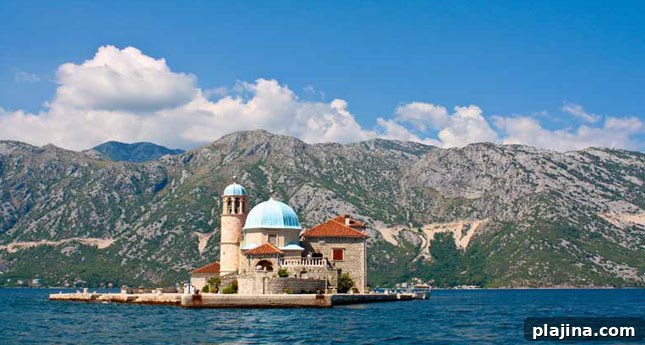
The Bay of Kotor also features two tiny islands that seem to float on the water: St. George and Our Lady of the Rocks. Each island is largely occupied by a single religious site. St. George hosts a Benedictine abbey dating to the 11th century, while Our Lady of the Rocks is home to a church built in 1632 on an artificial island formed over centuries by sailors and fishermen who deposited stones in devotion to the Virgin Mary. Our cruise line offered excursions to the latter, a poignant testament to local maritime tradition.
As we sailed out of the Bay of Kotor that evening, passing the shimmering isles, the region’s mix of dramatic natural scenery and well-preserved medieval harbors left a lasting impression. From deep inlets to fortified towns, the Dalmatian Coast stands among the Mediterranean’s most compelling destinations — an ideal continuation for anyone enchanted by Venice and eager to follow its influence along a wider sea.
INFO TO GO
Seabourn Cruises operates upscale small-ship sailings (208–450 passengers) in the Mediterranean and beyond, offering all-suite accommodations, complimentary beverages and a no-tipping policy. Round-trip voyages of the Dalmatian Coast depart from Venice from April through October. Marco Polo Airport (VCE) connects to Venice via shuttle buses to Piazzale Roma, boat shuttles and private water taxis. Venice’s Santa Lucia train station is served by vaporettos (canal buses). To reach the cruise docks at Stazione Marittima from the train station or Piazzale Roma, the People Mover provides a short connection.
Where to Stay on the Dalmatian Coast
HILTON MOLINO STUCKY, VENICE — A grand 379-room hotel housed in a restored flour mill on the Giudecca, offering lagoon views and convenient access to the cruise port and Venice’s attractions. Giudecca 810, Venice, Italy.
HOTEL VESTIBUL PALACE — A small property occupying apartments of Diocletian’s Palace in Split, blending ancient Roman exteriors with modern interiors for a distinctive stay in the heart of the Old Town. Iza Vestibula 4, Split, Croatia.
VILLA DUBROVNIK — A seaside villa with elegant rooms, spa facilities and its own boat service to Old Town Dubrovnik, providing refined Adriatic views and service. Vlaha Bukovca 6, Dubrovnik, Croatia.
Restaurants on the Dalmatian Coast
BOTA ŠARE — A group of coastal restaurants by chef Bodizar Šare featuring traditional southern Dalmatian dishes and celebrated oyster bars. Bačvice, Split, Croatia.
KONOBA ĆATOVIĆA MLINI — A family-run former mill on the bay at Morinj, renowned for shellfish, seafood salads, homemade cheeses and Montenegrin wines. 85338 Morinj, Boka Kotorska, Montenegro.
RESTAURANT NAUTIKA DUBROVNIK — Located between the bay and Old Town in a historic maritime building, Nautika serves refined Adriatic cuisine, including lobster salads and scampi on polenta. Brsalje 3, Dubrovnik, Croatia.