
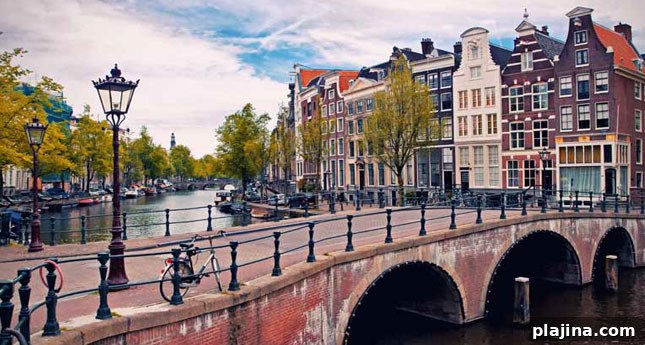
There is another way. While many international cities wrestled with congested streets, poured vast sums into public transport projects, and replaced vernacular low-rise neighborhoods with glass-and-steel towers, Amsterdam chose a different route.
In the city center, 17th-century gabled houses still line the canals. On this misty morning we walk on cobbles through a city that feels little changed in 400 years. Ducks drift on the water. Cyclists glide past in growing numbers. The rush hour has begun.
There are about 800,000 bicycles in Amsterdam, a telling statistic given the population of roughly 780,000: bikes outnumber people. Some 250 miles of dedicated bike routes and abundant parking racks help make Amsterdam one of the most bicycle-friendly cities in the world.
The health advantages are clear — the city’s obesity rate is around 11 percent compared with much higher rates elsewhere — and there are environmental gains from lower noise and air pollution. Perhaps the strongest case for Amsterdam’s approach is economic. With nearly two-thirds of journeys made by bike, the city saves an estimated $27 million a year on public-transport costs and a similar amount on vehicle infrastructure.
That pragmatic, cost-conscious thinking exemplifies Amsterdam: a city built on inventive responses to challenging conditions.
The first challenge facing Amsterdam’s early builders was the land itself. Much of the area was marsh and sand, hardly ideal for settlement. The founders drove forests of timber piles deep into the soggy ground to create stable foundations for buildings.
Ironically, to keep those piles from rotting the ground must stay damp. That necessity led to the city’s enduring preoccupation — and one of the main reasons for its success — with water management.
As the local saying goes, “God created the world; the Dutch created Holland.” About 60 percent of the country lies at or below sea level. Many parts of Amsterdam, and even Schiphol Airport, occupy land reclaimed from lakes and sea. Seawater is held back by an elaborate system of dikes, sea walls, canals and pumping stations that, before the Industrial Revolution, were driven by windmills.
Having repelled the water, planners took a characteristically counterintuitive step: they brought water back into the city. In the 17th century they began constructing the Grachtengordel — the girdle of canals — a spiderweb of manmade waterways linked to the nearby Amstel River.
Aeriel view of Amsterdam’s canals © Dirkthomas | Dreamstime.com
The canals delivered fresh water to doorsteps and connected Amsterdam to international trade. Barges and trading ships sailed into the heart of the city, transforming it from a modest North Sea outpost into one of the world’s wealthiest cities.
From canal-side docks the Dutch East India Company ran a vast commercial empire that stretched across Asia. As the world’s first multinational and the first corporation to issue public shares, the company ties Amsterdam to the origins of modern capitalism.
This morning we stroll through the downtown legacy of the city’s 17th-century Golden Age. Old buildings now house shops, cafés and residences; the waterways no longer carry the same international commerce. It’s easy to assume Amsterdam’s economic importance belongs to a bygone era — but that impression is misleading.
The city is one of Europe’s fastest-growing capitals, increasingly multicultural (about a third of residents are of non-European origin), and is investing billions in new infrastructure.
The commercial focus has shifted from the canals to De Zuidas, the south axis just outside the historic center. This 556-acre site, still developing with work continuing into the 2030s, already reshapes Amsterdam’s skyline with new office clusters, including the World Trade Center and the distinctive ING headquarters.
North of the old center a former harbor is being transformed into North Shore. Its centerpiece is a major renovation of a plain office block that will be renamed A’DAM Tower and feature a top-floor viewing deck with panoramic city views.
To the east, the city is meeting housing demand with bold solutions. IJburg is rising on eight manmade islands in the IJmeer, a two-square-mile suburb planned to house some 35,000 people, including a pioneering floating housing estate.
To connect these projects, the Amsterdam Metro is adding a north-south line. Excavation is complicated — tunnels must avoid the wooden piles that support the city — but the line is scheduled to enter service in coming years, improving links across Amsterdam.
For centuries Amsterdam’s Jewish community called the city Mokum, meaning “place” in Yiddish. Today that affectionate name still fits: Mokum remains a place that surprises, delights and inspires.
Things to do in Amsterdam
The old city is compact and easily walkable, but an organized tour is a helpful way to get your bearings. Amsterdam’s canal network and narrow streets are ill-suited to standard bus tours, so creativity won out: amphibious buses offer a fun way to experience the city from land and water on a single 45-minute tour.
Locals prefer two wheels, and visitors can join them. Numerous rental shops provide a full range of bicycles, tricycles, electric bikes and tandems for hourly or daily hire. Guided bike tours are a popular option and often include rain gear — a sensible precaution given Amsterdam’s maritime climate.
Dam Square © Henry Soesanto | Dreamstime.com
Dam Square is the traditional heart of Amsterdam, built where a 13th-century dam once linked the settlement’s sides. Over centuries it evolved into a bustling market and remains a focal point for public life — from celebrations to demonstrations.
Immediately east of Dam Square lies the Red Light District, the most visible sign of the city’s liberal approach to sex and soft drugs. Its central location makes it hard to avoid, and it’s a common area to find coffee shops where cannabis products are sold. The neighborhood is not family-friendly: many sights are strictly adult, pickpockets are active, and photographing workers is prohibited and can provoke hostile reactions.
At the other end of the spectrum, Amsterdam hosts world-class museums. The Rijksmuseum, reopened after a major refurbishment, showcases a vast collection that includes Rembrandt’s The Night Watch and Vermeer’s The Milkmaid. Nearby the Van Gogh Museum holds the most comprehensive collection of Vincent van Gogh’s work, while the Hermitage Amsterdam presents rotating loans from its Russian counterpart.
Interior of the Rijksmuseum © Jaroslav Moravcik | Dreamstime.com
Rembrandt’s House in the Old Jewish Quarter recreates the artist’s 17th-century environment and displays a large collection of his etchings and drawings. The Anne Frank House offers a moving memorial to life under Nazi occupation; advance online booking is recommended to avoid long queues.
CHECKING IN WITH Annemarie Satink and Ron Boyle
International Press Officer and Senior Area Manager, North America, I Amsterdam
WHAT OPPORTUNITIES DOES AMSTERDAM OFFER AMERICAN INVESTORS?
Annemarie Satink: Amsterdam’s central location makes it easy to reach major European customers within an hour’s flight. The city has a diverse, highly skilled workforce — more than 177 nationalities live here — and a culture receptive to innovation. Most residents speak multiple languages, and the high quality of life attracts multinational companies: more than 450 have established headquarters in the area.
WHAT CULTURAL DIFFERENCES SHOULD AMERICAN INVESTORS BE AWARE OF WHEN DOING BUSINESS IN AMSTERDAM?
Ron Boyle: The atmosphere is open and relaxed, but punctuality matters: an appointment is an appointment. Business is efficient, but retail hours are not round-the-clock — shops close in the evening, unlike in some parts of the United States.
HOW IMPORTANT IS THE BUSINESS SECTOR TO AMSTERDAM’S TOURISM INDUSTRY?
RB: Business travel is one of the three main reasons people visit Amsterdam; the average business traveler stays more than four days.
WHAT ARE THE KEY DEVELOPMENTS TO LOOK FOR IN AMSTERDAM’S FUTURE?
AS: De Zuidas is becoming a premier international district for work and living, minutes from Schiphol Airport. North Shore is another exciting project, featuring the A’DAM Tower as a new city landmark.
WHICH LOCAL ATTRACTIONS DO YOU RECOMMEND FOR VISITORS TO AMSTERDAM?
AS: Take a canal boat tour through the historic canals, visit at least one of the city’s 50-plus museums — the Rijksmuseum, Van Gogh Museum and Stedelijk among them — and check seasonal events, which change throughout the year.
Amsterdam: Just the Facts
Time Zone: GMT +2 (summer); GMT +1 (winter)
Phone Code: Country code: 31; City code: 20
Entry/Exit Requirements: U.S. citizens need a valid passport; no visa required for leisure or business trips up to 90 days.
Currency: Euro
Official Language: Dutch
Key Industries: Tourism, information and communications technology, financial services, logistics
Amsterdam Info to Go
International flights arrive at Amsterdam Airport Schiphol, a major intercontinental hub located about 5.6 miles southwest of the city center. The airport has a direct rail connection to downtown, along with bus and taxi services.
Where to Stay in Amsterdam
Amsterdam Wiechmann Hotel Housed in three historic mansions at the junction of two canals, this hotel evokes old Amsterdam. Prinsengracht 328-332 $$
Crowne Plaza Amsterdam-Zuidas Located in the Zuidas business district and a short train ride from the city center, it offers strong business facilities. George Gershwinlaan 101 $$$$
NH Grand Hotel Krasnapolsky Overlooking Dam Square, this iconic hotel has served visitors since the 19th century. Dam 9 $$$$
Restaurants in Amsterdam
Blauw Southwest of downtown, Blauw is a great place to try rijsttafel, Amsterdam’s take on Indonesian cuisine. Amstelveenseweg 158-160 $$$
Brasserie ‘De Poort’ A long-standing tradition: every steak comes with a numbered certificate, a novelty dating back generations. Die Port van Cleve Hotel, Nieuwezijds Voorburgwal 176-180 $$$
Vinkeles Restaurant Once a bakery, this Michelin-starred dining room retains its 18th-century ovens and combines classic and contemporary French cuisine. The Dylan Hotel, Keizersgracht 384 $$$$
Read more about Vincent van Gogh.