
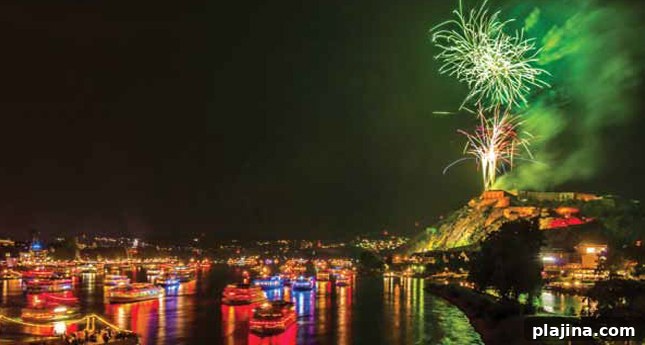
A kaleidoscope of color explodes over the Rhine River as flotillas of brightly lit boats glide through the storybook scene. Crowds cheer during the Rhine in Flames fireworks, one of many annual festivals along this historic waterway. The region’s dramatic scenery has long inspired poets, painters and composers, and celebrations here always carry a sense of romance and reverence.
The Rhine—known by its Celtic name Renos, meaning “raging flow”—begins in a Swiss Alpine glacier and winds roughly 820 miles to the North Sea. This major European border river passes through Liechtenstein, Austria, Germany, France and the Netherlands, threading together a series of historic cities and unforgettable landscapes.
Human hands as well as natural forces have shaped the Rhine’s surroundings: terraced vineyards, medieval villages, ancient castles and centuries-old wineries punctuate steep slopes and rolling valleys. No river in Europe is richer in legends and lore than the Rhine, and its scenery remains a powerful draw for visitors.
Beethoven, who grew up in Bonn, drew inspiration from the river’s moods. The Middle Rhine from Bonn to Mainz flows past countless medieval castles and villages, while the Upper Rhine Valley provides an easy gateway to Switzerland, France and Germany. Major hubs such as Frankfurt, Basel, Strasbourg and Düsseldorf make convenient starting points for exploring the Rhine by river cruise, guided tours, culinary and wine experiences, or cycling excursions.
Father Rhine and His Daughters sculpture in Düsseldorf © Hel080808 | Dreamstime.com
The Neo-Baroque sculpture Father Rhine and His Daughters in Düsseldorf provides a fitting introduction to the Rhine-Romantic Route, a 364-mile corridor from Düsseldorf to Mainz that ties together Germany’s cherished legends. In Bonn, the Beethoven-Haus museum displays manuscripts and mementos accompanied by an audio guide of his recordings. Each autumn the city hosts Beethovenfest Bonn, an international music festival that attracts top ensembles.
Passing the craggy Siebengebirge, local myths awaken—the tale of dwarves whose thrown earth formed the “seven mountains” is still told today. The rugged cliffs and steep slopes become especially dramatic as the river narrows in the Upper Middle Rhine Valley.
This 35-mile stretch between Koblenz and Bingen, designated a UNESCO World Heritage site in 2002, is the Rhine’s most visited section. It features a tapestry of about 40 castles dating from the 12th to the 15th centuries, nestled among quaint villages and romantic ruins. The region contains some of the world’s highest concentrations of castles and palaces. Marksburg Castle, the only intact castle in the Rhine Valley, and Burg Rheinstein, an emblem of German Romanticism, are highlights for many travelers.
Marksburg Castle atop the mountain © Serrnovik | Dreamstime.com
Approximately 20 million people visit the Upper Middle Rhine Valley annually. Wander through villages such as St. Goar, known for traditional crafts and taverns, then climb to hilltop castles and panoramic viewpoints. Burg Rheinfels, the Rhine’s largest fortress, towers above the river and welcomes tours. In Koblenz, the cable car offers sweeping views across the Rhine to Ehrenbreitstein Fortress, a Prussian stronghold built between 1817 and 1828 that watches over the confluence of the Rhine and Moselle.
At the river’s narrowest point rises the Loreley, a slate rock steeped in legend about a siren whose song lured sailors to shipwreck. The Loreley Valley Visitor Center provides information on nature, hiking routes and wine tours, and the open-air theatre there hosts summer concerts that draw locals and tourists alike.
Winemaking has flourished here since Roman times. In the Middle Rhine, one of Germany’s renowned wine regions, expect crisp, aromatic Rieslings. Small, family-run estates like Weingut Bastian in Bacharach welcome visitors to taste wines and meet generations of vintners who carry forward long traditions.
Round-trip river cruises from Bingen and Rüdesheim remain popular for seeing Loreley and the castle-studded landscape. Bingen’s cobbled streets and vine-covered slopes contrast with neighboring Rüdesheim’s lively mix of castles, churches and museums. Local taverns serve regional specialties and the long-standing Asbach brandy, produced in Rüdesheim since the late 19th century.
On the Upper Rhine, gently rolling hills reach toward the Black Forest in Germany and the Vosges in France. This tri-national corridor—bounded by Germany, Switzerland and France—offers rich traditions, exceptional cuisine, celebrated wines and inviting spa towns. The thermal baths around Baden-Baden, famed since Roman times, once drew literary figures such as Dostoevsky and Tolstoy and continue to lure guests to their healing waters and elegant leisure venues.
Baden-Baden’s Casino, founded in 1824, is among Germany’s oldest, and the city’s Festspielhaus is the country’s largest opera house. Art lovers can explore distinguished private collections at venues such as the Fabergé Museum and the Museum Frieder Burda, showcasing modern and classic works alike.
Across the border in northeast France, Alsace occupies a fragrant, fertile strip of land at the foot of the Vosges. The region is dotted with some 400 castle ruins—one of the densest concentrations of feudal fortresses in Europe. Château du Haut-Koenigsbourg, a restored medieval stronghold rising above the forest near Sélestat, remains one of France’s most visited historic sites.
Alsace produces sought-after white wines along its Route des Vins, where Sylvaner, Riesling and Gewürztraminer are commonly grown. Many wineries offer tours and tastings, and towns like Colmar—nicknamed “La Petite Venise” for its canals and half-timbered houses—provide picturesque settings for sampling regional cuisine. Colmar is also the birthplace of Auguste Bartholdi, the sculptor of the Statue of Liberty; his birthplace houses models and memorabilia.
Strasbourg, located on the Franco-German border, centers on Grand Île, a UNESCO World Heritage area anchored by the Cathédrale Notre-Dame de Strasbourg. The cathedral, marking a millennium since its origins, stands in the bustling Cathedral Plaza. La Petite France, with its maze of cobbled streets and charming half-timbered buildings, lines the canals where cafés and shops thrive. A short walk across the bridge connects visitors to Germany and offers pleasant views of passing vessels.
Cafés in La Petite France, Strasbourg © Sergey Kelin | Dreamstime.com
Food lovers find abundant pleasures across the Upper Rhine Valley, home to dozens of Michelin-starred chefs. Strasbourg’s storied restaurants serve refined Alsatian cuisine, while Baden-Baden’s dining scene includes contemporary fine dining such as the two-star Brenners Park Restaurant. From simple taverns to haute cuisine, the region’s culinary scene reflects its varied cultural influences.
Throughout the Rhine region, generations-old taverns and cafés invite relaxed, unhurried meals and local specialties. The river’s rich tapestry of customs, flavors and sights ensures that many visitors linger, savoring the region slowly.
Rhine Info to Go
The Rhine River Valley is accessible from several transport hubs. Regular trains connect Frankfurt Airport (FRA) to towns along the Rhine. Rüdesheim, Bingen and Koblenz are popular embarkation points for day cruises and shorter river journeys.
Where to Stay in the Rhine
Brenners Park-Hotel & Spa A Belle Époque spa hotel set beside Lichtentaler Allee in Baden-Baden, known for luxurious amenities and attentive service. 4–6 Schillerstrasse, Baden-Baden, Germany
The Grand Hotel Les Trois Rois Overlooking the Rhine in Basel’s Old Town, one of Europe’s oldest five-star hotels with refined guestrooms and a long history of distinguished guests. 8 Blumenrain, Basel, Switzerland
Hôtel des Berges A family-run five-star hotel between Colmar and Strasbourg along the tranquil L’Ill River, offering romantic rooms and regional hospitality. 4 Rue de Collonges au Mont d’Or, Illhaeusern, France
Restaurants in the Rhine
Auberge de l’Ill One of France’s long-established three-star restaurants, offering a menu rooted in regional tradition and carefully paired wines. Hôtel des Berges, 4 Rue de Collonges au Mont d’Or, Illhaeusern, France
Au Crocodile A Strasbourg institution serving refined Alsatian and French cuisine in a classic setting. 10 Rue de l’Outre, Strasbourg, France
Stübers Restaurant A farm-to-table experience overlooking the Rhine, showcasing local ingredients and regional specialties. Rhein-Hotel Bacharach, 50 Langstrasse, Bacharach, Germany