
Hidden behind unassuming desert-tan facades, beneath the shade of manicured palm groves, and within gleaming glass towers that reflect the McDowell Mountains, thousands of companies have relocated to what began as Arizona’s stylish winter vacation destination.
Scottsdale — with 17 pristine golf courses, roughly 600 restaurants, some 80 wine bars and nightspots, numerous gated residential communities, and more swimming pools per capita than any U.S. city — remains a top destination for leisure travelers. But the city has evolved. Alongside its luxury resorts, gourmet dining and vibrant arts scene, a thriving corporate ecosystem has emerged. Referred to by some as the “Silicon Desert,” Scottsdale now hosts a Silicon Valley–style casual corporate culture that attracts tech firms. More than 3,000 businesses operate in the Airpark office complex alone, and new tenants continue to sign long-term leases.
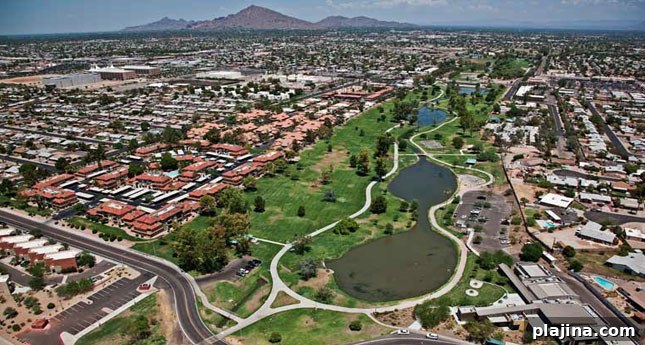
Scottsdale’s $3.3 billion revitalization has also drawn health care and bioengineering companies. City leaders entice executives with lower office costs, favorable tax and energy environments compared with California, and an appealing lifestyle. The region’s natural assets — including the 34,000-acre Sonoran Desert Preserve and the Indian Bend Wash Greenbelt, a canal-based flood-control project that added 11 miles of lakes, parks, golf courses and bike paths — reinforce the area’s quality of life.
Startups are taking root in Scottsdale. Stremor, founded by former Silicon Valley executives, secured $2 million in seed funding after relocating to the city. “No one believes we’re in Scottsdale,” said CEO Bill Irvine, noting that rapid growth from idea to seven-figure seed round and full staffing in seven months is a strong startup success story regardless of location.
Scottsdale’s unemployment rate, at about 6.3 percent, has generally remained below state and national averages, helped by its dual role as a vacation hub and a business center. The city is home to major companies such as Go Daddy, Yelp, General Dynamics, The Vanguard Group and McKesson, and hosts newer tech firms like iCrossing, AmazingMail, Clear Demand, CyberSponse, MobilManage and SOOH Media. SkySong, Arizona State University’s Scottsdale Innovation Center, serves as a well-designed business incubator supporting domestic and international startups. The opening of the Mayo Clinic’s Scottsdale facility in 1987 prompted additional health-related companies to locate nearby, including Global Medical Solutions, Scottsdale Healthcare, First Health Group and St. Jude Medical.
Developers have responded to the business influx with new office parks, particularly in North Scottsdale near the Scottsdale Airport and Airpark. Airpark alone supports nearly 50,000 jobs in private firms, including Go Daddy, JDA Software, Henkel Consumer Goods Inc., Hypercom/Equinox Payments and TASER International.
Residential and condominium projects have followed. A Texas developer began a $61 million, 17-acre project in North Scottsdale called Jefferson at One Scottsdale, planned to deliver 388 units. Downtown’s Old Town area transformed the 31,000-square-foot Galleria Corporate Centre—once a failed mall—into a modern hub for tech companies like Yelp and CA Technologies.
“When business leaders arrive and experience Scottsdale’s quality of life and corporate development, it feels natural,” said Bob Tunis, Scottsdale’s economic development manager. “But that result is intentional: Scottsdale is one of the few resort communities that has deliberately built a corporate base and attracted headquarters and a highly educated workforce.”
Projects such as the $41 million SouthBridge development on the Arizona Canal near the Waterfront district created an upscale neighborhood of restaurants, offices and residences with rare water views for the Southwest. The postmodern, pedestrian-only Soleri Bridge and Plaza by Paolo Soleri serves as an iconic symbol of the SouthBridge/Waterfront area and is one of about 50 public art installations included in the Scottsdale Public Art program.
Large-scale investments are also underway in South Scottsdale along the McDowell Road corridor, one of five business corridors targeted for redevelopment. With SkySong as a catalyst, more than $200 million has been invested along this east-west axis, including renovations and new facilities for General Dynamics C4 Systems, American Solar Electric, Ticketmaster and Yodle.
To accommodate growing numbers of business travelers, area hotels expanded meeting capacities and upgraded amenities. The Fairmont Princess completed a multi-phase renovation including expanded conference centers that together provide ample indoor and outdoor meeting space. The Four Seasons Resort in Scottsdale refreshed banquet facilities to provide tens of thousands of square feet for events, including outdoor lawns with desert and mountain vistas. The Hyatt Regency Scottsdale Resort and Spa at Gainey Ranch emphasizes environmentally conscious meeting options with substantial flexible event space.
After the 2008 real estate downturn, Scottsdale’s recovery outpaced many neighboring cities. Office and retail vacancies stabilized, and while housing prices remain higher than the Phoenix metro average, the city preserved its AAA ratings from Standard & Poor’s and Moody’s. In 2012, Scottsdale hotels generated approximately $517 million in revenue, and projections showed rising occupancy for luxury and upscale properties, led by resorts such as Hyatt Regency, The Fairmont Princess, The Boulders, The Phoenician, Four Seasons, JW Marriott Camelback Inn, W Hotel, The Saguaro and Hotel Valley Ho.
Scottsdale’s origins date to the late 19th century, when settlers established a small community named for Winfield Scott, a U.S. Army chaplain who arrived in 1888. Early residents adapted to desert heat with sleeping porches and other practical measures. The opening of Hotel Valley Ho in 1956, the city’s first modern hotel with central air-conditioning and year-round operation, helped transform Scottsdale into a year-round resort destination. Restored to its original midcentury style, the Valley Ho is now a national historic landmark known for its retro-chic accommodations.
Street names such as Camelback, Cactus Dust, Pima, Indian School, Jackrabbit and Tierra Buena reflect Scottsdale’s frontier heritage. Taliesin West, Frank Lloyd Wright’s winter home and studio built in 1937, now functions as an architecture school and visitor attraction. Former cattle and horse ranches that once covered vast desert tracts evolved into residential and recreational developments; names like McCormick Ranch, DC Ranch and Gainey Ranch now designate gated communities, golf courses, hotels and shopping districts.
While redevelopment and new business relocations continue, regional officials remain cautious about potential economic impacts from airline consolidation. The proposed merger of US Airways and American Airlines raised concerns about a possible relocation of US Airways’ headquarters to Dallas, which could affect thousands of jobs and reduce local tax revenue. Although US Airways publicly stated it would not move its headquarters, city leaders monitor the situation closely because many employees live and work in neighboring communities and the region’s airport hub status affects local commerce and travel.