
Once an adventurous rock climber created a clothing line for extreme sports and named it Patagonia, a word that sparks an instant response in anyone drawn to wild places. Even armchair travelers feel a thrill imagining one of the planet’s most remote regions: strange wildlife, rugged landscapes and weather that changes on a whim.
When Ferdinand Magellan explored the tip of South America, he used the term Patagon, interpreted as “giant” or “big foot.” His crew reported meeting exceptionally tall inhabitants, and the tale grew until it was widely believed that 12-foot-tall people lived there. That myth endured for centuries and was not fully examined until the 1800s.
Patagonia has retained its aura as a remote, mist-shrouded Shangri-La. Mountains, steppes, glaciers and lakes spread over an area roughly the size of Texas at the southern end of the Andes across Chile and Argentina. Though easier to reach today, the landscape remains largely untouched and retains an air of mystery. The region owes little to human influence and seems to tolerate visitors rather than welcome them.
Chile began protecting parts of Patagonia in the 1950s, leading to the creation of Torres del Paine National Park, an expanse of about 600,000 acres now recognized as a UNESCO World Biosphere Reserve.
Getting there requires travel: a four-hour flight from Santiago to Punta Arenas, then nearly three hours by road to Puerto Natales, the gateway town to Torres del Paine. Visitors arrive from around the world. Between October and April—spring and summer in the Southern Hemisphere—the town’s narrow streets, small restaurants and modest inns hum with languages from many countries. Excitement is tangible; strangers smile as if sharing membership in a secret club.
After a night at the Hotel Charles Darwin, our group of ten sets off in a van for the 72-mile drive into the park over mostly gravel roads that keep speeds modest. Gauchos and their dogs work flocks in flower-speckled fields. We stop at Milodon Cave, where late-19th-century discoveries of a giant prehistoric sloth sparked international interest. A life-sized statue of the creature stands in the grotto, recalling old legends.
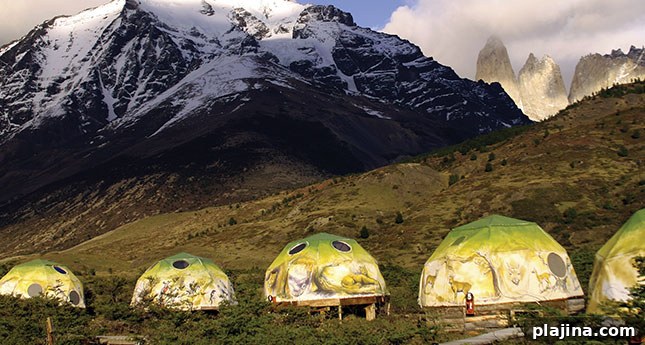
Late afternoon finds us at EcoCamp, a cluster of geodesic dome tents brightened with painted wildlife and native motifs. The domes catch the eye briefly, but soon attention shifts to the dramatic backdrop: craggy, snow-capped peaks rising from grassy steppes and the granite spires known as The Towers, their summits drifting in clouds and glowing in the sunset.
EcoCamp’s accommodations sit on wooden platforms linked by boardwalks. Facilities include a bathhouse with showers and composting toilets and a large dining and lounge dome warmed by a pot-bellied stove. Near the dining area, a lamb roasts on a spit, its aromas mingling with the chill air. Guests gather with pisco sours, enjoying the smells before sitting down to a meal of tender roast lamb and Chilean wine.
We turn in early, eager for the next day’s hikes, and find the two-person tents surprisingly cozy: flannel sheets, down comforters and sheepskins create warm nests for the cold night. A window behind each bunk frames The Towers, lit by moonlight, while another opens to a canopy of stars above.
Dawn is cold and clear. One staff member reports a puma sighting near the camp. Our guide explains that these big cats thrive in the park, hunting guanacos (wild llamas), rheas and hares—and occasionally preying on sheep from nearby ranches.
On the drive to Lake Pehoe the pumas remain out of sight, but guanacos are everywhere, watching with large brown eyes. Rheas run beside the vehicle and foxes pause, alert but not alarmed. In a shallow lagoon, feeding flamingos stir the surface and reflect in the wind-rippled water.
A rough trail leads to the Salto Grande Waterfall, a powerful cascade that empties into Lake Pehoe. On the lake shore stands the modern Explora Lodge, a luxury presence that contrasts sharply with the wild surroundings.
At Lake Grey, whose waters are milky with glacial silt, we follow a rocky path through forest, cross a swinging bridge and walk the shoreline to a dock where Zodiacs pitch in a strong wind. The ride to a larger catamaran is lively: passengers hang on as the boat cuts through waves toward Grey Glacier, dodging house-sized blue icebergs that drift and strand along the beach as they melt.
The catamaran’s passengers balance drinks as the vessel rolls and pitches, enjoying the thrill while conscious of the icy water below. The glacier rises nearly 100 feet above the lake. We brave the cold to listen for the sharp crack of calving ice as massive sections break away. After lingering near the face, the catamaran turns and rides the wind back to shore.
Hiking is the best way to experience Torres del Paine. With about 155 miles of trails and abundant rock faces, the park is a paradise for climbers and trekkers. Options range from day hikes to an 11-mile trek to the base of The Towers and a two-hour stroll along Lake Sarmiento that yields rich wildlife sightings to a strenuous seven-day circuit for experienced campers.
Farther south, in Punta Arenas, we board the 100-passenger Mare Australis and sail through the Strait of Magellan and the Beagle Channel, waterways once navigated by early Antarctic explorers. The ship’s accommodations are comfortable, with private baths and large windows. Meals showcase local seafood and meats paired with Chilean wines.
The voyage moves through a frosty seascape where snow-clad mountains plunge into the water and glaciers gleam. Zodiacs ferry passengers ashore for hikes through ancient forests, seal and penguin viewing, and the novelty of sipping spirits on ice from old glaciers.
On the third day we pass through Glacier Alley, where glaciers named for different countries flank the channel. As the ship traverses the channel, the crew marks each glacier with its national anthem and serves regional hors d’oeuvres and drinks to match.
We also make the challenging passage around Cape Horn, the southernmost point of South America, where violent weather, strong currents and icebergs have claimed many ships. Rounding the Cape remains a symbolic milestone for sailors. Passengers transfer by Zodiac to set foot on the rugged rock, climb steep steps buffeted by wind, and visit a monument honoring those lost at sea. A small chapel serves as a solemn memorial. Visitors can obtain a Cape Horn postmark as proof of the voyage.
Sailing into Ushuaia, Argentina, we see the sign “Fin del Mundo — the End of the World.” Although settlements and outposts lie further south, Ushuaia is the world’s southernmost town and a fitting endpoint to the journey.
With a late-afternoon flight back to Santiago, there is time to explore Ushuaia. The Maritime Museum, housed in part of an old prison, contrasts exhibits on early Antarctic exploration with cold, damp cells once occupied by notorious inmates. For adventurers and for prisoners alike, Ushuaia has often felt like the end of the world.
INFO TO GO
Adventures at EcoCamp Patagonia in Torres del Paine National Park can be arranged through established expedition operators. Cruising options between Punta Arenas and Ushuaia are offered seasonally by regional cruise lines. Prices vary by season, cabin class and itinerary; travelers should consult operators directly for current schedules and rates.