
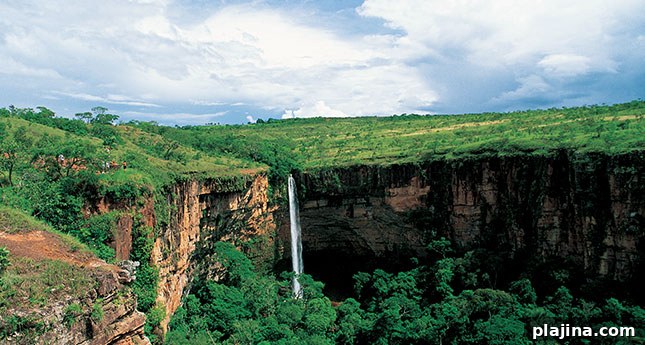
Having grown up on National Geographic, I dreamed of seeing the Amazon and its wildlife. My Brazilian wife, Maria, a carioca, suggested a different destination: the Pantanal, the world’s largest freshwater wetland.
Stretching across an area the size of Colorado and spanning parts of Brazil, Bolivia and Paraguay, the Pantanal is a hydrological marvel. Each October, rains in the surrounding highlands inundate its shallow basin; by April, the floodwaters recede, leaving fertile sediment and a changing mosaic of open savanna, gallery forest, scrub grassland, wooded copses, water holes and winding rivers.
Valmir Ortega, director of Conservation International’s Pantanal program, calls the region one of South America’s richest ecosystems. The Pantanal hosts roughly 3,500 plant species, more than 450 bird species, about 325 freshwater fish species and over 120 mammals, including threatened animals such as jaguar, maned wolf and pampas deer. It is the Pantanal, more than the Amazon, that reveals the highest visible concentrations of New World wildlife.
During the wet season the water can rise up to 10 feet, forcing animals onto higher ground. In the dry season they remain close to freshwater baías or brackish salinas. The extreme seasonal rhythms have discouraged large-scale development. Only a few hundred thousand pantaneiro cowboys live in this flood plain, where seasonal ranching has been the main commercial activity for centuries.
“The Pantanal is a unique region on the planet,” Ortega said, emphasizing its biodiversity, distinctive hydrography and limited human occupation, which together create exceptional scenic beauty.
Many Brazilians first learned about this swamp from El Pantanal, a 1990 telenovela that fused melodrama with wilderness imagery. The show, which featured a jaguar who transformed into a woman and her country-boy lover, put the mystical wetland in the spotlight and drew curious visitors.
After the telenovela’s debut, travelers began flying from São Paulo to the few gateway towns serving this near-trackless wilderness. Inns appeared along the Transpantaneira, a rough 90-mile causeway south of Cuiabá that provides the main access to the northern Pantanal. On rivers near Corumbá, close to the Bolivian border, sport fishermen occupied floating “botels” and cast for dourado and massive jau catfish.
On the southern edge of the swamp, around the cattle town of Aquidauana, ranches such as Fazenda Barranco Alto, Hotel Barra Mansa and Fazenda Santa Sophia started welcoming small groups of eco-tourists. These fazendas offer a South American-style safari: instead of dense Amazon jungle, visitors encounter a mosaic of open landscape that lends itself to excellent wildlife viewing.
All-inclusive fazenda programs commonly feature day trips on horseback and excursions by boat and canoe. Meals focus on free-range beef and savory feijão com arroz, followed by afternoon siestas in hammocks and spectacular sunsets enjoyed with caipirinhas — cocktails of crushed fruit, sugar, ice and cachaça.
Although I had hired a driver and a 4×4 in Campo Grande, I learned that few attempt overland travel into this ferocious, vehicle-swallowing wilderness. Much like remote parts of Alaska, the southern Pantanal is best reached by chartered bush plane. I realized this after an old, heavy farm truck had to pull our bogged Land Cruiser free from an anaconda-prone mire. Despite the boot-sucking ordeal, the Pantanal was worth it.
Our first morning began with the chatter of hyacinth macaws, the world’s largest parrots. Beyond the horse paddock a herd of capybaras emerged from the trees and settled into a nearby wallow. Along the tannin-stained Rio Negro, spectacled caiman basked in the sun.
While our pilot steered a small outboard skiff downriver, we spotted a dazzling variety of birds: toco toucans, jabiru storks, ostrich-like rheas and black skimmers slicing the water for fish with their unique bills. Sandy banks dotted with otter dens revealed giant and neotropical river otters. Capybaras moved along the riverside forest and caiman counts passed into the dozens. Camera traps on the property had also captured images of a puma and several jaguars.
These long-established fazendas have coexisted with the Pantanal for more than a century, but the region faces threats from agricultural runoff upstream and deforestation by charcoal producers serving foundries in Corumbá.
Compared with the Amazon, however, the Pantanal remains relatively intact: more than 80 percent of the wetland is still in excellent natural condition. Hardened by annual floods and seasonal fires, the ecosystem supports resilient, often fierce wildlife. In a place where large snakes prey on substantial mammals, survival is intense and visible.
The appeal of the Pantanal is subtle: a morning on horseback, an evening game drive, a quiet boat trip to a claw-scarred “jaguar tree,” or finding the fresh carcass of a giant river otter and following the vultures and caiman drawn to it. My guide suggested the otter’s death might have been from snakebite — one of many natural causes here. The Pantanal is not a petting zoo or a sanitized ranch; it remains a tough, beautiful wilderness.
On my final day, smoke from nearby burning fazendas cast a gray veil over the sky. We paddled canoes upstream behind curious giant otters, then landed on a river bend. Caiman reluctantly left the beach but lingered nearby as I cautiously waded. The pilot minimized concerns about piranha — “they prefer still water” — but when my son baited a bamboo pole with a scrap of beef, he promptly caught a thrashing piranha. That was enough. We got out.
Soon the long-awaited rains began, drumming on the parched earth and starting the cycle anew. Our return would be a muddy, gripping journey. Back at the fazenda a ranch hand sketched a crude map on cardboard and marked a route with encouraging notes: Segue. Continue. When my guide asked the date of my flight home and I told him, he smiled and said, “Then you have three days to get to Aquidauana.”
Info To Go
From São Paulo (GRU) or Brasília (BSB) it’s a 90-minute domestic flight to Campo Grande (CGR). Several family-owned ranches along the Rio Negro offer excellent wildlife and bird-watching opportunities, including Fazenda Barranco Alto, Barra Mansa Lodge and Fazenda Santa Sophia. These lodges are most easily reached by bush plane from Campo Grande or from Aquidauana, about 80 miles to the west.