
Waterfalls take many forms. Some thunder with immense power, dumping thousands of gallons per second and sending mist hundreds of feet into the air as water plunges over cliffs or ridgelines. Others are delicate, a slender ribbon tracing smooth rock and weaving a maze of channels before settling in a pool. Across cultures and centuries, waterfalls have inspired awe for good reason.
Niagara Falls, for example, has been a symbol of romance for more than a century. Since the 19th century, couples have traveled there to mark the start of their lives together, and the falls remain a major tourist draw and a meaningful site for many visitors. Still, Niagara is only one of many spectacular waterfalls around the world.
Iceland alone claims more than 10,000 waterfalls, each with distinct character. Dettifoss, in Vatnajökull National Park in the northeast, is often described as Iceland’s most powerful waterfall and one of Europe’s most forceful. Fed by meltwater from the Vatnajökull glacier, its gray-white torrent thunders nearly 150 feet into a deep canyon. Spanning some 330 feet across on the Jökulsá á Fjöllum River, Dettifoss dominates the surrounding landscape.
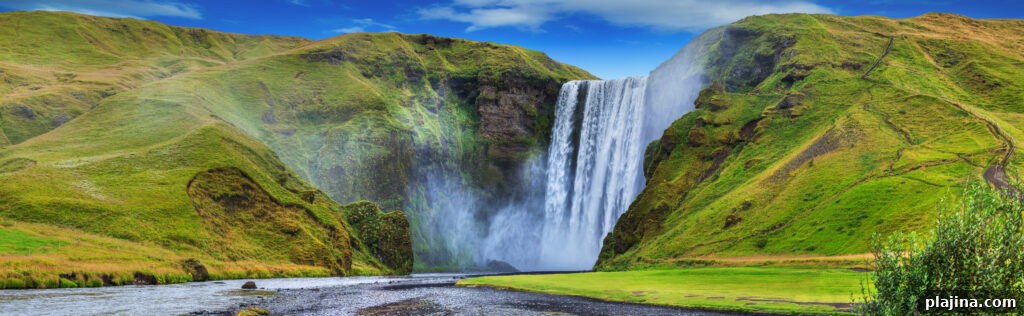
Seljalandsfoss, Iceland © Maksym Topchii | Dreamstime.com
On Iceland’s south coast lies Seljalandsfoss, a 200-foot fall visible from Route 1. What sets Seljalandsfoss apart is the narrow cave behind the cascade: walking behind the sheet of water gives visitors a rare, intimate perspective, as if peering out from the earth itself.
Across the sea in Ireland, Powerscourt Waterfall in County Wicklow is the country’s second-highest drop. Water flows down schist and granite ridges, splitting into multiple streams and tracing nearly 400 feet before reaching the rocky pool below. Located on the grounds of Powerscourt Estate, it makes an excellent day trip from Dublin—less than an hour’s drive away.
Asia hosts many impressive falls as well. In India, Kunchikal Falls ranks as the highest, with tiered drops totaling 1,493 feet. Jog Falls in Karnataka offers dramatic seasonal contrasts: during heavy rains it becomes a torrential, segmented plunge, sending water roughly 830 feet over a cliff amid lush hillsides.
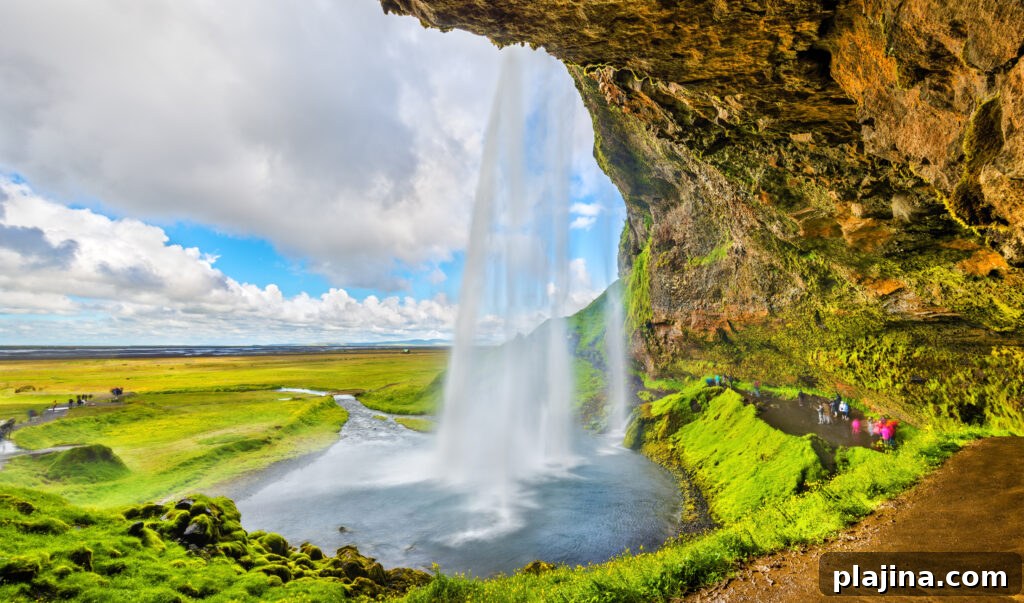
Seljalandsfoss © Leonid Andronov | Dreamstime.com
On the China–Vietnam border, Detian or Bản Giốc Falls showcases the slow work of erosion over millennia. Separated by trees and rock outcrops into three main sections, the cascade swells with the summer rains and crashes nearly 100 feet down in a thunderous spray.
In southern Africa, Victoria Falls spans the border of Zambia and Zimbabwe and stands among the world’s largest waterfalls. Named in the 19th century by explorer David Livingstone, it plunges about 354 feet and stretches over 5,600 feet across the Zambezi River, creating the largest continuous sheet of falling water on Earth. For adventurous visitors, seasonal conditions between September and December reveal Devil’s Pool, a natural rock-sheltered swim spot at the brink of the falls.
Venezuela’s Angel Falls is the tallest uninterrupted waterfall in the world and inspired the film Up. Dropping 2,648 feet from the Auyántepui plateau in Canaima National Park, Angel Falls is remote and requires flight access to Canaima Camp followed by river or jungle travel to reach the base—a journey that adds to its mystique.
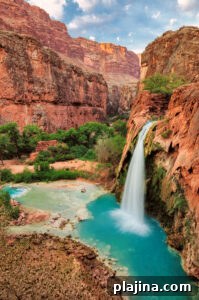
Havasu Falls © LuckyPhotographer | Dreamstime.com
Many waterfalls mark borders: Iguazú Falls sits between Argentina and Brazil and forms the largest waterfall system in the world. The Iguazú River splits into multiple chutes and tiers that cascade into a dramatic, staircase-like array, with a portion crashing into the 300-foot-deep gorge known as Devil’s Throat. Visitors can approach the falls from either the Argentine or Brazilian side, both of which protect the site in UNESCO-listed national parks.
South America is home to extremes. Guyana’s Kaieteur Falls, a single-drop plunge of about 741 feet in the heart of the rainforest, dominates its surroundings within Kaieteur National Park. Long revered by indigenous peoples, Kaieteur remains an iconic and powerful natural landmark.
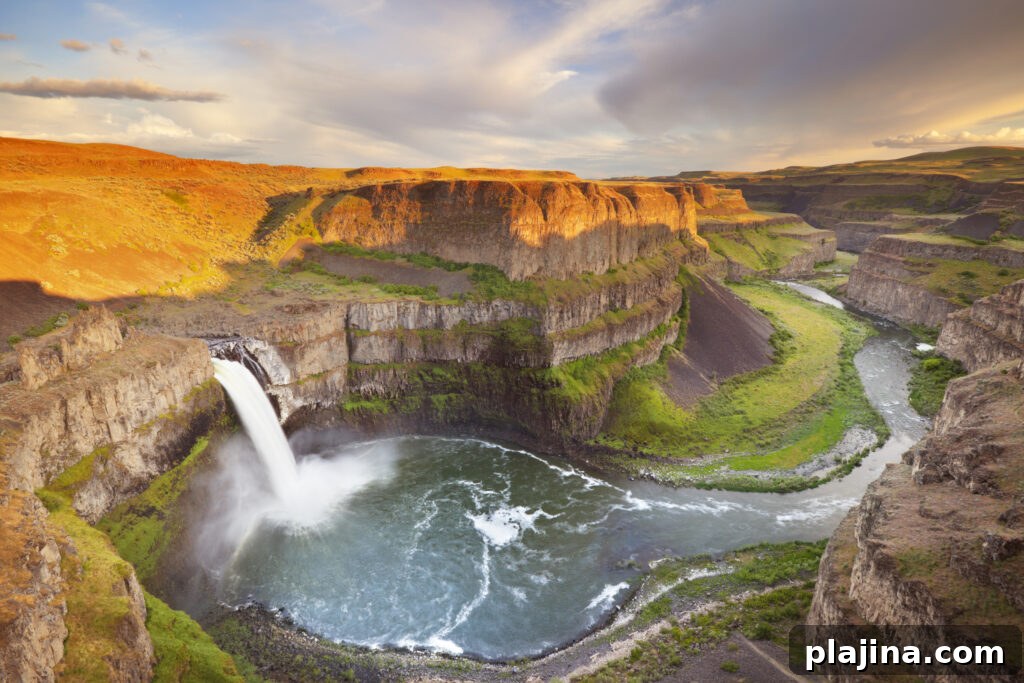
Palouse Falls © Sara Winter | Dreamstime.com
You don’t have to travel overseas to see remarkable waterfalls. North America offers many memorable sites. British Columbia’s James Bruce Falls, in Princess Louisa Marine Provincial Park, is the continent’s tallest measured waterfall, where a narrow stream descends some 2,760 feet from a snowfield. In Washington state, Palouse Falls drops about 200 feet into a rugged canyon and serves as the official state waterfall, surrounded by Palouse Falls State Park.
California’s Yosemite Falls drops in multiple stages for a combined 2,425 feet and is one of the park’s most iconic features. Trails provide a range of viewpoints, including a strenuous hike to the summit of the falls. On Hawai‘i Island, ‘Akaka Falls plunges 442 feet into a lush gorge and is easily seen from a short loop trail inside ‘Akaka Falls State Park, making it family-friendly.
Havasu Falls in the Grand Canyon presents a striking palette of red rock and turquoise water on Havasupai tribal lands; its vivid blue-green pools and sheltered swim spots make it unforgettable. And for something different, North Carolina’s Sliding Rock offers a natural water slide: a smooth, sloped rock face funnels cold water 60 feet into a refreshing plunge pool, blending thrill and simplicity.
From thunderous deluges to gentle veils, waterfalls are gifts of geology and climate. Each one offers a distinct experience—sound, motion, color and perspective—that draws people out into the landscape to witness the raw, ever-changing power of water.