
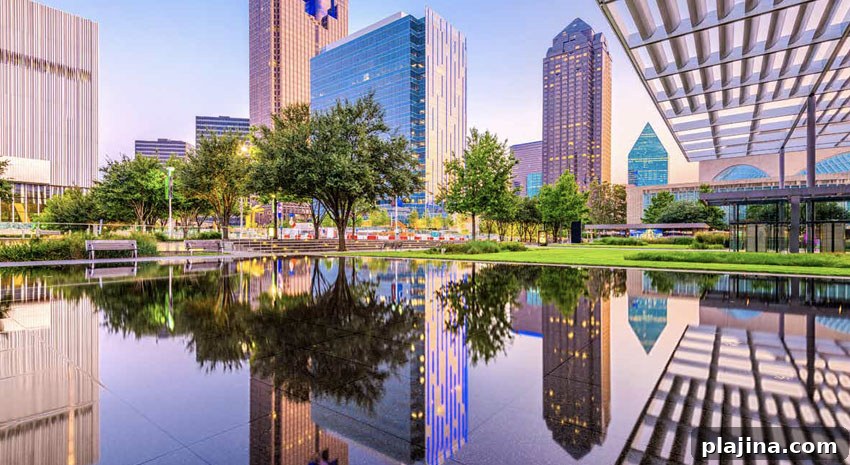
THE CITY’S NICKNAME, “BIG D,” could just as well mean Big Destination. Companies and job-seekers are discovering abundant opportunities throughout the thriving Dallas–Fort Worth Metroplex in central Texas. Positioned roughly halfway between America’s coasts, the region is a major transportation hub—interstate highways, rail lines and two busy airports—while ranking among the top U.S. metropolitan areas for Fortune 500 headquarters. As the nation’s ninth-most populous metro area, the Metroplex supports a wide range of projects and programs that encourage business development and workforce growth.
Anchored by industries such as banking and commerce, telecommunications and information technology, energy and transportation, and health care and medical research, the region hosts one of the country’s largest concentrations of corporate headquarters for publicly traded companies. Since 2010, more than 75 national companies have relocated to the area. Toyota moved thousands of employees to its Legacy West campus in Plano; MoneyGram shifted operations from Minneapolis; and Jamba Juice relocated from California. Combined with local corporate expansion, these moves have contributed to more than half a million new jobs in the market.
To amplify Dallas’s appeal as a center for business, the Dallas Regional Chamber partnered with member companies to develop initiatives focused on attracting both firms and talent. A 2015 strategic plan outlined priorities that include strengthening local education systems and positioning the region to draw skilled workers and innovative companies.
Recognizing that millennials are central to long-term growth, the Chamber launched “Say Yes to Dallas,” a campaign that highlights the region’s career opportunities, relatively affordable cost of living, diverse neighborhoods and broad access to parks, cultural institutions, arts, sports and entertainment. The Say Yes to Dallas site integrates tools and resources—job listings, a cost-of-living comparison calculator, neighborhood guides, dining and entertainment features, and testimonials from new residents—to simplify relocation decisions and showcase what the region has to offer.
Complementing talent outreach, the region’s corporate recruitment resources promote Dallas as “the best place to live, work and do business.” Recruitment materials emphasize a strong regional and state economy, competitive cost of living, a skilled labor pool, a pro-business environment and the absence of corporate and personal income taxes. Practical guidance—tax planning, business registration, employee relocation and startup procedures—helps companies navigate the move and begin operations efficiently.
Already home to numerous colleges, universities and trade schools, Dallas continues to invest in education improvement to ensure students are prepared to enter and compete in the workforce. Local efforts aim to provide every child with tools and pathways to future career success.
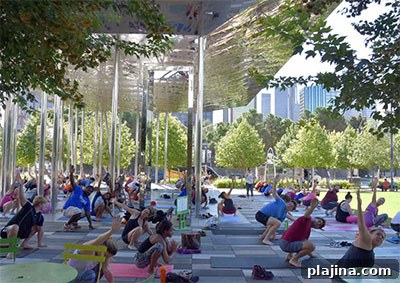
Yoga at Klyde Warren Park © RITU JETHANI | DREAMSTIME
Significant infrastructure improvements support these outreach and growth efforts. In downtown Dallas, a transformative urban green space now spans a former gap in the Woodall Rodgers Freeway. Klyde Warren Park features walking paths, play areas for children and dogs, a performance pavilion and a regular schedule of lectures, yoga sessions and live concerts, providing an accessible gathering place for residents and visitors.
To address chronic congestion on I-635—the Lyndon B. Johnson Freeway—the northern 13-mile segment was rebuilt and expanded with toll-operated TEXpress lanes that effectively double the corridor’s capacity. Congestion-priced lanes have eased commutes and support access to the emerging Dallas Midtown development, a mixed-use district of office towers, condominiums, hotels, restaurants, shops, trails, fitness facilities, a theater and a trolley linking the area to Galleria Dallas.
Public transit options include extensive bus service and the nation’s longest light-rail network, which together help connect commuters across the region. Cultural amenities such as one of America’s largest contiguous arts districts and the million-square-foot, column-free exhibit space at the Kay Bailey Hutchison Convention Center contribute to the city’s attractiveness for conventions, business events and cultural tourism. Dallas Regional Chamber leaders note strong project activity, ongoing population and corporate growth, and a promising economic outlook for the region.
SCENIC DRIVES
For a day trip or weekend outing, head north to Frisco, home of the Dallas Cowboys’ world headquarters and practice complex known as The Star. The 91-acre campus includes a cutting-edge indoor stadium, restaurants and shops. Visitors can take guided tours to view Super Bowl memorabilia, stroll the Nike Star Walk that highlights team milestones, and explore the War Room, where portions of the NFL draft are conducted. The surrounding area hosts additional sports facilities and attractions, including hockey, baseball and soccer venues and the National Videogame Museum.
About 20 minutes northwest of downtown, Irving features the Toyota Music Factory, a multi-venue entertainment center with concerts, dining options and an Alamo Drafthouse Cinema that pairs films with meals. Nearby Las Colinas offers tree-lined canals and walkways along the Mandalay Canals, a serene setting of shops, offices and restaurants. A dramatic bronze sculpture of nine mustangs galloping across pink granite anchors Williams Square, and local favorites such as Via Reál serve Southwestern-inspired dishes that reflect the region’s culinary personality.