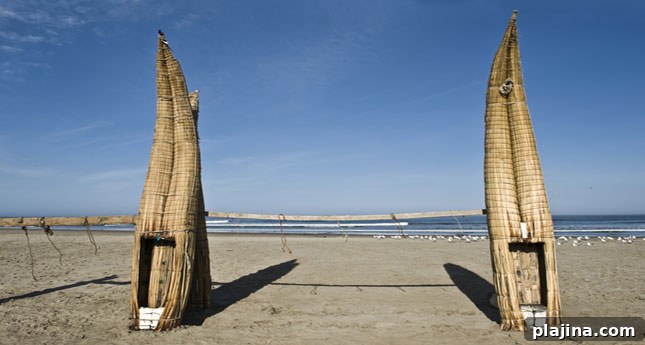
Many Peruvians challenge the commonly held belief that surfing originated in Polynesia, suggesting instead that the Pre-Inca Moche people on Peru’s northern coast may have been riding waves as early as around the year 200. Archaeological finds from coastal sites include ceramic pottery that depicts figures riding logs and small boats later called caballitos de totora (“little reed horses”). Examples of these ancient surfing artifacts are displayed in several of Peru’s major museums.
While historians cannot definitively prove either origin story, the famous Norwegian explorer Thor Heyerdahl demonstrated that contact between ancient Peruvians and Polynesians was plausible. One clue that invites further investigation is the enduring use of caballitos de totora along the beaches of Huanchaco. These small, boardlike reed boats are made from totora reed, the same kind of material Heyerdahl used to construct the raft Kon-Tiki for his 1947 voyage across the Pacific. Today, local fishermen still rely on the stable, surfable design of these craft to ride waves back to shore after a day at sea.
The archaeological record and living traditions together offer a compelling picture: the technology and practice of wave riding on Peru’s coast have deep roots. Pottery scenes carved and painted by the Moche illustrate people on boards and boats engaging with the sea, suggesting that riding waves was integrated into coastal life long before European contact. Ethnographic continuity—fishermen continuing to use reed boats shaped for both fishing and wave riding—reinforces the idea that Peru’s surf heritage is ancient and culturally significant.
Thor Heyerdahl’s experiments added a practical dimension to the debate by showing that materials and seafaring knowledge could have enabled interactions across great ocean distances. Although his work does not prove cultural exchange in either direction, it does show that Pacific crossings were possible with technologies available in premodern South America. That possibility keeps the question open and encourages interdisciplinary research combining archaeology, anthropology, and maritime studies.
Today, the caballitos de totora remain a visible link between past and present. Visitors to Huanchaco and other coastal towns can still observe fishermen launching and landing these reed boats, and museums preserve Moche pottery that records early coastal practices. Together, these living and material cultures contribute to a richer understanding of surfing’s diverse origins and highlight the importance of Peru’s coastal communities in the broader history of wave riding.