
Much as the 9/11 attacks led to heightened security across aviation, the COVID-19 pandemic accelerated rapid change, shifting priorities toward the health and safety of passengers, employees and service providers. Airports pursued contactless solutions: mobile check-in systems such as Collins Aerospace’s Kiosk Connect removed the need to touch kiosks; autonomous cleaning robots using UV light began operating in terminals; and some airports trialed wearable technologies. Hong Kong International Airport was among the first globally, and Pittsburgh International the first in the United States, to deploy cleaning robots. At Doha’s Hamad International Airport, staff used Smart Helmets equipped with infrared thermal imaging, artificial intelligence and augmented reality displays to screen traveler temperatures.
Many of these measures will remain in the near term and are likely to evolve into permanent improvements, shifting the airport experience toward a more passenger-centric model. The industry had long anticipated a digital transformation intended to create faster, safer and more secure processes while giving aviation the flexibility to meet future demand without constantly expanding physical infrastructure. That future is now arriving.
As early as 2013, the Future of Travel Experience Global Think Tank’s “Vision 2025” report described a seamless walk-through airport experience with automated check-in, permanent bag tags and universal passenger identification tokens at every checkpoint. The report noted a shift in focus for the industry: from engineering airplanes to engineering customer-centric travel services.
Similarly, the Airport Think Tank of ENAC Alumni presented “The Future of Airports: a Vision of 2040 and 2070,” which anticipates airports evolving from facility operators into mobility providers and hosts. With global population projected to rise to around 9 billion by 2040 and 10.5 billion by 2070, future terminals will need to move beyond grand architectural statements and return to terminal fundamentals: providing straightforward, seamless and pleasant access from curb to aircraft.
Technology firms such as IDEMIA, known for TSA PreCheck solutions, foresee biometrics—using a traveler’s face, iris or fingerprints as a travel document—fundamentally reshaping travel. By linking a traveler’s biometric identity to their ticket, processes like contactless bag drop, streamlined security and health checks, and faster boarding can become the norm. Pre-enrollment via biometrics also enables more personalized experiences upon arrival.
Donnie Scott, senior vice president and general manager of Public Security at IDEMIA, noted that while biometric discussions began before the pandemic, COVID-19 has accelerated adoption as travelers and operators seek a safe return to normal operations.
Airports are adopting biometrics at different paces. Dubai’s Smart Tunnels can recognize passengers as they walk through, completing immigration checks in seconds; Singapore’s Seletar and Changi Airports have implemented biometric immigration systems. In the United States, the Transportation Security Administration (TSA) envisions a biometrics capability developed with partners to enhance security, streamline operations and simplify the passenger experience.
IDEMIA has collaborated with U.S. Customs and Border Protection to test entry/exit biometric systems for international travelers, and some airlines are trialing the technology. Rollouts are underway at major U.S. hubs including Newark, Los Angeles and Atlanta.
The case for biometrics is compelling: conventional biographic identifiers—dates of birth, social security numbers, mother’s maiden names—have repeatedly been compromised, whereas biometric characteristics are uniquely tied to individuals. The CBP reports that biometric processing can identify travelers more quickly and consistently than traditional in-person checks.
Privacy and cybersecurity concerns persist. IDEMIA emphasizes mobile-first, privacy-centered approaches: enabling mobile devices to act as secure repositories for identity data without centralizing sensitive information. The company describes its role as facilitating secure, trusted transactions between citizens and commercial or governmental entities, and building privacy into the architecture so users retain control over their data.
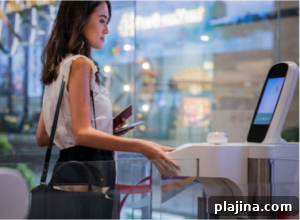
PHOTO: © RAPHAEL OLIVIER / IDEMIA
IDEMIA outlines a “couch to gate” vision that replaces the traditional curb-to-gate journey. Passengers begin at home, enrolling with a mobile device to capture biometric data and creating a secure digital travel document. That document may embed biometric templates directly in a boarding pass or use the biometric traits themselves—face, iris or fingerprints—as the boarding credential.
Pre-enrollment gives airports and airlines better advance knowledge of travelers, enabling targeted guidance on arrival and a higher level of trust established before passengers reach the terminal. This allows for contactless, socially distanced processing and lets security personnel focus on exception screening rather than routine checks of low-risk travelers.
Future terminals aim to integrate security and passenger experience into the infrastructure itself, recognizing travelers on the move without requiring stops or manual interactions. Technologies such as IDEMIA’s MFace Flex employ multicamera identification to recognize people of different heights, including families and passengers in wheelchairs, without requiring them to pause at a fixed camera.
Pre-enrollment and a secure digital travel document also promise a more predictable and pleasant airport visit. When an airport recognizes you as an anticipated guest, biometric data can help optimize your movement through each stage of travel.
Scott describes a system in which rental car companies, hotels, airlines and parking providers all use more accurate timing and queuing data to deliver individualized predictions. By analyzing the time each component takes, airports and service providers can generate personalized travel time estimates for each passenger on a given day.
That vision includes reimagined security lines, check-in areas, lounges and restaurants—not simply as responses to COVID-19, but as improvements driven by better technology and a finer understanding of how passengers spend time in the terminal. With airports acting as mobility providers, the goal is to minimize missed flights and reduce unnecessary early arrivals.
Picture the couch-to-gate journey: you check in at home and have an estimated time from car park to aircraft. A contactless kiosk recognizes your biometrics and prints your bag tag. TSA and your airline already recognize you and direct you to the best checkpoint or check-in lane. Real-time estimates tell you how long screening will take. Security scanners confirm your identity without requiring shoes off, jackets removed or laptops unpacked. You know the walking time to your gate and whether you have time for the lounge, where biometric access is seamless. A boarding alert prompts you to the e-gate; a camera verifies your identity and boarding status, and you proceed to your seat. At your destination, you receive a precise time to collect checked luggage, avoiding crowded baggage claim areas.
This future depends on collaboration among travelers, airports, airlines and governments. Scott envisions a model where travelers control what data they share, and trusted records and consent reduce risk profiles before arrival. With a personal device, unique biometrics and secure travel documents under the traveler’s control, the system can deliver a safer, more private and far more convenient travel experience.