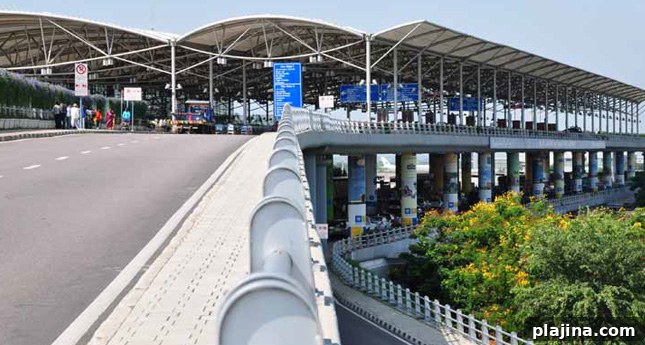
Less than a decade after opening in 2008, Hyderabad’s Rajiv Gandhi International Airport is already planning for the future. Situated about 19 miles south of Hyderabad’s city center—a rapidly growing hub with special economic zones for information technology, pharmaceuticals, biotechnology and finance—the airport is a central piece of a broader regional development strategy.
Unveiled in January 2013, the Hyderabad Master Plan 2031 covers roughly 2,300 square miles of the Hyderabad Metropolitan Region and serves a population of about 18.4 million people, including the Rajiv Gandhi International Airport. The plan sets out a long-term vision for travel infrastructure to meet rising demand through the middle of the 21st century. Today the airport handles roughly 12 million passengers annually, and under the master plan it is projected to expand capacity to around 40 million passengers a year, positioning it as a primary gateway to central and southern India.
Phase 1 of the master plan focuses on the airport’s existing facilities and includes the primary runway, which is the second-longest in India and capable of handling current superjumbo aircraft such as the Airbus A380. A parallel secondary runway supports large aircraft up to the size of a Boeing 747. On-site infrastructure also includes a dedicated cargo terminal, rescue and firefighting services, and modern air traffic control systems with advanced operational databases.
The main passenger terminal was designed with modular expansion in mind, allowing the airport to scale efficiently as demand grows. Current passenger amenities include multiple contact boarding bridges, remote stands, common-use terminal equipment, staffed check-in counters and self-service kiosks, customs and immigration processing, and a transit hotel. An “Airport Village” provides a centralized retail and hospitality area with shopping, dining, lounges, meeting points, a children’s play area, parking and transfer assistance.
Future phases of development described in the master plan call for a dual-runway layout connected by two cross-taxiways, two integrated passenger terminals, and additional dedicated cargo terminals to boost freight-handling capability.
Beyond physical expansion, the airport has also embraced technology to improve passenger experience. In August, Rajiv Gandhi International became the first airport in India to receive regulatory approval for eBoarding. As part of the government’s broader “Digital India” efforts, paperless boarding is expected to streamline boarding processes and reinforce the airport’s role as a technology leader within India’s aviation sector.