
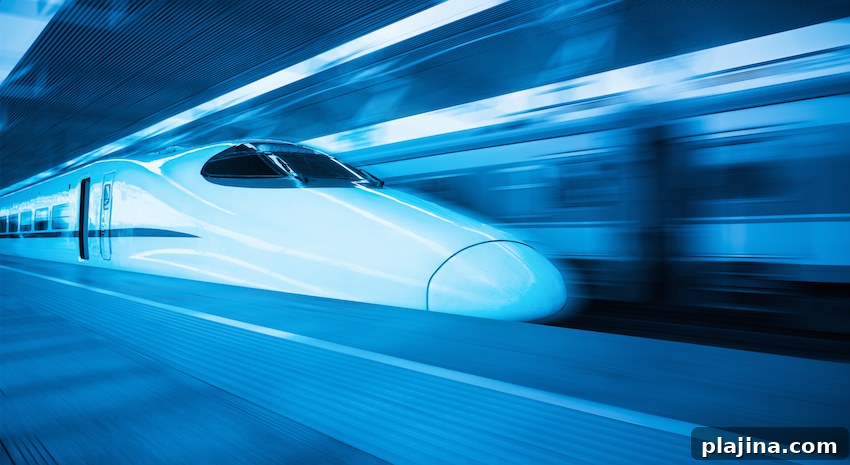
While the United States has lagged behind other countries in developing high-speed rail, a new startup called Pacific Hyperloop is aiming to change that — at least for the Pacific Northwest.
Pacific Hyperloop proposes a high-speed transit connection between Seattle and Portland using the Hyperloop concept originally popularized by Elon Musk. The proposed route would carry passengers between the two cities in about 15 minutes by reaching near-supersonic speeds of roughly 760 mph.
The company is currently a semifinalist in the Hyperloop One Global Challenge, meaning the idea remains conceptual for now. Pacific Hyperloop’s proposal is part of a broader field of entrants exploring how Hyperloop technology could transform regional travel.
“We will be giving our finalist presentation on April 5th and 6th in Washington, D.C., in front of Hyperloop One and government officials,” said Richard Kim, director of marketing and public relations for Pacific Hyperloop, in an email to GeekWire. “If/when we become a finalist, Seattle and Portland will be the starting grounds for Hyperloop’s innovation and prominence.”
Elon Musk introduced the Hyperloop concept in 2013 as a proposal for rapid travel between the Bay Area and Los Angeles: a roughly 30‑minute trip at an estimated fare of around $20. Although the idea has inspired numerous startups and studies, Musk himself has not directly built a commercial Hyperloop line.
Pacific Hyperloop’s Seattle–Portland plan highlights the potential advantages of ultra-high-speed ground transport for crowded corridors that lie just beyond the efficient range of conventional rail or short-haul flights. A sub-30-minute trip would dramatically reduce travel time, encourage regional economic integration, and offer a lower-carbon alternative to short flights, provided the infrastructure can be built and powered sustainably.
Technical and regulatory hurdles remain significant. Hyperloop systems require near-vacuum tubes, sophisticated magnetic levitation or air-bearing technologies, and rigorous safety systems to operate at such high speeds. Route acquisition, environmental reviews, and coordination with state and federal agencies would also be major challenges for any developer.
Still, interest in Hyperloop concepts has spurred engineering competitions, feasibility studies, and pilot projects worldwide. For cities like Seattle and Portland, which are separated by roughly 175 miles, a Hyperloop could transform daily and business travel patterns if the technology proves viable and cost-effective.
At this stage, Pacific Hyperloop’s proposal is a vision rather than a finished project. As the Hyperloop One Global Challenge progresses and companies refine their plans, local leaders and transit advocates will need to weigh potential benefits against costs, technical risks, and environmental impacts. If Pacific Hyperloop advances to the final rounds, the Pacific Northwest could become a prominent test case for the next generation of high-speed ground transportation.