
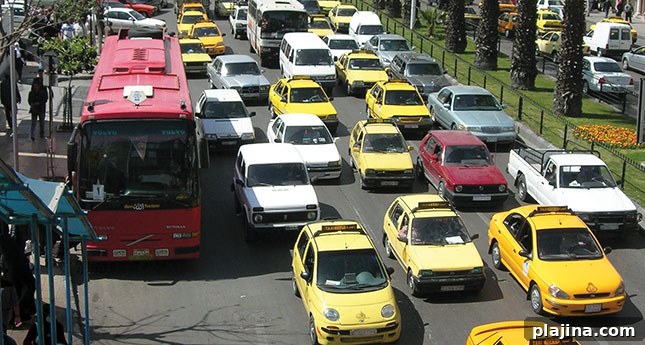
Damascus in the evening rush hour is the definition of chaos. As an outsider, you would not want to be driving through the city at that time, and certainly not across the six-way intersection of Sahaat Yousef al-Azmeh — and most definitely not at the wheel of a local taxi.
So what was I doing one Monday evening, piloting a battered yellow taxi across Sahaat Yousef al-Azmeh?
That question rattled in my mind as I steered the taxi through a disordered tangle of other cabs, worn cars, crowded minibuses and the random pandemonium of motorcyclists, hand-pulled carts and pedestrians.
My reluctant conversion from tourist to temporary driver had taken place on the road back to Damascus. I was returning from Bosra, near Syria’s border with Jordan, where I had spent the day scrambling over magnificent Roman ruins. The driver had been sleeping in the shade beside the car while I explored. When we left, he drove for a while, then we were stopped at a military checkpoint.
At the roadblock the driver was asked for his license. After a theatrical search through pockets and glove compartments he came up empty. A soldier then asked me for my documents. I produced my license and, not exactly under threat but certainly urged, was guided into the driver’s seat.
After a brief orientation to the pedals and a futile reach for a non-existent seat-belt, I set off with the ashamed driver beside me. A military jeep tailed us and stayed in the grimy rearview the whole way.
Damascus is likely the oldest continuously inhabited city on earth. Modern planners have grafted highways and flyovers onto its fabric, but step off the main arteries and you are immediately plunged into a haphazard street pattern grown over three millennia — streets better suited to camels than to cars.
“Here?” I asked the embarrassed driver, pointing toward a vacant stretch of curb. He shook his head, signaled left then right, and steered into an alley so narrow that pedestrians pressed themselves back against the storefronts to let us pass.
Once we were satisfied the military escort was no longer watching, the driver asked me to stop. A stilted argument over the fare followed. Eventually he agreed the Bosra trip should be off the meter; I paid half the original price and he drove away.
I watched the taxi disappear and suddenly realized I had no idea where I was. Given the way Syria had been portrayed — painted as part of the so-called “Axis of Evil” — being left in the heart of its ancient capital might have been alarming.
Yet my assumptions about the country had been dismantled since my arrival two days earlier. Nothing had prepared me for the warmth and generosity of the people I met in Damascus.
On my first afternoon I had been invited to sit with a group of men sharing tea from a flask on the threadbare grass of a city park. We chatted easily for an hour; when I left, they wished me a pleasant stay. Apart from the brief humiliation of driving someone else’s taxi, that wish proved true.
Now stranded in the old town, I asked a passerby for directions to the Street Called Straight, hoping to reorient myself. “I’ll show you,” he said. Though it took him out of his way, he guided me through a maze of alleys that have preserved their biblical alignment, leading me to the famous route that runs northwest to southeast through the ancient walls.
For part of its length the Street Called Straight becomes Madhat Pasha Souq, a covered market under a perforated, rusty canopy. During daylight, shafts of sun glint through holes in the roof, turning the ceiling into a pattern like a star-spangled night sky.
If you tune out the modern buzz of traffic and stalls hawking Casio watches and bargain televisions, the Street Called Straight can transport you. It offers sounds, scents and scenes that feel unchanged by time.
Historic markers are scattered across the city. The National Museum provides a clear survey of Damascus’s layered civilizations — Egyptians, Assyrians, Persians, Greeks, Romans and the rise of Islam.
From the Street Called Straight I made my way to the Umayyad Mosque, one of the city’s most important Islamic sites. The mosque’s main hall is open to non-Muslims and houses a revered marble tomb reputed to contain the head of John the Baptist, a reminder of the intertwined roots of Islam and Christianity.
Of course, the two religions battled fiercely here during the medieval Crusades. As I walked along the outer wall of the mosque I passed the modest mausoleum of Saladin, the great Muslim commander who earned respect even from his Christian adversaries.
The day before, I had stood near Saladin’s tomb among local tourists. One man, speaking halting English, said: “Saladin, very good. Richard Heart of Lion, very good.” Invoking those ancient figures allowed us to put current political tensions aside for a moment; we posed together for a cheerful photograph.
At dusk the mausoleum was closed and Saladin’s tomb lay in quiet shadow. I kept walking, planning to return to my hotel, but decided first to rest at a sidewalk café. I ordered a beer.
In many Islamic countries public drinking could be illegal, but in Damascus locally brewed beer is widely available and packs a surprising punch.
I poured half the liter bottle into a glass and took a long, refreshing sip. A nearby group of Syrians watched with curiosity. Catching my eye, they smiled and invited me to join them.
I carried my bottle and glass over to the empty chair at their table. Sometimes that simple gesture is enough to bridge any divide.