
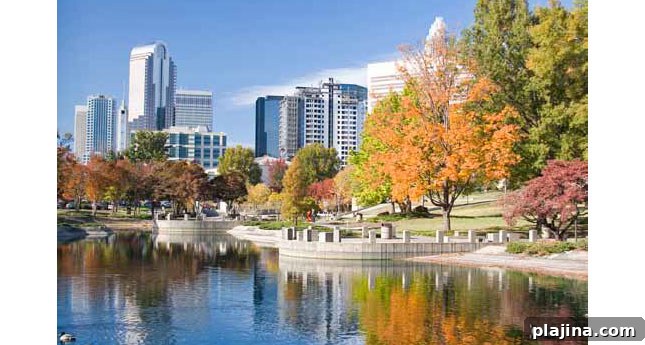
As my flight began its final descent into Charlotte Douglas International Airport, the skyline emerged through a rolling green canopy of trees: glass-and-steel towers glinting like a modern, metallic Oz set against the Southern landscape. The sight of those skyscrapers — the Cesar Pelli–designed Bank of America Corporate Center, the Duke Energy Center, Hearst Tower, One Wells Fargo Center and Bank of America Plaza — only hints at Charlotte’s transformation.
Over the past three decades, Charlotte reinvented itself from a modest Southern textiles town into a major banking and insurance hub, now second only to New York City in financial services. Yet despite this rise, Charlotte has managed—through thoughtful planning and a bit of Southern serendipity—to retain a relaxed, small-town atmosphere alongside its high-rise core.
Today the city offers a lively mix of urban amenities and neighborhood charm. A bustling fresh-food public market thrives on East 7th Street, new museums and cafés line South Tryon Street, and a modern light rail line has helped convert previously neglected blocks into attractive streetscapes with mini-parks, bike trails and pop-up music events. Uptown streets are shaded by crepe myrtle, ginkgo and Yoshino cherry trees; fountains animate colorful flowerbeds; and office workers often take leisurely lunch breaks on shaded benches. That mid-19th-century Carolina charm coexists with gleaming towers, while many former brick textile mills have been repurposed as residential lofts, galleries and restaurants in neighborhoods such as NoDa.
“Charlotte’s development exemplifies what a wonderful, modern city this is,” said Cheryl Myers, senior vice president of planning and development for Charlotte Center City Partners. “The city has great architecture, and we have terrific new museums and theaters, and the Uptown and South End districts have become a very desirable place to live.”
The city faced a severe setback during the 2008 housing crisis and bank failures, losing nearly 16,000 jobs that year alone. Still, the recovery has been visible across gentrified neighborhoods such as South End, Ballantyne, Dilworth, NoDa, SouthPark and the historic Fourth Ward, as well as in the growing office parks outside the beltline.
Charlotte’s economy continues to attract companies and residents. Cold-weather retirees are drawn to the milder climate, while businesses relocate to take advantage of the region’s pro-business environment and relatively low energy costs. From 2000 to 2010, no U.S. metro area with a million or more residents grew faster than Charlotte. The Charlotte-Gastonia-Concord metro area has been recognized among national boomtowns as financial services and other industries generate thousands of jobs.
More than half of the Fortune 500 maintain a presence in the region. Major corporate headquarters include Bank of America, Lowe’s, Nucor, Duke Energy, Family Dollar, Sonic Automotive, Domtar and SPX. Electrolux consolidated its North American headquarters in Charlotte in 2011, and Chiquita Brands also relocated here recently, reflecting the area’s growing corporate appeal.
Local corporations play an active role in supporting Charlotte’s cultural and sports institutions. Bank of America Stadium hosts the Carolina Panthers, while Time Warner Cable Arena is home to the NBA’s Charlotte Bobcats. Corporate sponsorships underwrite arts programming across the city: Wells Fargo supports Opera Carolina, North Carolina Dance Theatre, the Charlotte Symphony Orchestra, the Mint Museum, the Bechtler Museum of Modern Art and the Harvey B. Gantt Center for African-American Arts + Culture. Duke Energy sponsors performing arts seasons and community projects, and Branch Banking & Trust holds naming rights for the city’s minor league BB&T Ballpark.
As development pushes outward into former farmland, the center city is also going vertical. Private developers are building mixed-use towers to add residential, office and retail space. In 2012 more than 7,100 new residential units opened in Uptown, welcoming over 15,000 new residents who now enjoy easy access to dining, sports and cultural venues. South End is expanding rapidly as well: multiple residential projects under construction are projected to increase that neighborhood’s population substantially.
Investment is following growth, particularly in transportation. Charlotte’s first light rail line opened in 2007, and ongoing funding is extending the LYNX Blue Line from the city center toward the UNC-Charlotte campus. Additional stations and the commercial activity that follows are already boosting property values along the route.
Business travelers will find abundant meeting and lodging options in a city filled with familiar corporate hotel brands and large conference properties, from Marriotts, Omnis, Hiltons, Hyatts and Westins to the Ballantyne Hotel and Lodge and the Ritz-Carlton.
NASCAR Hall of Fame Museum © Redwood8 | Dreamstime.com
The Charlotte Convention Center provides over 126,000 square feet of flexible meeting space, 280,000 square feet of exhibit space and a ballroom that connects to the NASCAR Hall of Fame by an over-street walkway, making it the largest meeting venue in the region. Several cultural institutions nearby, including the Mint Museum and the Gantt Center, also offer attractive private function spaces.
SCENIC DRIVES
For a full-day outing, drive north on Interstate 77 to Exit 73 (about 60 miles, roughly 75 minutes) to explore wineries in the Yadkin Valley. Local signage marks vineyards, and winding roads through rolling farmland afford views of the Blue Ridge Mountains and numerous opportunities for tastings.
Closer to the city, Crowders Mountain State Park lies about 35 miles west via Interstate 85 (approximately 40 minutes). The park, part of the Kings Mountain range, features Pinnacle Peak at its northern end and offers an accessible eight-mile route with scenic overlooks, hiking and rock climbing—surprisingly wild terrain within easy reach of Charlotte’s towers.
An alternate drive follows North Carolina Highway 24 East to the small town of Badin (about 47 miles, an hour’s drive), a gateway to the Pee Dee River Valley. Noted for its distinctive French-inspired townhouses and listed on the National Register of Historic Places, Badin provides access to local roads that run along the river and lead to Morrow Mountain State Park and Uwharrie National Forest.