
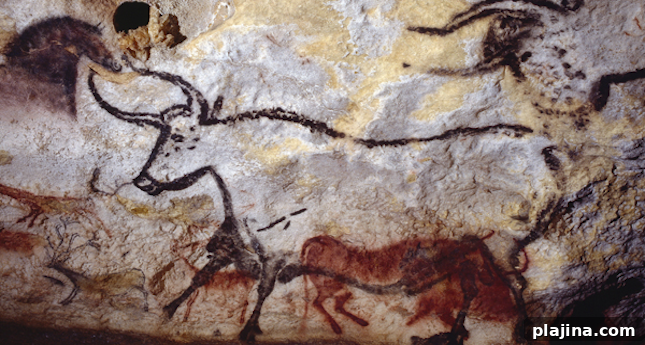
Since its discovery in 1940 in southwest France by four schoolboys and a dog, the Lascaux Cave has remained an extraordinary archaeological and artistic treasure. The cave walls are covered with prehistoric paintings of animals — horses, felines, ibex, bulls, a rhinoceros — and even a figure often described as a unicorn. Alongside these animal depictions are human figures and a variety of abstract signs that continue to generate interpretation and debate among archaeologists, historians, and art scholars.
An international exhibition presents highly accurate replica panels of five paintings from the cave’s Nave and the Well Scene, reproduced down to the finest detail and paired with modern digital technologies to convey the sensation of visiting the original UNESCO World Heritage site. Scenes From the Stone Age: The Cave Paintings of Lascaux is on view through March 23 at the Houston Museum of Natural Science. The show combines faithful reproductions with interactive displays, 3D projections, a virtual cave tour, and a large-scale model of the cave to offer a comprehensive, immersive experience.
The replicas are created to preserve the visual and spatial relationships of the original compositions while allowing visitors to appreciate the paintings without risking damage to the fragile Paleolithic art. Advanced imaging and conservation methods used to document the cave informed the reproductions, ensuring that textures, pigments, and brushwork are represented as accurately as possible. The exhibition’s digital components provide context: interactive screens explain scientific findings and dating techniques, while projection mapping and virtual reality re-create lighting conditions and viewing perspectives that would have shaped how prehistoric artists and their contemporaries experienced the space.
Beyond visual fidelity, the exhibition emphasizes the cultural and scientific importance of Lascaux. The cave’s paintings date to the Upper Paleolithic period and offer rare insights into early human creativity, symbolic thinking, and interactions with the natural world. Scholars interpret the animal imagery and signs in different ways — as hunting magic, ritual symbolism, clan markers, or narrative scenes — and the exhibition presents these multiple perspectives without privileging a single explanation. By combining reproductions with up-to-date scholarship and accessible displays, it invites visitors to explore both the artwork and the ongoing debates surrounding its meaning.
For museumgoers, the installation creates a layered learning experience. The large-scale model helps situate the replicas within the cave’s architecture, clarifying how narrow passages, ceiling curves, and chamber sizes would have influenced composition and visibility. Interactive kiosks provide high-resolution images, technical analyses, and comparative material from other Paleolithic sites, enabling visitors to trace stylistic connections and regional variations. 3D projections and virtual tours offer dynamic ways to engage: viewers can simulate moving through the cave, examine paintings from multiple angles, and toggle explanatory overlays that highlight specific motifs or pigment compositions.
The exhibition also highlights the conservation challenges that led to the creation of precise reproductions. Since the mid-20th century, the original Lascaux paintings have been threatened by environmental changes, microbial growth, and the impact of human visitation. To protect the site, access to the original cave is strictly limited, and carefully produced facsimiles have been used to share the art with the public. This approach balances the need for preservation with the desire to make one of humanity’s earliest artistic achievements accessible to a wide audience.
Visitors leave with an enhanced appreciation of how prehistoric people used imagery, space, and material to express ideas and communicate across generations. Scenes From the Stone Age: The Cave Paintings of Lascaux brings together meticulous reproduction, scientific interpretation, and immersive technology to convey the visual power and cultural resonance of these ancient works.