
Reimei Kobashi footbridge, which links Kachidoki Station and Harumi 3-chome in Tokyo’s waterfront district, opened to the public in 2024 and has since earned numerous design awards. Most notably, it won the Architectural Design Infrastructure category at the Architecture Master Prize 2025, an international competition that recognizes outstanding architectural achievement. The bridge was designed by Tokyo-based Hoshino Architects, led by Hiroaki Hoshino.
© ebi – times
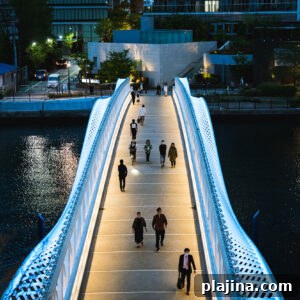
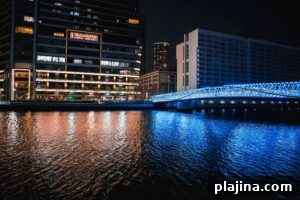
Stretching approximately 280 feet, the bridge spans the Asashio Canal and connects to Grand Marina Tokyo. Its form features a soft, arching profile that evokes the gentle rise and fall of waves. The continuous white structure appears to hover above the water, its subtle undulations reflecting the rhythm of the canal’s surface. As daylight shifts, the bridge’s shadow on the water accentuates a layered wave effect, encouraging viewers to imagine overlapping currents and movement.
The design is conceived as a single, fluid motion derived from three-dimensional geometric changes. As pedestrians traverse the bridge, they experience a dynamic sense of motion created by the changing geometry underfoot and around them. Integrated lighting further enhances that experience: an adjustable color program gradually shifts hues according to season and day of the week. These changing palettes produce a variety of atmospheres, so evenings in the growing residential neighborhood are animated by transient color combinations and slowly evolving light sequences.
© ebi – times
The footbridge is part of the broader Harumi 3-chome Project, a major development in Tokyo’s Chuo Ward focused on creating green connections between parks and establishing a barrier-free pedestrian network that extends into the city. Reimei Kobashi plays a central role in that vision by linking the residential complex directly to Harumi Daisan Park across the street, improving accessibility and neighborhood connectivity. The architecture of the surrounding buildings draws inspiration from wake waves formed by boats cutting across the water: varied façade details reference that motion and help define an approachable gateway to the Harumi area.
Beyond the footbridge and park linkages, the Harumi 3-chome development includes mixed-use elements such as office space and a hotel, arranged in distinct buildings to balance public access with private functions. Together, these components contribute to a cohesive urban fabric that emphasizes pedestrian movement, visual continuity with the waterfront, and a human-centered approach to everyday urban life.
By combining sculptural form, responsive lighting, and thoughtful urban planning, Reimei Kobashi has become both a functional crossing and a civic landmark. Its award-winning design highlights how infrastructure can enhance public space: as residents and visitors pass over the canal, they encounter an engineered landscape that resonates with the water beneath, the changing seasons above, and the evolving life of the Harumi neighborhood.