
While Alexis Tsipras, Greece’s prime minister, focuses on renegotiating the nation’s debt with the European Union, Greeks across the country continue their long-standing tradition of welcoming visitors to the islands, Athens and Thessaloniki.
Thessaloniki, about 300 miles north of Athens and close to the borders of Bulgaria, North Macedonia and Albania, is Greece’s second-largest city and the capital of the northern Macedonia region. The city itself is home to roughly 363,000 residents, with another 170,000 living in the surrounding hilly suburbs and sun-drenched towns along the Aegean coast. Thessaloniki offers a distinct slice of Greek life that contrasts with Athens and the popular islands.
Accessible from Athens by a five- to six-hour drive, a 4.5-hour express train or a 50-minute flight, Thessaloniki makes an excellent add-on destination for leisure or business travelers who want cooler hills, less crowded historic sites and a vibrant nightlife away from the crowds at the Acropolis and Parthenon.
Founded around 315 B.C. by King Cassander of Macedon and named for his wife Thessalonike, a half-sister of Alexander the Great, the city retains a wealth of early Christian and Byzantine monuments. UNESCO has recognized 15 of these sites as World Heritage. Thessaloniki’s historic architecture, archaeology museums, thriving arts scene and seafront promenade helped earn it the title of European City of Culture in 1997.
Thessaloniki’s seafront promenade pedestrian zone © Thessaloniki Tourism Organization
Since the fall of communism in Eastern Europe, Thessaloniki has emerged as a major trade and business hub for the Balkans, hosting numerous trade fairs and international conferences. The city supports several large educational institutions, including Aristotle University of Thessaloniki—the largest university in Greece—established in 1926, the University of Macedonia and the Technological Education Institute of Thessaloniki. With more university students living in Thessaloniki than in Athens, the city benefits from a lively café and bar culture.
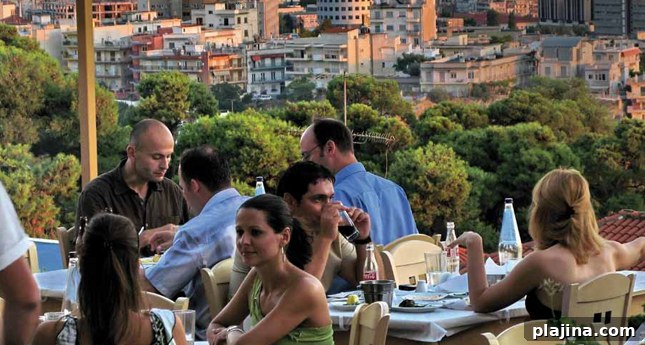
National Geographic recently ranked Thessaloniki ninth worldwide for nightlife, noting the city “has more cafés per capita than any other European city.” Each evening, office workers and students gather in cozy bars and outdoor cafés in former industrial quarters such as Syngrou/Valaoritou and in the converted warehouses of Ladadika near the port. Upscale Ano Poli offers quiet streets and family-friendly tavernas where outdoor dining is lit by stringed lights and stars. Late at night, beaches and energetic clubs attract locals and visitors who dance until sunrise.
Beyond nightlife, Thessaloniki offers serene pleasures: seaside walks, fresh seafood at waterfront restaurants and a rich museum scene. The city hosts roughly two dozen museums covering topics from ancient and contemporary art to cinema, railway history, science and photography.
The Jewish Museum of Thessaloniki interior, showing ancient gravestones from a Jewish cemetery damaged during the 1942 Nazi occupation © Jewish Museum of Thessaloniki
During the Nazi occupation from 1941 to 1945, about 49,000 of Thessaloniki’s 52,000 Jewish residents were deported to death camps. The Jewish Museum of Thessaloniki, housed in a historic city building, documents the history of this once-large community through artifacts, photographs and archival material.
The Archaeological Museum of Thessaloniki, founded in 1925 and expanded with a modern exhibition space in 2006, displays an impressive collection of pottery, mosaics, sculpture and paintings. The Thessaloniki Olympic Museum highlights the modern Olympic movement while acknowledging the ancient games that began in Greece in 776 B.C.
A stroll along the seafront promenade from Aristotelous Square to the statue of Alexander the Great is a must. The route passes the iconic White Tower, a cylindrical stone fortification from the 1500s and a city landmark. The walk covers about 2.5 miles and can take about an hour without stops for refreshments. For hot days, an air-conditioned local bus reaches the same destination in half the time for a small fare. With the euro trading relatively low against the U.S. dollar, visitors currently find taxis, public transport, meals and hotels especially affordable.
Travel sites note Thessaloniki among European cities offering good value for luxury hotels, with competitive five-star rates. Uncertainty around the country’s economic situation has so far contributed to favorable exchange rates for tourists seeking authentic Greek experiences at attractive prices.
From Thessaloniki, travelers can explore northern mountain villages, panoramic Aegean coastlines and nearby archaeological sites by car, train or short flights. The Met Hotel is one of the city’s modern five-star properties, offering 212 rooms, underground parking, complimentary WiFi, a rooftop pool and a Sky Bar overlooking the sea. The boutique Excelsior hotel, with 34 rooms and private balconies, provides a more intimate luxury option in the downtown area.
Halkidiki aerial view © Halkidiki Tourism Organization
An hour south of the city lies Halkidiki, a region of three peninsulas famed for olive groves, vineyards and sweeping sea views. Newly opened resorts such as Ikos Olivia and Ikos Oceania offer beachfront accommodations and suites overlooking the Gulf of Toroneos, popular with both locals and visitors seeking a coastal retreat.
Cultural destinations within day-trip distance include Vergina, where the ancient city of Aigai and the Museum of the Royal Tombs showcase royal Macedonian heritage, and Pella, the ancient capital and birthplace of Alexander the Great, with a museum notable for its mosaic floors. Both sites are easily reached from Thessaloniki.
Thessaloniki Info to Go
Passenger traffic at Thessaloniki International Airport, located about nine miles from the city center, has increased in recent years as carriers expand service across Europe. Fast train service connects Thessaloniki and Athens in approximately 4.5 hours, with first-class options that include onboard meals. Ferries link Thessaloniki with nearby islands year-round, and seasonal routes expand connections to island groups in summer. Travelers should be aware that ferry schedules can change, and late-night departures or arrivals are not uncommon.