
When people think of Austrian wine, white varieties usually come to mind — and for good reason. Whites account for at least 70 percent of Austria’s wine production. Yet beyond Grüner Veltliner, Riesling and the country’s celebrated sweet wines, Austria also produces a notable range of red wines. Some come from varieties rarely found elsewhere, such as Zweigelt, the country’s most widely planted red, Blaufränkisch, one of Austria’s finest grapes, and St. Laurent. Austria also grows Blauburgunder (Pinot Noir) and international varieties like Cabernet Sauvignon and Merlot.
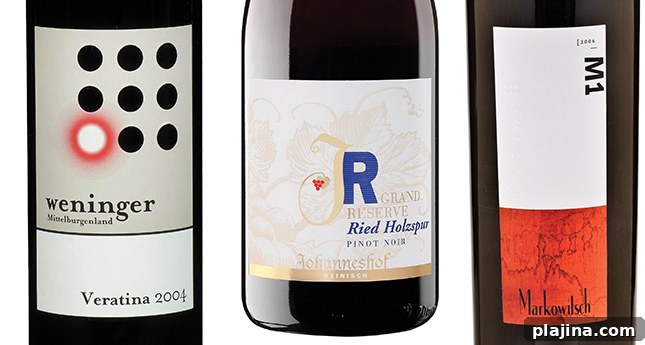
At a recent blind tasting I attended, where wines were poured into numbered glasses and only identified after judging, Austrian reds performed exceptionally well against comparable French wines. The spicy Pittnauer St. Laurent Alte Reben, for example, tied with a Côtes du Rhône as the top wine in its group. Dark, intense and ripe, this St. Laurent delivered an impressively long finish. A silky Austrian Pinot Noir from Johanneshof Reinisch narrowly outscored the Burgundy entry, a Clos de Vougeot. In a flight of Merlot-based wines, the Austrian Markowitsch M1 — a blend of Merlot and Zweigelt — earned the most votes.
Weninger Veratina, a blend of Blaufränkisch, Cabernet Sauvignon and Zweigelt, shows dark fruit notes with a hint of chocolate, supported by solid structure and bright acidity. In its comparison group it achieved a score more than twice that of a Château Margaux.
Perhaps the most striking example of Austrian red quality in that tasting was Arachon T.FX.T. Evolution, a blend with 50 percent Blaufränkisch complemented by Merlot, Zweigelt and Cabernet Sauvignon. It finished first in its flight, receiving twice as many votes as the second-place wine, Château Mouton-Rothschild. Arachon presented a ruby color, blackberry aromas, concentrated body and a long finish. Price-wise, Arachon Evolution retails for about $55, while Mouton-Rothschild is roughly $100; both wines were from the 2004 vintage.
Overall, Austria produces roughly 1 percent of the world’s wine, and Austrians consume about three-quarters of their own production, leaving only a small volume for export. Despite that limited availability, the reds that do reach international markets demonstrate that Austria can produce wines of exceptional quality.