
I spent most of my life avoiding South Africa’s Kruger National Park. Growing up, I preferred safaris in Kenya, Uganda, Tanzania, Malawi (where I worked as a wildlife officer), Zambia, Zimbabwe, Namibia, Botswana and private South African reserves.
Kruger always felt too tame: paved roads, fenced camps and crowds of vehicles clustered around a single sighting. Yet there are persuasive reasons to visit South Africa’s oldest and largest park. Kruger is vast — nearly the size of New Jersey — and contains a rich mosaic of habitats. Away from the main camps and along the many dirt tracks that branch from the primary routes, it’s easy to find solitude and a true sense of wilderness.
Last year my wife and I set aside our prejudices and spent two weeks self-driving through Kruger. We were converted and returned for another two weeks this year. This trip combined the traditional self-drive experience with a more exclusive offering on Kruger’s eastern flank.
On the park’s eastern boundary, bordering Mozambique, a 33,000-acre concession is managed by the high-end safari company Singita. Singita Lebombo Lodge features 15 luxury suites perched along a cliff overlooking the N’wanetsi River. After the practical facilities of Kruger’s government camps, arriving at Singita was a culture shock.
Pulling up in our dust-streaked VW Polo, attendants greeted us with wet towels and cold drinks, whisked our luggage to the suite and drove our car away. When we saw it again at departure three days later, it had been cleaned inside and out.
Singita’s public spaces blend natural materials with a modernist architectural language. The glass-walled suites feel like lofts: contemporary comfort that sits lightly within the surrounding wilderness. We barely had time to settle before heading along the winding walkway to the lounge for teatime snacks and the evening game drive.
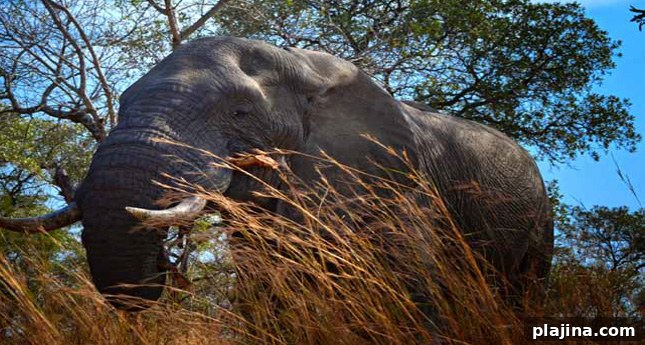
Unlike Kruger’s main areas where visitors must stay on roads and observe a sunset-to-sunrise curfew, our open Land Rover at Singita allowed Enos, our driver/guide, and Howard, the tracker perched above the bumper, to explore off the beaten path. Minutes from the lodge we stood amid a herd of elephants. A young male flapped his ears and postured, but most remained calm; we could smell them and hear the low rumble of their communication.
Later we joined a pride of 36 lions clustered around a recent buffalo kill. Enos maneuvered across rough ground to a perfect viewing position. We sat as the sun sank, surrounded by full-bellied big cats. After sundowners at a scenic vantage, we continued after dark with Howard scanning the bush. We added hyenas, black-backed jackals, grazing hippos and owls to our list.
Back at the lodge, dinner by the glowing pool was included with the stay, and a guard escorted us to our suite. There is no fence around the lodge and animals sometimes wander through.
At dawn we dressed warmly for the morning drive. After a quiet first hour, Howard found a female leopard. Enos displayed remarkable intuition, leading us away from the initial sighting, lowering into a sandy riverbed and circling back. The leopard had recently taken an impala and was trying to drag it up the bank before giving up. For 30 minutes we watched this magnificent cat at close range. Quality sightings like that are what make Singita exceptional.
While Singita excels at the Big Five, we were eager to seek rarer species. That led us to an entirely different landscape: Tswalu Kalahari Game Reserve, South Africa’s largest private reserve, owned by the Oppenheimer family.
We flew from Johannesburg’s private Fireblade Aviation terminal in a Pilatus for a 90-minute flight to the 250,000-acre reserve. On touchdown the Kalahari unfolded in a tapestry of color: bleached grass, red and fawn sand, dark green trees and layered purple hills. Our guides, Nicole and tracker Jackson, met us. Tswalu’s wildlife differs from Kruger and Singita: no elephants here, but desert-adapted species such as Kalahari lions, gemsbok, springbok, desert black rhino and the elusive aardvark.
After settling into a spacious thatched suite at the Motse, Tswalu’s main lodge, we set out on an afternoon drive. It didn’t take long: a bumbling shape moved through the tall white grass. “Aardvark,” Nicole said. We left the vehicle and stalked quietly, careful with each step. Soon we had a clear view: rabbit-like ears, a long snout and a kangaroo-like tail. Unlike in other parts of Africa where they are strictly nocturnal, aardvarks at Tswalu often emerge in late afternoon and are accustomed to being tracked.
We returned to the vehicle elated — part of a small group of people who can say they have seen an aardvark in the wild. Tswalu is split by a fenced government road into two sectors. On the Motse side, painted hunting dogs are prominent; on the other side, large Kalahari lions reign. Reading fresh tracks, Nicole and Jackson guided us to a pride. The lions reclined within feet of our open vehicle, uninterested in our presence.
On our final morning we walked to a clearing peppered with burrow entrances. One by one the meerkats emerged, standing on hind legs to warm in the sun and scan for raptors and snakes. They ignored us completely, allowing intimate views of their social behavior before they dispersed to forage.
Our last drive produced cheetahs, an impressive kudu bull and, waiting at the airstrip with our plane in sight, a large herd of giraffes. Departing any safari is a wrench; after days in timeless landscapes the return to modern life feels abrupt. Yet the memories from Singita and Tswalu — the close encounters and the silence of wide-open places — are lasting remedies for everyday stress.
Safari Info to Go
Johannesburg’s O.R. Tambo International Airport is a convenient gateway to both Kruger National Park and Tswalu Kalahari Game Reserve. We flew scheduled services to Kruger Mpumalanga International Airport and then drove by rental car to Kruger; the drive from the airport to the park is just over an hour, and from Kruger’s gate it’s roughly five hours to Singita when factoring slow driving and wildlife viewing. Transfers to Tswalu are available from Johannesburg or Cape Town via private carriers such as Fireblade Aviation.