
Just before everything spun out of control and the world seemed to tilt, I was talking with my guide, a Canadian from Whitehorse. We had just crossed the frozen Takhini River in snowshoes and were loading the SUV for the drive along the Alaska Highway to my hotel.
The road ahead looked like a sheet of polished ice. “How can we possibly drive on that?” I asked.
“You treat the Alaska Highway the same way you treat brown bears in the wild. You must show respect at all times. If you drop your guard, even for a second, you’ll get savaged.” Five minutes later, that warning proved true.
The vehicle struggled up a steep grade. My guide pressed the accelerator to push us over the final rise. At the crest he turned and said, “Made it!” At that exact moment the road fell away and the rear of the SUV slipped out.
We began to spin, gathering speed as we pirouetted down the highway. An oncoming truck flashed past within inches before we cartwheeled into a snowdrift. When the vehicle finally stopped I was hanging upside down, held by the seatbelt at my waist. I unclipped it and dropped onto the ceiling, amid a heap of snowshoes, camera gear and the soggy remains of our lunches.
By the time I pushed the door open and wriggled out, my guide was already standing in thigh-deep snow, assessing the damage. “Could have been worse,” he said, matter-of-fact. “At least the vehicle seems okay.” Then, almost as an afterthought: “Are you okay?”
That accident marks one of the lowest moments in my complicated relationship with the Alaska Highway. It’s a road I’ve driven many times and in every season. On clear fall days there is no better place to be behind the wheel. The route winds northwest beside the snowcapped Wrangell–St. Elias range in the Yukon, then threads through the foothills of the Alaska Range, with the roadside vegetation burning gold and red in autumn.
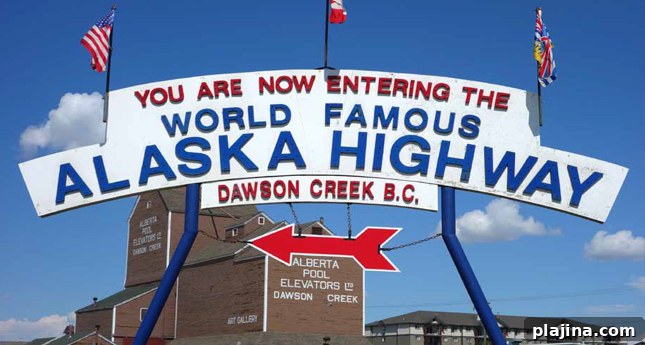
The essential companion for anyone traveling this route is The Milepost, a comprehensive guide that lists sights and services along the full length of the highway, from Mile 0 at Dawson Creek in British Columbia to Mile 1520 in Fairbanks, Alaska.
Building the highway was a remarkable feat. Construction began in 1942, carried out by the United States Army Corps of Engineers to establish a land supply route between Alaska and the Lower 48 during World War II. Much of the hardest labor was performed by African-American soldiers, and the Black Veterans Memorial Bridge over the Gerstle River at Mile 1392 stands as a reminder of their contribution.
What started as a wartime lifeline has since become both a transport route and a travel destination. In summer months the Alaska Highway is filled with SUVs and RVs, while winter travel is far less common—and far more dangerous. Standing beside our overturned SUV on the roadside near Whitehorse, I understood why many avoid it in the cold season.
The truck we nearly hit drove on without stopping. We flagged down the next one; with ropes and chains its driver pulled our SUV back onto the road and righted it. After a brief inspection, my guide decided we were fit to continue. What could so easily have been a fatal crash cost us only 15 minutes and a shock that lingered.
We carried on with a renewed respect for the highway and for the people who built it, carefully rattling our way back toward town. Oddly, I felt grateful for the reminder of the Alaska Highway’s wild, untamed character. It’s more than just a road — it’s the drive of a lifetime.