
Whenever we converse, we engage in a form of fencing: using words instead of blades. We parry awkward questions, deflect barbs and deliver ripostes that shift the flow of the exchange.
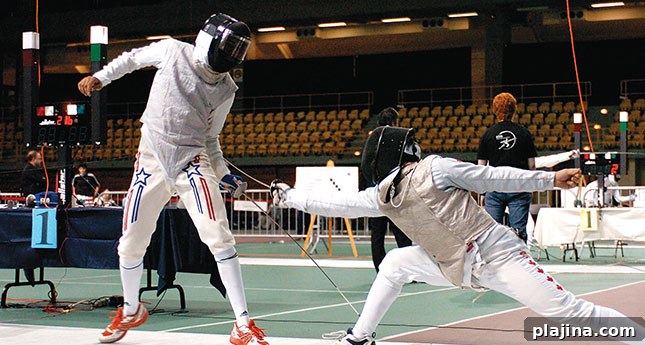
Likewise, when two fencers face each other, they are essentially conversing. In fencing, the clash of blades is often described as a “conversation.” Each attack poses a question; each defense offers an answer.
Human behavior is shaped by an instinct for combat. Whether speaking or fighting, we rely on reflexes and patterns shaped over millennia. Both dialogue and duels have been refined by social rules—grammar and codes of honor—but, at their core, talking can resemble fighting and fighting can resemble talking.
During the Renaissance, both words and swords gained cultural prominence. Poets and playwrights produced works that still resonate, and swordplay shifted from battlefield necessity to an aristocratic pastime. Rules were formalized and blunted tips or buttons were added to swords to reduce lethality.
The word “fencing” comes from “defense,” and learning to fence was more than sport for young European men: it was a practical skill for survival, useful on the battlefield and in the formal duels that settled disputes when rhetoric alone failed.
Although firearms eventually replaced swords in warfare and personal disputes, the art of swordsmanship persisted. Fencing became part of the first modern Olympic Games in 1896 and remains one of the few sports featured in every modern Olympiad. There were occasional flare-ups of old tensions—most famously in 1924, when disputes led to removed buttons and raw duels—but those incidents were rare and did not erase the sport’s ceremonious heritage.
Contemporary fencing divides into three distinct disciplines, each with its own weapon and tactics. Most elite athletes specialize in one rather than attempting to master all three.
The foil is the lightest weapon, with valid scoring limited to the opponent’s torso. The épée is closest to the traditional dueling sword: the whole body is a valid target, and only touches with the tip count. The saber, originally a cavalry weapon, emphasizes cutting actions; its entire blade can score on the opponent above the waist.
The characteristic fencing attire—a white, padded jacket and breeches topped by a metallic mesh mask—serves a vital protective purpose. Before electronic scoring, fencers dipped tips in soot and judges examined marks on the white uniforms to determine hits. Today, electric scoring equipment records touches immediately, improving clarity and fairness.
Bouts occur on a long, narrow strip called the piste; stepping off it incurs penalties. A standard match typically consists of three three-minute periods with one-minute breaks between them. The first fencer to reach 15 points wins; if time expires, the higher score prevails.
Despite its rich history, fencing remains a niche pursuit. Specialized gear and training can be costly, and reaching a competitive level demands sustained practice.
Still, the metaphor holds: we all fence in everyday life. When a particularly sharp remark hits its mark, we often borrow the sport’s language to acknowledge the point—touché.