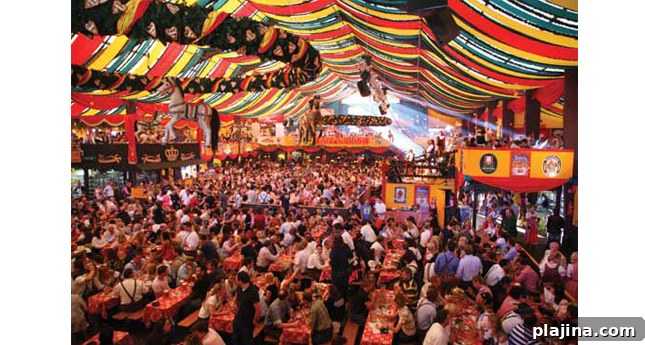
From the moment the Lord Mayor taps the first cask in mid-September, Munich erupts into the two-week celebration known worldwide as Oktoberfest.
The world’s largest and most famous beer festival (Sept. 19–Oct. 4 this year) traces its origins to the wedding in 1810 of Crown Prince Ludwig and Princess Therese von Sachsen-Hildburghausen. The horse race held as part of the wedding festivities proved so popular that it was repeated the following year and eventually became an annual tradition. Over the next century the event grew, beer tents were added, and the celebration evolved into the modern festival.
A grand parade of bands, carriages and elaborately decorated brewery wagons announces Oktoberfest’s opening on the first Saturday. The following day the costume and marksmen parade winds through the heart of the city in an even more colorful display of Bavarian culture, featuring floats, traditional dancers, regional costumes, flag-throwers, horse-drawn brewery drays and marching bands. On the festival’s second Sunday a large outdoor concert brings together all the Oktoberfest bands—around 400 musicians—for a spirited performance.
Löwenbräu tent © Filmfoto | Dreamstime.com
Throughout the 16 days the action centers on the enormous beer tents on the Wiesn festival grounds, where roughly 6.3 million visitors consume about 6.4 million liters (approximately 6.7 million quarts) of draft beer. The large brewery tents line Wirtsbudenstrasse; Augustiner remains the only major brewer still serving beer from wooden barrels, while others use steel kegs. The Hackerbräu tent is known for its revolving stage, hosting traditional Bavarian bands and lively entertainment, and Hofbräu maintains one of the most famous tents. All tents serve classic Bavarian dishes, but some offer specialties: the Ochsenbraterei-Spatenbräu is known for its traditional ox roast, and the Schützenfesthalle features roast suckling pig alongside steins of Löwenbräu.
Smaller tents managed by local beer halls often offer distinctive character. The Fischer-Vroni tent, the smallest on the grounds, serves Augustiner beer and grilled fish. The Armbrustschützen tent pours Paulaner and presents themed booths celebrating hunting traditions with dishes like pheasant and wild boar. For visitors who prefer alternatives to lager, one tent focuses on wines and Weissbier, a German wheat beer. Oktoberfest is not only about beer: the Wiesn also offers traditional music and dancing, variety shows and a full carnival of rides from old-fashioned carousels to high-adrenaline attractions.
While international tourists flock to Munich, many Germans favor Stuttgart’s Cannstatter Volksfest, held this year from Sept. 25–Oct. 11. Second only to Oktoberfest in size, Cannstatter Volksfest began in 1818 as a harvest festival celebrating recovery from famine and has been held in late September ever since. Its beer tents, music, costume parades, rides and fireworks attract around 4 million visitors annually. Locals typically don traditional lederhosen and dirndl dresses to enjoy beer and wursts; travelers seeking an authentic German festival experience among native attendees will find it here.