
In mid-May, KLM took part in the Sustainable Flight Challenge, operating two demonstration round-trips—Amsterdam (AMS) to Trondheim (TRD) and Amsterdam to Los Angeles (LAX)—that showcased more than 100 existing and newly trialed sustainability measures. Twenty-two airlines participated in the event, each aiming to share lessons learned and accelerate improvements in aviation sustainability.
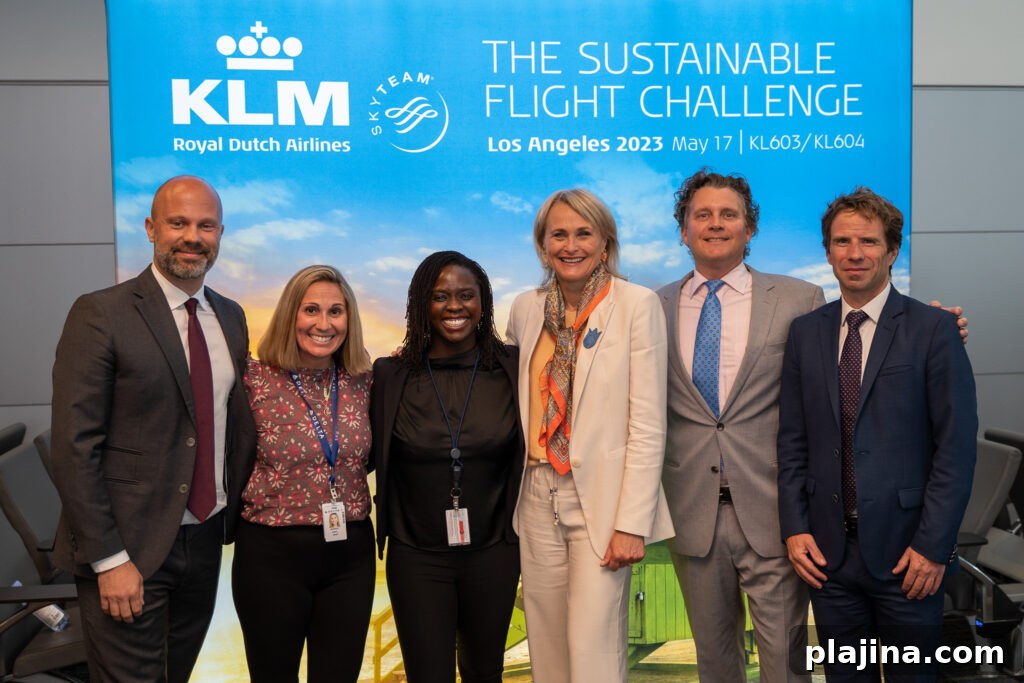
© KLM
“KLM’s target is to cut CO2 emissions by 30% by 2030 versus 2019 levels. That is an ambitious goal because near-term options to reduce aviation emissions remain limited. Nevertheless, we are committed to making continuous progress,” said Marjan Rintel, president & CEO of KLM. “The Sustainable Flight Challenge gives us a practical platform to test new ideas and to learn from other carriers. It underlines how vital collaboration is—between colleagues, partners, and across the supply chain. When initiatives prove effective, they should be rolled out quickly to help the whole industry meet its sustainability objectives.”
The two flights were operated with an Embraer 190 and a Boeing 787-10. Measures demonstrated during the Challenge covered a broad range of operational and onboard changes: the use of sustainable aviation fuel (SAF), targeted weight reductions coordinated with KLM Cargo, lighter tableware and recycled service trays, and a meat-free menu on the Los Angeles sector. Crew uniforms were updated with more sustainable materials, and ground teams focused on optimal aircraft loading and other efficiency improvements. Together these actions aimed to reduce fuel burn and emissions while maintaining service quality.
By participating in events like the Sustainable Flight Challenge, KLM and its peers can accelerate the practical uptake of proven solutions. Piloting multiple small improvements across operations, catering, cabin products and ground handling creates cumulative gains that help move the sector toward long-term climate goals. Sharing data and best practices among airlines, suppliers and airports enables faster deployment of effective measures and supports industry-wide progress.
While no single intervention will deliver the full emissions reductions required, a coordinated approach—combining SAF, operational efficiency, lighter materials, sustainable provisioning and continual innovation—can deliver meaningful results. KLM’s involvement in the Challenge demonstrates the airline’s commitment to testing tangible measures and scaling those that show real environmental benefits, contributing to the wider transition to more sustainable aviation.