
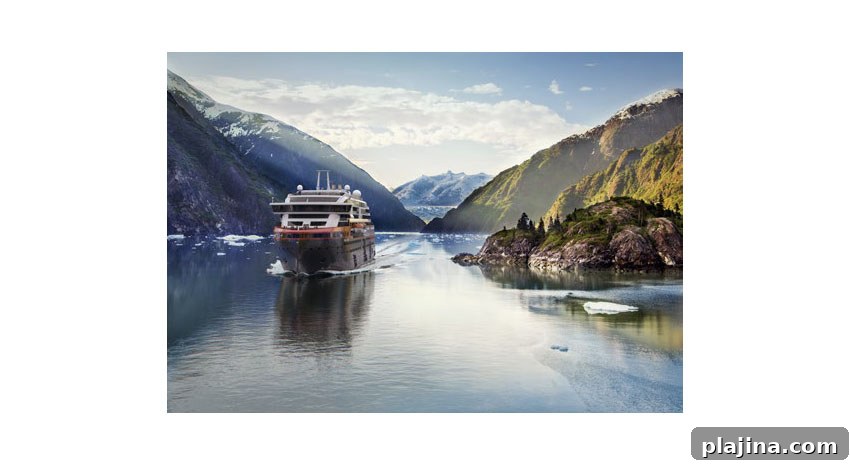
FOR PASSENGERS DRAWN TO cold-water sailing—from the Arctic to Antarctica—and for travelers who prefer exploration to typical resort-style cruising, Hurtigruten is a name that stands out. Founded in 1893 to carry passengers, mail and cargo along Norway’s icy, fjord-lined coast, the company has expanded into expedition cruising as that sector surges in popularity. Nearly half of the new ships launching this year are smaller vessels built for adventurous exploration, and Hurtigruten, calling itself “the world’s largest expedition cruise operator,” is keeping pace.
With a fleet that includes 11 coastal vessels and five expedition liners, Hurtigruten visits about 250 ports a year. Its itineraries focus on long-established routes in Norway, Iceland, Greenland, Canada’s High Arctic and Antarctica, while some voyages also explore warmer regions in the Caribbean and Central and South America. Across all deployments, the line emphasizes expedition-style experiences—field-guided excursions, nature-focused programming and onshore exploration—rather than theater productions or high-glamour amenities, while still offering comfortable, well-equipped ships.
This commitment to exploration is clear with the introduction of Hurtigruten’s first new expedition ship in a class of 530-passenger ice-capable vessels, the MS Roald Amundsen. The Roald Amundsen raises the bar for expedition accommodations: 60 percent of cabins have balconies and 20 percent are suite-category. The ship carries expert English-speaking guides and provides facilities tailored for discovery, including a science center, three restaurants, indoor and outdoor observation decks, a running track, an infinity pool, a gym and a sauna. Practical touches for shore excursions—such as a supply of rubber boots—underscore the focus on hands-on adventure.
Sustainability is a core part of Hurtigruten’s identity, and the MS Roald Amundsen reflects that priority. The line has long pursued environmental initiatives, including a ban on single-use plastics and a program to replace older engines with systems that use liquid natural gas and liquid biogas. The new generation of ships goes further: the Rolls-Royce–designed Roald Amundsen is a hybrid vessel that combines battery power with cleaner fuels. Its battery banks—large enough to fill significant spaces in the hull—can power the ship for 30 to 45 minutes on battery alone. Overall, the hybrid diesel/electric propulsion system reduces fuel consumption and emissions by roughly 20 percent.
The MS Roald Amundsen is scheduled to serve Hurtigruten’s newest destination, Alaska. Its inaugural cruise is an 18-day voyage from Nome to Vancouver departing Sept. 10, and in 2020 the ship will operate a series of longer Alaskan itineraries, ranging from 14 to 18 days.
Although a 530-passenger ship is relatively large for expedition cruising, Hurtigruten’s approach aims to make adventure travel more accessible by offering lower fares than typically associated with small-ship expeditions. For travelers who want an alternative to mainstream, large-ship cruises and prefer immersive, nature-focused voyages in cold-water regions or beyond, Hurtigruten presents a compelling option.