
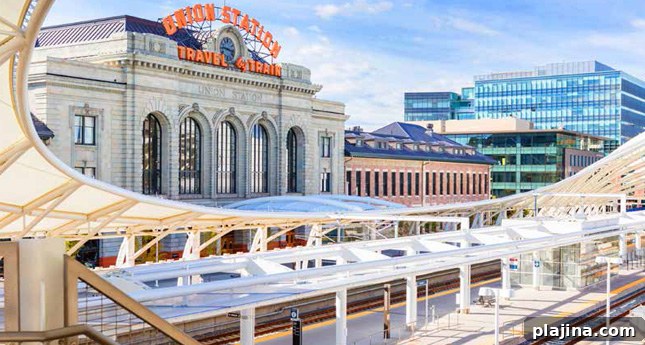
Back when Denver was little more than a dusty frontier settlement on a well-worn trail, most travelers pressed farther west. Everything shifted when the railroad arrived, cutting tracks through the heart of town and turning Denver into the largest stop between Chicago and San Francisco. By the 1860s, the promise of gold and silver in the nearby Rocky Mountains made Denver an essential railroad hub. During railroading’s heyday the Union Depot handled more than 200 trains per day, and the city’s fortunes were closely tied to the rails.
Over time, trains yielded to automobiles, and Denver—like many growing cities—faced congestion and air-quality challenges. In response, voters approved a $4.7 billion regional initiative in 2004 to improve rail and commuter connections across eight counties. That long-range plan came to fruition on April 22 when Denver launched inaugural rail service connecting the airport to downtown in roughly 30 minutes. RTD FasTracks, the regional transportation district, led this transportation renaissance and reshaped Denver’s image from a former cow town into a modern urban center with efficient public transit.
Today Denver blends its cowboy beginnings with an energetic urban culture that takes advantage of nearby mountain terrain. Wesley Marshall, an associate professor of civil engineering at the University of Colorado at Denver, appreciates cities that allow residents and visitors to get around without driving. “Denver is definitely beginning to move in that direction,” he says. “Beyond transit, downtown Denver has also evolved into a place where walking and bicycling are increasingly viable. The bike-share system is easy to access, and car-sharing and ride-hailing options such as Lyft and Uber provide flexible choices for short-term vehicle needs.”
Marshall notes that Denver adopted transit-oriented development (TOD) along new rail corridors to concentrate mixed-use projects near stations, a strategy that encourages people to live and work close to transit. He also cautions that the city sometimes reverted to older patterns by prioritizing congestion relief and routing rail along highways—an approach that can limit the potential of TODs by separating stations from the nearby neighborhoods they are meant to serve.
Mount Evans Scenic Byway © SHARON DAY | DREAMSTIME.COM
Rail brings a degree of permanence that often stimulates economic development around stations. “A new bus stop rarely triggers major investment, but rail stations—because the tracks are a lasting presence—tend to attract development,” Marshall explains. For business travelers, Denver is more accessible than ever. Denver International Airport handles more than 50 million passengers a year and ranks among the busiest airports in the United States. The airport offers numerous nonstop international connections and continues to expand its route network, making Denver a convenient entry point for domestic and overseas visitors alike.
The Westin at Denver International Airport, which opened in late 2015 and sits alongside Jeppesen Terminal, reflects a trend toward airport hotels designed for convenience and quick access to flights. From a platform beneath the hotel, travelers can board the 24-mile rail line that reaches Union Station in downtown Denver in about half an hour. Union Station, fully restored in 2014 and presented in an elegant Beaux-Arts style, has reclaimed its role as a major transportation hub and also houses the 112-room Crawford Hotel, a refurbished railroad-era property. Guests can request a Pullman-style room inspired by classic private sleeping cars for a touch of historic travel charm.
Rail history enthusiasts have several attractions to explore. The Colorado Railroad Museum displays steam engines and historic locomotives, including narrow-gauge mountain trains that recall the state’s rail heritage. The Forney Museum of Transportation exhibits more than 600 items related to historic transportation, highlighted by the massive Union Pacific Big Boy Steam Locomotive. Aviation history is preserved at Wings Over the Rockies Air and Space Museum on the former Lowry Air Force Base, where the collection includes notable military aircraft such as bomber models from the U.S. Air Force era.
SCENIC DRIVES
For those who prefer exploring by car, the region around Denver offers memorable scenic drives. Drive west on I-70 to the Mount Evans Scenic Byway & Wilderness—the highest paved road in North America and frequently called the “Road to the Sky.” From the parking area, a short climb of about a quarter mile takes you to the 14,260-foot summit, where rare alpine flowers and ancient bristlecone pines grow and mountain wildlife such as bighorn sheep and mountain goats are often seen.
Travel north on I-25 for about 65 miles to Fort Collins, home to Colorado State University and a lively cultural scene at the base of the Rockies. Fort Collins is noted for outdoor recreation, farm-to-table dining, and craft breweries including the well-known New Belgium Brewery, which draws food and beer enthusiasts alike.
Head south on I-25 toward Pueblo and take U.S. 50 to Cañon City to experience the Royal Gorge, where the world’s largest suspension bridge spans the Arkansas River. The 1,260-foot-long bridge supports a substantial load and provides dramatic views of the gorge below. Visitors can purchase tickets for the aerial tram and ride the world’s steepest incline railway to the river level, or enjoy a scenic journey on the Royal Gorge Route Railroad, a heritage line that navigates a 24-mile roundtrip through what many consider one of American railroading’s most spectacular landscapes.