
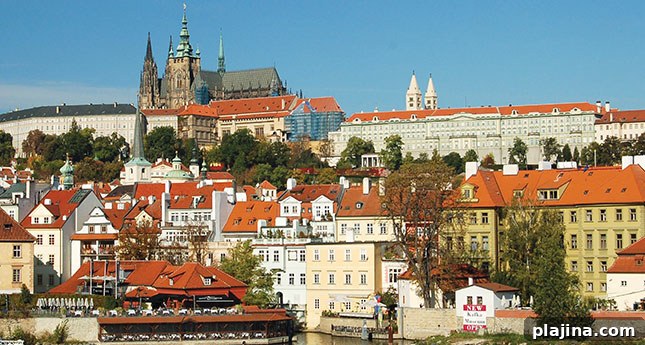
Mother of cities. Golden city. City of a hundred spires. Heart of Europe.
Prague wears many nicknames, each reflecting a different facet of its character. That variety—historic and modern woven together—gives the city its unique and lasting appeal.
The Czech Republic’s capital is simply stunning. Set among rolling hills and narrow lanes, and boasting an extraordinary range of architectural styles, Prague is one of Europe’s most visited destinations. Unlike many other European cities, Prague escaped widespread destruction during World War II, leaving an unusually complete historic fabric. Wandering its streets, you encounter intact monuments and neighborhoods that lend the city an atmosphere few places can match.
Prague’s history has been turbulent: uprisings, wars, fires and periods of occupation have all shaped the city. After World War I it became the capital of the new Czechoslovakia. Although it avoided total wartime devastation, Prague later fell under Soviet influence. In 1989 the Velvet Revolution, sparked by student demonstrations on November 17, brought an end to communist rule. When Czechoslovakia peacefully split in 1993, Prague became the capital of the independent Czech Republic.
Today Prague is a vibrant metropolis of roughly 1.2 million residents. The city’s historic buildings are not merely a stage set but part of a living urban core where contemporary life thrives alongside centuries-old landmarks. In recognition of its cultural importance, Prague was named a European City of Culture in 2000 and was added to the UNESCO World Heritage list in 1992.
Known in Czech as Praha, which loosely translates to “doorstep,” Prague has long stood at the crossroads of European trade routes. Its central location and position on the Vltava River make it a natural hub for business and travel. As the nation’s primary economic center, the city attracts a significant share of the country’s investment and hosts many companies’ European headquarters.
Historically Prague’s industries included food processing, textiles, printing and woodworking. Over time the city developed strong engineering and technological sectors—machine building, aircraft and diesel engines, electronics and chemicals are important parts of the local economy. Tourism is now a major driver as well; a substantial portion of national income depends on visitors, and Prague’s picturesque streets and historic sites have made it an attractive location for film productions.
Prague has long been a center for scholarship and research. The city is home to numerous universities, institutes and cultural institutions. The Astronomical Clock on Old Town Square is a celebrated example of Prague’s medieval ingenuity and remains a symbol of the city’s scientific and artistic heritage.
Exploring Prague on foot—meandering cobblestone alleys, browsing open-air markets or pausing in a café—reveals layers of history and an enduring charm. The city feels both timeless and forward-looking, honoring its past while embracing modern life.
As the many nicknames suggest, Prague is a multifaceted destination. One constant is clear: the city continues to flourish, balancing reverence for history with a confident eye toward the future.
Diversions
There is no shortage of sights and activities. Spend time in Old Town (Staré Město) and New Town (Nové Město) to appreciate Prague’s contrasting districts.
Dominating the skyline is Prague Castle (Hradčany), the country’s most visited attraction. The castle complex includes the imposing Cathedral of Saints Vitus, Wenceslas and Adalbert, palace gardens, the Black Tower and more. As the largest medieval castle complex in the world, it remains the official seat of the Czech president. Visitors can also observe the hourly changing of the guard at the main gates.
Nearby, Golden Lane offers a glimpse into castle life: a row of small historic houses once inhabited by servants, goldsmiths and other tradespeople. Franz Kafka lived and worked at house No. 22, and today the lane hosts boutiques and galleries that preserve its intimate atmosphere.
The Old Town Astronomical Clock on Staroměstské náměstí is a marvel of medieval craftsmanship. Operating every hour between 9 a.m. and 9 p.m., the clock presents a procession of the twelve apostles, accompanied by allegorical figures including a skeleton and a figure of Vanity. The mechanism displays multiple time systems, from Central European Time to Old Czech Time and astronomical measurements.
Charles Bridge (Karlův most) is lined with more than 20 baroque statues and offers spectacular views of the Vltava and the city’s skyline. Wenceslas Square, in New Town, was a focal point of the Velvet Revolution. The Jewish Quarter (Josefov) contains the Old-New Synagogue, the oldest active synagogue in central Europe, along with several other synagogues and the Jewish Museum, which documents the area’s long and complex history.
Info To Go
Václav Havel Airport Prague (formerly Ruzyne, PRG) is the city’s main airport. Traffic and narrow streets make driving less convenient—Prague’s efficient public transport network, including the metro, trams and funicular, is the recommended way to get around. Use licensed taxi companies to avoid overcharging. International and regional trains also provide convenient connections to other European cities.
Lodging
Alchymist Grand Hotel & Spa
A short walk from the Astronomical Clock and Old Town Square, this hotel occupies a quiet cobblestone lane and blends historic charm with modern comforts. Tržiště 19, tel 420 226 201 910
Corinthia Hotel Prague
Located on a hill at the city’s edge, the Corinthia offers sweeping views across Prague and convenient conference facilities. Kongresová 1, tel 420 261 191 111
Golden Well Hotel
Set at the foot of Prague Castle, the Golden Well provides upscale accommodations in the heart of the historic district. Zlatá Street, tel 420 257 011 213
Dining
Hergetova Cihelna
Overlooking Charles Bridge, this restaurant serves traditional Czech dishes reinterpreted with modern touches, along with international options. Cihelna 2b, tel 420 296 826 103
Mlýnec Restaurant
Chef Marek Purkart’s acclaimed restaurant offers refined Czech cuisine and has received notable culinary recognition. Novotného lávka 9, tel 420 277 000 777
Restaurant Bellevue
Renowned for its elegant dining and river views, Bellevue is a favorite for special occasions and contemporary Czech cuisine. Smetanovo nábř. 18, tel 420 222 221 443