
Namibia is a driver’s paradise — with a few caveats. Before you set out, ask yourself: can you handle a manual transmission? Are you comfortable driving on the left side of the road? Do you know how to manage gravel surfaces without losing control? And are you prepared to remain calm if you encounter an angry elephant?
If automatic is a must, book early. Rental fleets at Hosea Kutako International Airport in Windhoek carry a limited number of automatics; they go quickly. On my trip I hadn’t reserved ahead, so I took a gleaming white Toyota Corolla straight from the lot—though it didn’t stay gleaming for long.
The first real challenge comes at the junction onto the main road toward Windhoek: turn right, but keep left. Namibia’s left-side driving traces back to South African rule, which itself followed British custom. Remember, the country uses metric measurements too—speed limits are posted in kilometers per hour.
The Corolla handled paved roads comfortably. After leaving bustling Windhoek behind, traffic thinned and I settled into the posted limit of 120 kilometers per hour (about 75 mph). The open highway was easy going until I left the tarmac and headed north onto gravel.
Gravel can be treacherous for the uninitiated—slippery in a way that feels almost like ice, despite temperatures well over 100°F. I reduced my speed to a steady 80 kph (50 mph) and approached corners gently. Sudden braking or sharp turns can easily send a vehicle into a rollover, so smooth inputs are essential.
By the time I reached Okonjima, a private game reserve renowned for rescuing and rehabilitating African predators, the Corolla was coated in a film of red dust. After a welcome drink I climbed into an open Land Cruiser for a game drive. A gate ahead carried a blunt warning: “Beware! Dangerous Animals.” We drove through tall, dry grass until the guide stopped, climbed onto his seat and shouted.
Within moments cheetahs surrounded us. The guide produced a bucket of meat and tossed pieces to draw them close. One cheetah leapt onto the front of the vehicle, and we fed it by hand—an electrifying experience best shared from the passenger seat.
After two memorable nights at Okonjima I continued alone, driving about four hours to Etosha National Park, one of the world’s most remarkable wildlife reserves. The scenery shifts dramatically on approach: scrubby ranchland gives way to a bright, pale limestone plain that can make sunglasses essential to cut the glare.
Inside Etosha, cars rattle over corrugated dirt roads, kicking up plumes of white dust. The park’s arid climate helps wildlife viewing in two ways: animals are often visible from great distances, and they reliably gather at waterholes to drink—prime opportunities for observation and photography.
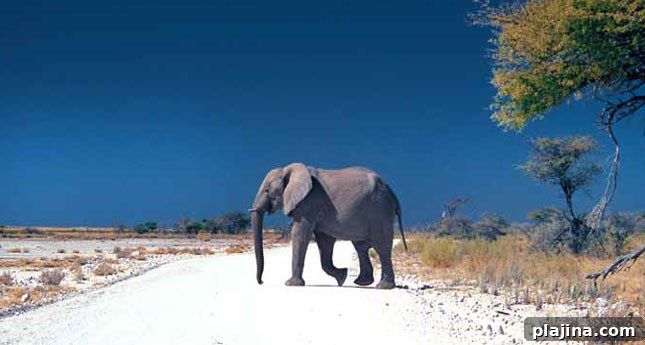
During three days of game drives I saw gemsbok, springbok, black rhinos, giraffes and lions. Yet it was the elephants that left the strongest impression. Etosha’s elephants are among the largest on Earth, and you only appreciate their scale when you compare them to a small rental car parked nearby.
Most elephants pass by calmly, but occasionally a matriarch or lone bull will flare its ears and wave its trunk in a clear show of irritation. In those moments, having the driving confidence to reverse quickly and create distance is one of the most valuable skills you can bring to Namibia’s roads.