
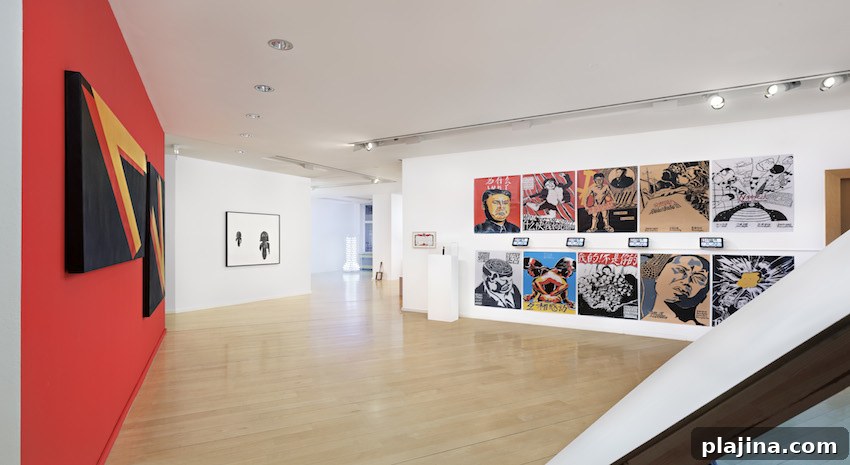
The Daimler Contemporary Berlin has opened the third and final installment of a series showcasing the visions of roughly 20 contemporary Chinese and international artists. Titled “Last Night’s Fortune Teller,” the exhibition presents a wide-ranging selection of abstract and conceptual works alongside pieces using new media, intentionally steering clear of tying the art to any single nation or cultural identity.
At the entrance, a grinning Humphrey Bogart sculpture by Belgian artist Guillaume Bijl sets a provocative tone. Bijl’s practice frequently examines how artistic forms intersect with everyday social realities, and this welcoming figure frames the exhibition’s exploration of image, perception and cultural context.
Also featured is Dayanita Singh’s “Go Away Closer,” a photographic sequence Singh describes as a novel without words. The work uses sequencing and photographic framing to build narrative and emotional resonance without relying on text, inviting viewers to engage through visual rhythm and association.
The show includes monochromatic photographs by Yang Fudong, whose images often probe memory and modern life, alongside subtle, geometric paintings by German artist Ulrich Erben. Sculptures by Monika Brandmeier add three-dimensional counterpoints, bringing varied textures and forms into dialogue with the two-dimensional works.
Additional contributors to “Last Night’s Fortune Teller” include Ding Yi, Zhang Ding, Simone Westerwinter and Bethan Huws, among others. Each artist contributes a distinct approach—ranging from minimal and meditative compositions to more overtly conceptual or media-driven pieces—yet the presentation as a whole emphasizes a shared interest in ambiguity, interpretation and the limits of cultural labeling.
Overall, the exhibition resists easy categorization. By assembling diverse practices that do not explicitly anchor themselves in a single cultural narrative, “Last Night’s Fortune Teller” encourages viewers to consider how meaning is shaped by form, context and individual perspective. The result is a thoughtfully curated final chapter to the series that highlights contemporary practices across borders while foregrounding the open-ended conversations art can provoke.