
Four days into our weeklong voyage around the Galápagos Islands, my brother and I set foot on Bartolomé Island. Sally Lightfoot crabs, their shells glinting like red gems, dotted the dark volcanic rock while turquoise water framed the shoreline in vivid contrast.
We followed a wooden boardwalk up to the island’s high point — 374 feet above sea level — and for a moment it felt as if we’d stepped onto another world. Reddish-orange soil stained by iron told the story of past eruptions, and jagged lava paths cut through the terrain. From the summit Pinnacle Rock loomed, pockmarked and leaning toward the sea as though pulled by some unseen force.
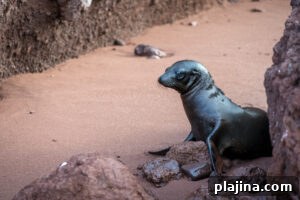
Sea lion on Rabida Island © Seth Singer
An hour later we slid into wetsuits, grateful for the cool relief, and snorkeled along the shallow reef. Galápagos sharks, pufferfish, sea cucumbers and manta rays appeared in quick succession, alongside species with evocative names such as hieroglyphic fish and chocolate chip starfish.
Wildlife viewing here feels effortless. A casual glance toward the water can reveal sea turtles, the fin of a sunfish, or a penguin sunning itself. Black marine iguanas cluster by the thousands, leaving narrow pathways for people. Sea lions lounge under the dock at Baltra Island, one of the main boarding points for multiday boat trips.
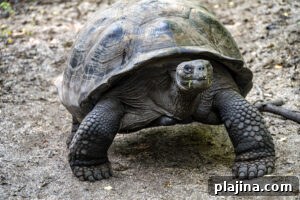
Giant tortoise © Seth Singer
Yet many residents require a keen eye. Our guide, Soto, spotted an octopus’s tentacles as we swam. It shifted colors — purple to blue to pink — as it crawled along coral, blending and transforming with uncanny grace.
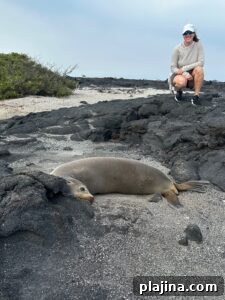
Sea lion at Urbina Bay © Seth Singer
This extraordinary biodiversity drew us to the Galápagos — a cluster of about 20 major islands off Ecuador’s west coast. The archipelago hosts one of the highest proportions of endemic species on Earth, plants and animals found nowhere else. Much of it was designated a national park in 1959 and later a marine reserve in 1998. We hoped to see giant tortoises, fur seals, Galápagos penguins and the iconic blue-footed boobies. To our delight, many of those encounters happened quickly and repeatedly.
Most trips to the islands start on the mainland. Quito, Ecuador’s high-altitude capital at roughly 9,300 feet, served as our cultural and culinary primer. The city’s historic center is a UNESCO World Heritage site, where cobblestone streets wind past well-preserved Baroque, neo-Gothic and pre-Columbian architecture. Vendors sit in doorways selling potatoes, garlic and citrus like naranjilla. We took a short taxi ride to the Middle of the World monument to stand with one foot in each hemisphere.
Still, the Galápagos felt like the true center of our trip.
A short flight, followed by a bus and panga (dinghy), brought us to our home for eight days: Quasar Expeditions’ Evolution yacht. While some travelers stay on the main islands and join day trips, living aboard a vessel felt like the most complete way to experience the archipelago.
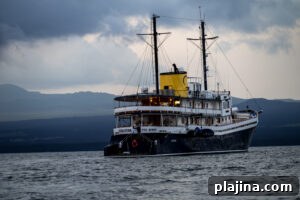
Evolution yacht © Seth Singer
The yacht hosted up to 32 guests, which allowed ample time with three naturalist guides. Each guide was a walking encyclopedia, explaining behavior and biology with clarity. We learned why marine iguanas on Fernandina Island sport spines and stout, turtle-like heads: they warm up after cooling off while foraging, because they can’t regulate body temperature internally. The guides also taught us how to distinguish fur seals from sea lions — fur seals are smaller and have denser coats that darken when wet; sea lions are larger and more playful. One group even nipped at a fellow passenger’s shoes during a panga ride, a mischievous reminder of their curiosity.
What makes the Galápagos unforgettable is the frequency and intimacy of encounters. One afternoon you sift red sand while flamingos lift into the sky; another, you stand a few feet from a lumbering giant tortoise grazing in the grass.
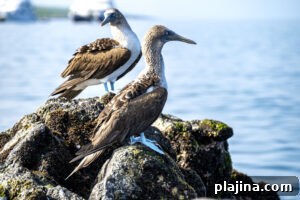
Blue-footed boobies © Seth Singer
Many moments felt private and rare. One evening my brother and I stood side by side on the yacht’s bow as Fernandina Volcano erupted, sending red sparks into the black sky — an intimate fireworks display just for our group.
LODGING
FINCH BAY GALAPAGOS HOTEL
Six contemporary suites with soaking tubs and spacious balconies recently opened at Santa Cruz Island’s only beachfront hotel. The property includes a spa and a 20-person yacht for archipelago excursions.
Barrio Punta Estrada, Puerto Ayora, Santa Cruz Island, Galápagos
$$$$$
MONTEMAR ECO LUXURY VILLAS
A sustainable lodge on Santa Cruz where giant tortoises roam freely. Founded by naturalist guides, it features a farm and just two luxury villas for a hyperlocal, private stay.
Km. 13.7 via Baltra, El Carmen, Santa Cruz Island, Galápagos
$$$$$
ROYAL PALM GALAPAGOS, CURIO COLLECTION HOTEL BY HILTON
Set in the Miconia Highland Forests of Santa Cruz, the estate offers 21 hacienda-style accommodations, an infinity pool and an underground restaurant built into a lava tunnel.
Km. 18 Via Puerto Ayora, Santa Cruz Island, Galápagos
$$$$
DINING
ALMAR
Waterfront dining with fresh seafood, including ceviche and whole grilled fish prepared using traditional recipes and local ingredients.
Charles Darwin Avenue and Marchena Street, Puerto Ayora, Santa Cruz Island, Galápagos
$$$
LA CASA DEL ASADO DE ANÍBAL GARCÍA
A local favorite on Isabela Island, this open-air grill offers communal seating and grilled meats and seafood. Order lobster when it’s in season.
77 Puerto Villamel, Isabela Island, Galápagos
$$$
FINCH BAY GALAPAGOS RESTAURANT
Chef Andrés Orlando elevates Ecuadorian and Galápagueño cuisine with international touches, often featuring vegetables from the hotel’s garden.
Barrio Punta Estrada, Puerto Ayora, Santa Cruz Island, Galápagos
$$$$
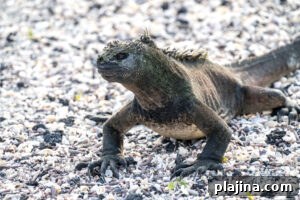
Marine iguana © Seth Singer
INFO TO GO
The Galápagos enforce strict entry rules to protect the ecosystem, including a Galápagos National Park entrance fee paid on arrival (currently $200 for international adult visitors and $100 for children under 12). Regular flights operate from mainland Ecuador — Quito (UIO) and Guayaquil (GYE) — to Baltra (Seymour Ecological Airport) and San Cristóbal Island Airport.