
Lively strains of salsa and marimba music, the rhythmic pat-pat-pat of hands shaping tortillas, and the soft voices of Mayan women urging you to buy bright woven huipils turn every market into a vivid kaleidoscope — this is Antigua, Guatemala’s former colonial capital.
Once considered one of Latin America’s most beautiful cities, Antigua was devastated by an earthquake in 1773. Today its cathedral, with a tumble of broken columns lying in a roofless nave, Baroque convents and elegant 17th-century buildings present a striking mix of romantic ruins and carefully restored colonial architecture.
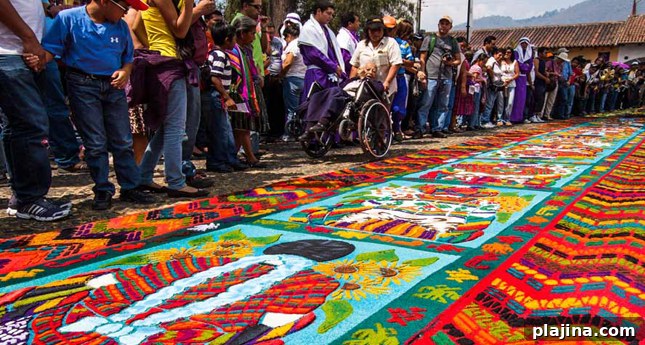
For one week each spring, however, the city takes on a new dimension: a calm, reverent hush overlays its usual lively buzz as residents observe Semana Santa, Holy Week. Predominantly Catholic Guatemalans decorate the streets with intricate, temporary carpets made from brightly colored sawdust and live flowers, transforming paved roads into vibrant works of art.
Over these ephemeral carpets, robed men carry heavy religious platforms and statues of Christ in a penitential act for the year’s transgressions. The processions are both beautiful and deeply moving — a public expression of faith in which participants retrace the Via Dolorosa, the path to Calvary, and look toward renewal with Easter.
These alfombras, brilliant floral carpets that pave the route of each procession, are a tradition dating back to colonial times. Like many Guatemalan religious customs, they blend Spanish Catholic and indigenous Mayan influences. The streets are first prepared with a bed of pine needles, and temporary wooden frames mark the edges. Intricate border patterns, reminiscent of Persian rugs, are laid in fine dyed sawdust, while fresh blossoms and more sawdust create vibrant tropical birds, flowers and Mayan motifs in the center panels. Once common across the Spanish world, this custom now survives in only a few places.
Processions begin at noon on Palm Sunday, when purple-robed cucuruchos shoulder monumental platforms carrying images such as Jesús Nazareno and carry them through carpeted streets into the night. Throughout the week, slow-marching brass bands, horses and images from local churches form a continuous flow of observance, often accompanied by the fragrant smoke of burning copal.
On Holy Thursday, several processions wind their way along flower-covered routes; some statues are carried by women. The most solemn events take place on Good Friday, beginning before dawn and intensifying at midday with services at the cathedral followed by long processions into the night. Throughout the week, volunteers continually refurbish the carpets while parishioners keep vigils at outdoor altars, and decorated sidewalks in front of churches serve as small neighborhood shrines.
The scent of fresh blossoms mingled with incense fills the air, and night processions take on a particularly atmospheric quality as torchlight and candles illuminate the floats and the alfombras. Then, on Easter Sunday morning, the tone shifts from mourning to celebration: the robed penitents give way to joyous crowds in their Sunday best, and parades featuring the resurrected Christ move through Antigua to lively music, color and communal rejoicing.
Visiting Antigua during Holy Week offers a rare chance to witness a living cultural and religious tradition that fuses history, artistry and devotion. The temporary carpets and processions are reminders of the city’s layered past and of the powerful, ongoing importance of faith and community in Guatemalan life.