
Every city hides layers beneath its streets: networks that carry utilities, passages built for transportation, storage, shopping, shelter, burial and even living. These underground realms can be natural or engineered, public or forbidden, yet most people walk above them unaware.
That’s certainly the case in Vienna, where many visitors miss a petal-shaped metal cover set into the cobbles of Girardi Park, a tiny green island at a busy junction. Fans of the 1949 film The Third Man will recognize that cover: it opens onto spiral steps descending into Vienna’s sewer system. On The Third Man Tour — offered Thursdays through Sundays at 3 p.m. from May to October — guides lift the cover and lead visitors down into the tunnels.
The film’s dramatic chase was shot in this short stretch of Vienna’s roughly 1,550-mile sewer network. Down in the arched brickwork, the city above recedes. You might expect an overwhelming odor, but the smell is milder than imagined; on weekends, when many locals do laundry, soap suds can even disguise the harsher scents.
In Paris, not far from the Eiffel Tower, an entire museum is devoted to the sewer system. The Musée des Égouts de Paris includes around a third of a mile of tunnels. Part of the route is dry, with exhibits explaining the system’s history and mechanics; another section is wet, where walkways allow visitors to view flowing sewers (the wet route closes when water levels rise).

© BUKKI88 | DREAMSTIME
Further south, beneath Montparnasse, lies one of the world’s most chilling subterranean sites: the Catacombs of Paris. The stone used to build the city was quarried here, leaving vast man-made caverns five stories below ground. In the late 18th century these spaces were repurposed as ossuaries; over time the remains of more than six million people were relocated here.
The Catacombs are a popular attraction, and advance reservations are recommended. Visitors descend 131 steps to an entrance marked “Arrête! C’est ici l’empire de la mort” (“Stop! This is the empire of the dead”). Along the one-mile route bones and skulls are stacked into walls and chambers, creating an eerie, humid environment that is not for the faint-hearted. Yet few sites immerse you so completely in history; the underground voids have also influenced the city above, limiting the height of buildings directly overhead because the hollow ground cannot safely support taller structures.
Rome offers another vast historical underworld. The city’s bedrock contains tunnels and crypts, many more than 2,000 years old. The Domitilla Catacombs span more than ten miles, sheltering the remains of around 150,000 people and preserving an ancient underground Christian basilica. The Catacombs of Callixtus contain the Crypt of the Popes; so many pontiffs were buried there that the site earned the nickname “Little Vatican.”
Subterranean spaces are often wrapped in myth. In Rome it is commonly said that Christians used the catacombs because they were barred from burial and worship within the city walls, but many historians argue the primary motive was the expense of surface land rather than persecution.
Modern legends surround other tunnels. Beneath Portland, Oregon, a network of linked passages and basements is popularly called the Shanghai Tunnels. A small portion is shown on guided tours. Tales claim the tunnels were used to smuggle goods and to kidnap — or “shanghai” — men for service on ships at the nearby port. The more likely explanation is prosaic: the passages moved goods between riverfront warehouses and downtown businesses without using busy streets.
In Moose Jaw, Canada, stories of tunnels offering refuge for Chinese immigrants, storing liquor for Al Capone during Prohibition, or later serving as a Cold War bunker have endured for decades. The Tunnels of Moose Jaw attraction stages theatrical, interactive tours that dramatize these episodes. Historians debate the scale and accuracy of the tales, and many regard an extensive underground network under Moose Jaw as an urban myth. Still, the tours entertain and provide an immersive glimpse into North American life across three distinct eras.
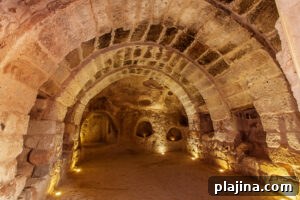
PHOTO:
© IGOR STRAMYK
| DREAMSTIME
In Türkiye the existence of entire underground cities is well established, though questions remain about their precise ages and builders. For many years Derinkuyu in Cappadocia was considered the largest known complex. Carved from volcanic tuff, its tunnels and chambers descend up to 18 levels and may have been first excavated by the Phrygians more than 3,000 years ago. At its peak it could shelter thousands of people. Recent research points to as many as 200 interconnected underground settlements across the region, likely designed to protect communities from invaders.
In modern urban life, subterranean spaces also serve practical needs such as weather protection. Toronto’s PATH is a 19-mile network of tunnels linking 70 buildings and more than 1,200 shops; it is widely regarded as the world’s largest underground shopping complex and offers shelter from winter cold. Similar underground malls and pedestrian networks exist in Houston, Oklahoma City, Philadelphia, central Seoul, many Japanese cities, and numerous Chinese cities, providing relief from extreme temperatures, traffic and pollution.
Some subterranean schemes have declined. Dallas once planned an extensive Pedestrian Network beneath downtown in 1969. Over time section closures and private ownership blocking access reduced the system’s usefulness, and today most locals and visitors are unaware it exists.
© MEHMET CETIN | DREAMSTIME
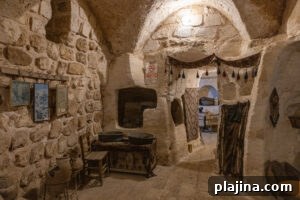
Sometimes long-forgotten underground cities reemerge by accident. In 2020, construction workers in Midyat, southeastern Türkiye, broke into an ancient tunnel complex that proved to be Matiate. Only around three percent has been excavated, but initial findings suggest it was inhabited for roughly two millennia and may have sheltered as many as 70,000 people, with underground churches and a synagogue. If estimates hold, Matiate could be the largest underground city ever found. Our knowledge of subterranean history remains limited — when it comes to what lies below, we have barely scratched the surface.