
Twelve thousand feet above the New Zealand countryside, I watched my friend Ashleigh disappear out the rear door of a small plane. My stomach flipped, and I fumbled with the metal bolts that fastened my harness to the instructor’s until he gave a calm nod.
“Our turn,” he said, edging us toward the opening.
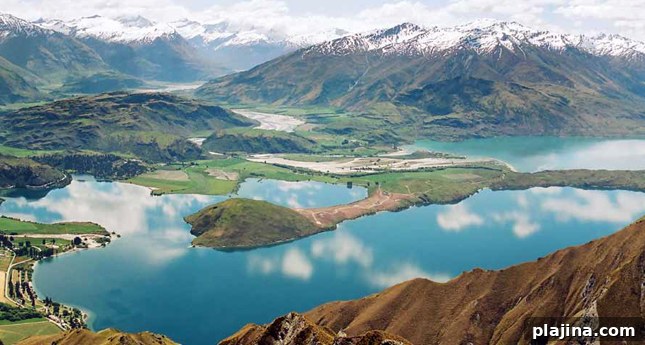
Moments later we were in free fall. The panic dissolved as Lake Wanaka glittered below and the glacier-rimmed peaks of the Southern Alps unfurled across the horizon.
Ashleigh and I had driven to Lake Wanaka from Christchurch, arriving at the airfield in our rented station wagon about 20 minutes earlier. After a short safety video we climbed aboard. Our goal was to pack as many bucket-list experiences as possible into a five-day loop around New Zealand’s South Island, beginning and ending in Christchurch.
Though Christchurch has a British feel and is often described as New Zealand’s most conservative city, it’s ideally located for adventure. Within a few hours of the city you can skydive, bungee jump, ice climb, tube through caves and swim with dolphins. The city itself enjoys mild, sunny weather, large parks and gardens, and a lively arts scene—qualities that helped Christchurch recover after the 2011 earthquake that claimed 185 lives and damaged much of the urban core.
The Chalice sculpture in downtown Christchurch © Pierre Jean Durieu | Dreamstime.com
We recovered from a red-eye from Sydney with a late start and a hearty brunch, then set out to explore Christchurch’s compact downtown on a warm February morning. Cathedral Square remains the city’s heart; the original Gothic Revival cathedral was heavily damaged in the quake, but architect Shigeru Ban designed a temporary Cardboard Cathedral made from cardboard tubes that seats 700 and sits a few blocks away.
A short walk in another direction leads to the Botanic Gardens, shaded by enormous, ancient-looking trees and alive with late-summer roses. With about one-eighth of its land devoted to parks and reserves, Christchurch lives up to its nickname as a Garden City, reflecting a long English tradition of green public spaces.
The next day we picked up our rental car from a friendly local family who had equipped it with a tent, sleeping bags, a camping stove and a cooler. Our first destination outside the city was Mount Cook National Park—known to the Māori as Aoraki—a realm of the country’s tallest peaks and vast glaciers. Mount Cook itself rises to 12,316 feet; its Māori name is often translated as “cloud piercer.”
Driving on the left felt odd at first, but traffic quickly thinned after leaving Christchurch. Aside from the occasional RV and a few sheep, the two-lane highway was empty enough to allow roadside stops for photos, a picnic, and a refreshing swim in the aquamarine waters of Lake Tekapo.
The drive from Christchurch to Mount Cook National Park covers roughly 200 miles. After several leisurely stops we reached the park late in the afternoon beneath dark, brooding clouds. Mount Cook has long drawn climbers—among them Sir Edmund Hillary—and with limited time we chose an hourlong hike to Kea Point. From there the panorama of green-and-black mountain faces braided with waterfalls was unforgettable.
We woke to cold mist at the campground and hurried east to make our skydiving appointment at Lake Wanaka. Wanaka lies about two hours southwest of Mount Cook and has a more relaxed pace than neighboring Queenstown, while still serving as a hub for outdoor thrills set against glacier-capped peaks and clear lakes. Back on solid ground, we pushed on toward Mount Aspiring National Park on the island’s west side.
Leaving Wanaka the road climbed and rolling farmland gave way to lush rainforest. Short downpours left behind rainbows that arced between peaks. Mount Aspiring, at close to a million acres, is New Zealand’s third-largest national park; the highway skirts its edges as we followed the surging Haast River north toward Fox Glacier.
Helicopter on Fox Glacier © Harlz | Dreamstime.com
Fox Glacier, within Westland National Park on the west side of Mount Cook, and nearby Franz Josef Glacier are unique: two of the world’s few glaciers that descend to within about 1,000 feet of sea level. Although both have retreated over the past century, Fox Glacier still reaches just over seven miles from the coast through temperate rainforest. Its terminal face is a short walk from Fox Glacier Village, making it one of the most accessible glaciers for helicopter tours, guided ice treks and ice climbing.
Weather here can change quickly. We woke to steady rain the morning we had booked an ice-climbing lesson; other participants canceled, but the guide said we could still go. Layered in waterproof parkas, helmets and crampons, we followed him to the glacier mouth.
Overcast light enhanced the glacier’s colors—glowing aquamarine beneath a surface of moraine and dust—and we peered into dark crevasses the guide warned us to avoid alone. After a brief lesson on axes and crampon techniques, a top rope was rigged and we began climbing. Each swing of the ice axe and step forward felt deliberate and slow, but the experience of ascending blue ice was exhilarating.
Sore but satisfied, we continued north along the coast to Hokitika, where we stretched out on a windy beach and dozed among the driftwood. In the afternoon we turned inland on Highway 73 through Arthur’s Pass, the island’s first national park. The historic route, once built to reach west-coast gold fields, threads through dense rainforest before opening into beech forest and alpine meadows.
To complete our loop we drove past Christchurch to the peninsula that juts into the Pacific east of the city. The harbor town of Akaroa, formed in a collapsed volcanic crater, is filled with historic houses, sunny cafés and the chance to see Hector’s dolphins, a rare species found only in New Zealand waters.
Hoping to swim with dolphins, we donned thick wetsuits and boarded a tour boat to search the harbor. After an hour of scanning the water, we finally sighted a rounded, gray dorsal fin. Tourists scrambled and plunged into the chilly sea, though the quick-moving dolphin slipped away before long.
Pleased with piping-hot fish and chips and a partial refund for the short dolphin encounter, we headed back to Christchurch to return the station wagon and catch our flight home. We arrived as the sun set, the final light splashing the western peaks in pink and gold—a perfect final frame for a short but packed South Island adventure.
Christchurch Info to Go
Christchurch International Airport lies about six miles northwest of Cathedral Square; shuttle buses and taxis connect the airport and city center in roughly 20 minutes. Limited rail service runs from Christchurch to Greymouth and Picton. InterCity buses cover many major South Island routes and sights, but renting a car remains the most convenient way to explore—just remember New Zealand drives on the left.