
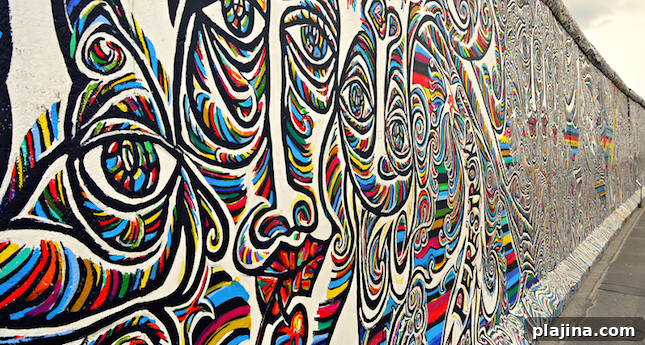
Twenty-five years after the fall of the Berlin Wall, several original sections of the once-imposing barrier have been preserved by collector Elmer Prost. For decades Prost stored these concrete segments in a former cement factory in Teltow, a small town just south of Berlin. The slabs are tangible pieces of history, bearing the weight of decades of division and the memory of both oppression and liberation.
Recently the cement factory closed, and Prost decided to offer the preserved wall sections to artists and institutions who want to create new public works while keeping the fragments intact. Each slab measures roughly 4 feet by 12 feet and weighs about three tons. They are available for purchase at a price of €500 per segment, but the program includes specific conditions intended to encourage creative reuse and responsible stewardship.
Under the terms, artists who acquire a slab have six months to paint or otherwise decorate their piece. After that period, they must either sell the finished work on a profit-share basis or relocate the entire slab to a new site. The buyer, artist or institution that takes ownership is responsible for all moving and transport costs. Because each slab is heavy and bulky, logistics and storage must be planned carefully.
Street artist Thierry Noir, who became well known for his brightly colored murals on sections of the Berlin Wall in the 1980s, has already secured five of the preserved slabs. His involvement underscores the cultural significance of the initiative: these fragments are both historical artifacts and living canvases. Museums, schools and cultural organizations from various countries have expressed interest in acquiring pieces for exhibitions, educational projects and public installations.
The project aims to strike a balance between memorial preservation and contemporary expression. By inviting artists to work directly on authentic wall sections, the program creates opportunities to reinterpret a charged symbol and foster dialogue about history, division and reconciliation. At the same time, the rules ensure that the heavy concrete slabs are cared for responsibly and remain accessible to the public in new contexts.
Information about how to participate is managed through the project website, which contains details about purchasing, painting deadlines and logistical requirements for moving the slabs. The site is currently available in German, so interested parties who do not speak the language may need assistance translating the instructions and contractual terms before committing to a purchase.
Prospective buyers should consider several practical factors before acquiring a slab: the cost and arrangement of heavy transport, suitable display or storage space that can safely support a three-ton concrete element, local permits that may be required for public installations, and the financial implications of the required profit-sharing or resale. For institutions and artists committed to preserving the historical character of the Berlin Wall while creating new artistic statements, these original sections offer a rare and powerful opportunity.
By preserving these wall fragments and making them available to artists and organizations, the initiative keeps a meaningful piece of recent history in circulation. The slabs can function as educational tools, memorials or public art, helping new audiences engage with the story of Berlin’s division and reunification through both original material and contemporary artistic interpretation.