
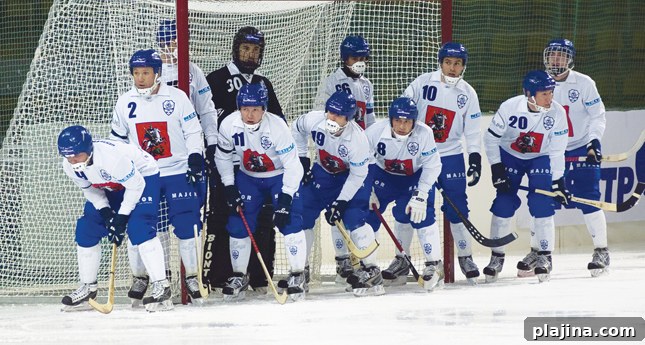
It took me twenty-five years to link a single word to a few minutes I spent beside a frozen lake in Moscow on a gray winter afternoon during the Cold War.
The word is “bandy.” If you ask me to define it, my first instinct is to say “bow-legged.” That, however, has no connection to my Moscow memory. Pushed further, I recall, from three years working with reptiles at a zoo, the Latin name Vermicella annulata — a venomous black-and-white Australian snake commonly called the bandy-bandy. A Russian winter is hardly the place for a bandy-bandy.
There is also a verb, to bandy: “to exchange words in a heated or hostile manner.” On that cold, misty afternoon in the Soviet capital I kept my mouth shut and did not bandy words with the group of Red Army soldiers standing before me, bundled in heavy coats and fur hats.
The soldiers were watching a game, and I watched with them. Only now, a quarter-century later, can I resolve the slow-burning mystery of what I witnessed on that freezing afternoon behind the Iron Curtain. The answer appears in my dictionary: “an early form of hockey, often played on ice.”
I lingered unobtrusively behind the soldiers on a snowy bank. Below us lay the largest improvised ice rink I had ever seen. Marked with red lines, it matched the dimensions of a soccer field.
Two opposing teams of eleven players each skated and chased the play in something that resembled ice hockey. But curious differences soon became apparent. The playing surface was about twice the size of a standard ice-hockey rink. There were too many skaters for ice hockey, where teams have just six players on the ice. And instead of a puck, the players used their sticks to propel an orange ball.
Bandy’s history stretches back more than a thousand years. In medieval Russia, monks on frozen rivers played a game using simple skates, sticks and a ball. A similar pastime developed in the flat fenlands of eastern England.
In the 19th century English version of bandy evolved alongside soccer and the sport is still often called “winter soccer.” Standing on that windswept bank, I recognized familiar elements: the play moved broadly and fluidly from end to end, and players constantly sought space to receive the ball.
The goalkeepers at each end carried no sticks. As attacks came their way they shuffled side to side, ready to dive and parry the ball with pad-protected bodies or gloved hands.
Milder winters contributed to bandy’s decline in England, but the Federation of International Bandy adopted the English code in the 1950s. The game, as I saw it all those years ago, is open and easy to follow. Its simplicity — only eighteen formal rules — combined with the expansive field, encourages a style of play largely free of heavy body contact and frequent disputes.
To my mind, the main obstacle preventing bandy from winning a broader audience beyond its strongholds in Russia and Scandinavia is the unfortunate name. There is no natural link between the five letters of the word and the exciting, fast-moving sport they describe.
I consult the dictionary one more time, hoping for a clearer sense of the term. The fifth definition reads: “bandy: to give and receive blows.” That, I think, is not bandy at all — that is ice hockey.