
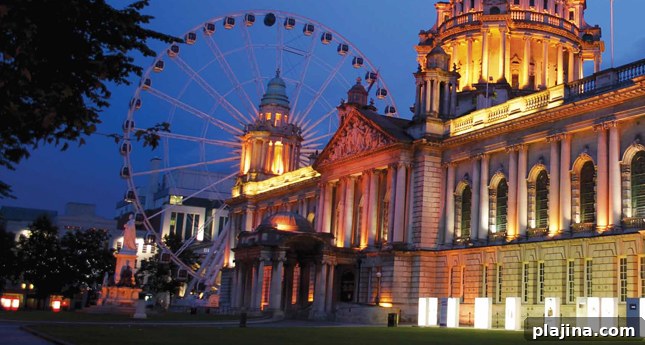
Taking the theme song literally — the Titanic’s heart “will go on and on” — the city that built the famous liner is honoring the Titanic’s past and preparing to mark the April 14th centennial of the ill-fated voyage. Plans include exhibitions, tours, events and themed meals designed for all ages. Combined with Belfast’s rich collection of historic attractions, the city is positioning itself as an ideal family destination.
Founded in 1613 on the muddy shores of the lough at the mouth of the River Lagan, Belfast grew into one of Europe’s leading industrial centers. Linen, tobacco and rope manufacturing were significant industries, and by the early 1900s the city hosted the largest and most productive shipyard in the world.
The wealth of that era is visible in Belfast’s exuberant Victorian architecture. Merchants and civic leaders left a legacy of ornate buildings, from the ornate “wedding cake” City Hall to the quirky Albert Memorial Clock, which leans noticeably on its reclaimed foundation (locals joke that Prince Albert has both the time and the inclination).
When she set out on her maiden voyage, the Titanic was the largest, heaviest, most costly and most luxurious moving object ever built. The city’s pride was cut short when news of the iceberg disaster arrived and men wept openly. After World War I Belfast entered a period of decline, and later endured the sectarian conflict known as “the Troubles” from the 1970s through the 1990s. Now the city is in resurgence. With a strong retail sector, significant technology and financial company presence, low unemployment and a young population—almost half under 30—Belfast ranks among the fastest-growing regional economies in the United Kingdom.
Two massive yellow shipyard cranes, nicknamed Samson and Goliath, still dominate the skyline and recall the city’s shipbuilding heritage when Harland and Wolff led the world. Home to the world’s largest dry dock, Belfast blends historic redbrick sites such as the Victorian St. George’s Market with modern developments like the multistory Victoria Square shopping complex.
Driving much of the city’s renewal is the Titanic Quarter, where the former shipyards are being redeveloped. More than $7 billion is being invested to create riverside offices, industry and housing, turning derelict docks into an active waterfront quarter.
Central to that revitalization are authentic Titanic sites restored for visitors. At the head of the original slipways where the liner was built, Titanic Belfast is a striking multimedia museum. Its exterior evokes the ship’s prow, and inside visitors move through immersive galleries that begin with life in 1900s Belfast and follow the ship’s construction, outfitting and launch. Artifacts and replicas of the liner’s fittings and furnishings are on display, and the experience ends with a dramatic recreation of the wreck projected beneath visitors’ feet.
Nearby at the Ulster Folk & Transport Museum, “TITANICa: The Exhibition” features artifacts recovered from the seabed—items such as a faux-ivory hand mirror, a third-class soup plate and a Café Parisien demitasse cup. The museum offers a Kids Trail that guides children through portholes, riveters and other hands-on displays in the museum’s preserved Ballycultra Town of historic buildings.
Beyond museum visits, guided walks and transport-based excursions take visitors to nostalgic shipyard landmarks. The SS Nomadic, the tender that ferried Cherbourg passengers to the liner, is being restored and is viewable so visitors can step onto a real deck where Titanic passengers once embarked.
Smaller exhibits at the Dock & Pump-House tell the story of the ship’s construction through the eyes of an apprentice. Food-focused experiences let visitors sample local specialties: a guided gourmet tour treats guests to tastes in shops and cafés around the city; a floating barge restaurant serves dinner in a galley-style dining room among maritime displays; and out along the lough, Rayanne House country inn offers the Titanic Menu, a recreation of the multicourse last dinner served to first-class passengers.
Yet Titanic is only one facet of what Belfast offers. In the history-rich St. Anne’s Quarter by the Cathedral, the World War II Exhibition shares moving accounts of Belfast’s wartime role. The area’s lively arts scene and traditional pubs—such as the Spaniard, Deer’s Head, Morning Star, Duke of York and John Hewitt’s—invite relaxed exploration.
Near Queen’s University the neighborhood hums with students browsing bookstores, coffee shops and trendy boutiques. The Botanic Garden and its notable Palm House sit beside the Ulster Museum, where visitors can see European paintings, prehistoric artifacts, Armada relics and works by Irish painters, glassmakers, ceramists and silversmiths.
Downtown, the modern Odyssey Complex includes a large Arena hosting concerts, shows and ice-skating, plus the 5W (Whowhatwhenwherewhy) interactive science center that’s popular with children. Families can also visit Belfast Zoo or take a farm experience at Streamvale, a family-run open farm.
Tours of West Belfast along Falls and Shankill roads offer on-the-ground history lessons about the Troubles; Black Taxi Tours point out powerful murals that depict local heroes and martyrs and stop at the Peace Line where visitors can leave messages of goodwill.
Sport is an important part of local life: Belfast supports more than 20 hurling and Gaelic football clubs, and attending an Irish football match gives insight into a fan culture that obsesses the city. Ice hockey is also popular, with the Belfast Giants drawing crowds to Odyssey Arena.
The Titanic 100 Festival began last March, and 2012 programming includes lectures, the opening of Titanic Belfast, a stage production of Titanic the Musical and requiem and commemoration services for the April anniversary. In the months surrounding the centennial, Belfast will also host festivals devoted to film, chamber music and street buskers, in addition to the World Irish Dancing Championships and the Annual Belfast Spring Fair. Whether following the Titanic trail or simply touring a historic city, families will find that Belfast’s attractions indeed go on and on.
Info To GoMost flights from the United Kingdom land at George Best Belfast City Airport (BHD) on the city’s edge, while many international arrivals use Belfast International Airport (BFS) in Aldergrove, roughly a 30-minute drive from the center. Regular bus service connects the airport and city (one-way fares vary). Only licensed taxis operate from the ranks; fares into town are higher than local buses, and a taxi-share scheme is sometimes available. The Belfast Welcome Centre, a short walk from City Hall on Donegall Place, provides maps, information and local apps for mobile devices. |
LodgingHilton Belfast Hotel: Contemporary glass high-rise between the train station and Waterfront Hall with Lagan River views. Family amenities include cribs, high chairs and children’s menus. 4 Lanyon Place. $$$ Hilton Templepatrick Hotel & Country Club: Set on the Castle Upton estate, the property offers a pond, golf course and spa. Children often stay free with parents. $$$ Radisson Blu Hotel, Belfast: Located in the Gasworks area within easy walking distance of the city center, offering modern rooms, fitness facilities and on-site parking. $$$ |
DiningMetro Brasserie: A relaxed brasserie popular with a youthful, sophisticated crowd, serving dishes such as cod and chips, baked chicken and lively desserts. $$ Mourne Seafood Bar: Known for fresh oysters, mussels and seafood platters at reasonable prices; family-friendly and often busy. $$ Nicks Warehouse: The chef’s converted warehouse offers contemporary takes on classic dishes and remains a local favorite. $$ |