
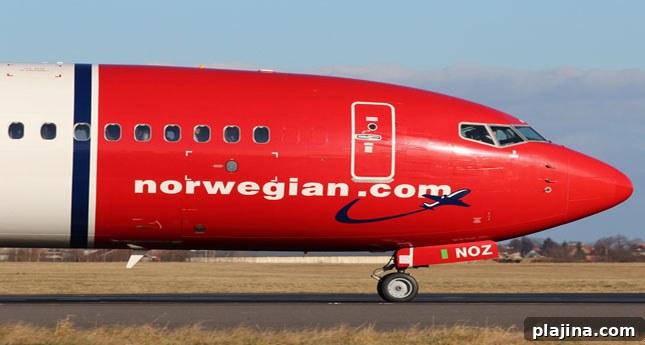
Norwegian was the first European airline to provide complimentary WiFi across all European routes, and this month the carrier marks the fifth anniversary of that service. Since introducing free in-flight internet, more than 19 million passengers have connected, and Norwegian recently reviewed passenger behavior to understand how travelers use WiFi while flying.
The analysis revealed that a large share of travelers go online almost immediately after takeoff. About 28 percent of passengers log into a social media account within five minutes of boarding, and a smaller segment—around 3 percent—say that being unable to access social media would significantly diminish their flight experience. Among nationality groups, passengers on American Airlines and British Airways flights are most likely to post about their journey: roughly 40 percent of American travelers and about 20 percent of British travelers share updates while in the air. The most common types of travel-related posts are in-flight selfies and photos of the airplane wing, particularly popular with passengers aged 18 to 25.
Connection behavior also varies by country. German, Swedish and Danish passengers tend to be the quickest to connect to onboard WiFi, often logging on shortly after the aircraft reaches cruising altitude. By contrast, passengers from the United Kingdom, Spain and the United States generally wait longer before using the connection. This difference in behavior may reflect traveler preferences; approximately 10 percent of passengers use flight time intentionally to step away from their digital devices and enjoy a break from online activity.
Beyond social media, passengers use in-flight WiFi for a variety of purposes that reflect modern travel needs. Many travelers check email, catch up on work, or stream entertainment during longer flights. Some use the connection to coordinate arrival plans, message family and friends, or access news and weather updates for their destination. The availability of reliable, free internet has changed expectations: passengers increasingly treat connectivity as a standard amenity rather than a premium add-on.
Providing complimentary WiFi on all European routes supports a smoother travel experience and helps passengers stay productive and connected. For families and business travelers alike, onboard internet enables remote work, school activities, and communication without incurring extra costs. For younger passengers and social media users, it offers an immediate way to share travel moments in real time. For those who prefer to disconnect, the option remains to power down and enjoy the flight without digital interruptions.
As airlines continue to invest in cabin connectivity, usage patterns will likely evolve. Passenger priorities—whether instant social sharing, entertainment streaming, or work-related tasks—shape how inflight WiFi is designed and delivered. Collecting anonymized usage data helps carriers tailor bandwidth, content offerings and network upgrades to meet passenger needs while balancing the technical limits of airborne networks.
Norwegian’s five-year milestone highlights how free onboard WiFi has moved from a novelty to a near-standard expectation for many travelers. By observing how millions of passengers connect and engage during flights, airlines can better understand traveler behavior and improve inflight services. Whether passengers log on within minutes or use the time to unplug, in-flight connectivity now plays a clear role in modern air travel.