Most boys fall in love twice before their teens: once with an unattainable person — a movie star, singer, or perhaps a teacher — and once with an unattainable car. Both infatuations are usually unrequited.
My unattainable person was the “blonde girl from ABBA.” Pronouncing her name didn’t matter. A poster of her was the last thing I saw at night and the first thing I saw in the morning. That passion faded. She is now more gray than blonde, and the skintight jumpsuit that seemed so thrilling 35 years ago no longer holds the same appeal.
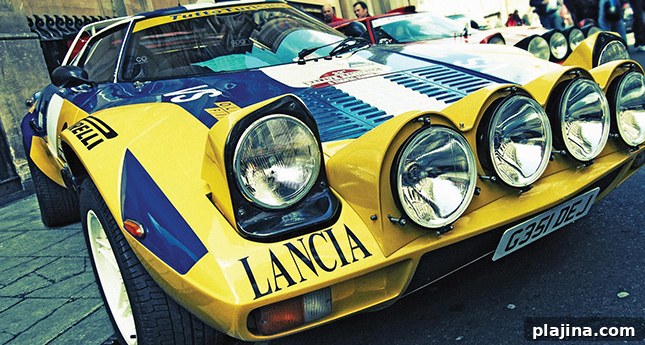
My love for the car, however, has never dimmed. To my mind it represents the peak of automotive design, as striking today as when it emerged from an Italian factory in 1972: the Lancia Stratos.
I don’t need to rely on memory to picture it. A 1/72 scale model of a Stratos sits on my desk — a Christmas gift from long ago — and it has held pride of place for my entire working life.
The Stratos’s form follows its very specific function. It was never intended for shopping trips (nowhere to stow purchases), romantic evenings (the cramped, roll-bar-protected cockpit makes graceful entry and exit impossible), or family duties (there are no rear seats). The Stratos was built for one purpose: to be driven fast on rough, winding roads. It was the world’s first car designed specifically for rallying.
Rallying dates back to the earliest days of motoring. Almost as soon as cars existed, people raced them. In the beginning, endurance mattered more than outright speed; in the 1880s, simply making it to the end of the block without a breakdown was a triumph. By the turn of the 20th century, manufacturers were producing dedicated sports cars and wealthy enthusiasts raced along a growing network of public roads. The Monte Carlo Rally began in 1911 and remains a glamorous annual event.
Beyond the spectacle, rallying became a crucial proving ground for manufacturers. Production models were adapted to meet the demands of increasingly varied and punishing rally events around the world. Cars were plastered with sponsor logos, and rally driving moved from an expensive hobby to a professional sport with commercial rewards.
By the 1970s the World Rally Championship had raised the profile and intensity of the discipline. It was in this competitive environment that designers at Turin-based Lancia set out to build a car that could dominate the world stage.
They began with a very short wheelbase to allow the car to rotate and drift through corners. They placed on it a sculpted chassis and a futuristic wrap-around windshield that evoked a jet fighter. The Stratos debuted in 1974 and went on to win the championship three years in a row.
One of the toughest events on the calendar was the East African Safari Rally in Kenya. In 1976, during that brutal contest, the legendary Italian driver Sandro Munari stopped and invited local schoolchildren to sit in the co-driver’s seat of his parked Stratos. I was one of those children.
Even as a kid, the interior felt tiny and austere. It smelled of oil and stale sweat. That brief experience taught me that unattainability has its perks. For more than 30 years my affection for the Stratos has been sustained by longing and imagination — unspoiled by the compromises and disappointments of real ownership.