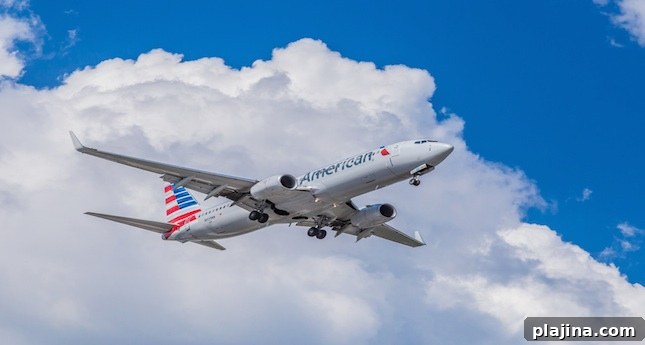
American Airlines and the Transportation Security Administration have announced a partnership designed to reduce passenger screening times by roughly 30 percent. The move responds to recent historic delays at airport security checkpoints that caused many travelers to miss flights. TSA and American Airlines plan to deploy faster automated screening lanes and computed tomography (CT) scanners at key hubs: Chicago (ORD), Dallas/Fort Worth (DFW), Los Angeles (LAX) and Miami (MIA).
CT scanners, similar to those used in medical diagnostics, capture X-rays from multiple angles and provide far greater detail than conventional single-view X-rays. In an airport security context, these scanners improve the ability of screeners to identify potential threats concealed on a person or inside carry-on items, increasing detection capabilities while supporting more efficient throughput.
“Our foremost priority is the security of the traveling public,” said Peter V. Neffenger, TSA administrator. “To ensure that we remain up-to-date in an evolving threat environment, the TSA continues to test and deploy state-of-the-art technologies. This collaboration with American Airlines is an important step in enhancing the traveler experience while maintaining effective security.”
In addition to CT imaging, the program will introduce automated conveyor belts that can divert a specific bag from the main line if an anomaly is detected, allowing the rest of the queue to keep moving without delay. Larger carry-on bins will be introduced to better accommodate items and reduce repeated handling. These new bins will include Radio Frequency Identification (RFID) tags to help passengers and staff quickly identify and match belongings, reducing confusion and hold-ups at checkpoints.
“We are proud to be working collaboratively with the TSA to support next generation screening technology at five of our hubs this fall,” said Robert Isom, chief operating officer of American Airlines. “These state-of-the-art lanes, along with new detection technology that will be tested in Phoenix, will enhance security effectiveness and efficiency, while improving the customer experience. On behalf of our team members who are working to take care of customers every day, we appreciate the TSA’s partnership in implementing these new innovative technologies.”
The initiative is being launched as a pilot program. If the trials prove successful, the technologies could be expanded to airports across the country. One potential outcome of broader deployment is relaxed restrictions for certain items: passengers may eventually be allowed to leave liquids and laptops in their bags during screening, which would further reduce processing time and simplify the travel experience.