
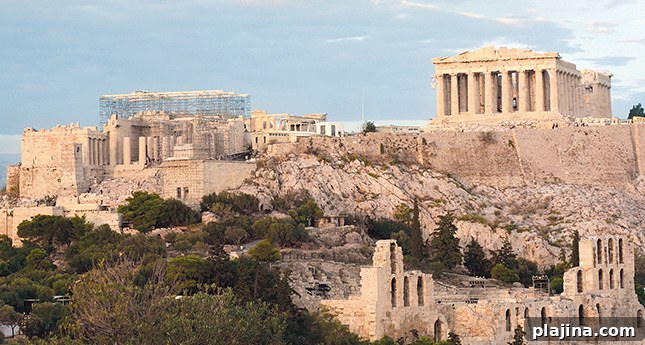
“Check out the view.” Those four words turned into a refrain during my visit to Athens. Everywhere I went, hosts and shopkeepers wanted to point out the Acropolis, each convinced their spot offered the best perspective in the city. The UNESCO World Heritage site became the defining image of my trip, and it made me wonder: how could anyone concentrate on much else while in Athens?
With limited time to explore a city I had longed to see, I joined a city tour — and that was my first full glimpse of the view. “If you look now out of the right window, you will see the Acropolis. Check out the view.”
At Dionysos, a restaurant perfectly situated at the foot of the Acropolis, I was guided to a second-floor table and told to sit next to the window so I could “check out the view.”
Later, at Première in the InterContinental Athens Athenaeum, my server steered me to a seat facing the landmark so I could “check out the view.” Admittedly, the meal’s rich flavors briefly competed with the scenery for my attention.
Again and again I was nudged to take in the Acropolis. Of course it deserves that attention—especially at night, when the monument glows. I never passed up an opportunity to pause and appreciate the panorama.
Beyond the view itself, the Acropolis permeates everyday life in Athens. Its image appears on key rings, T-shirts and souvenirs throughout the tourist-packed Plaka, a constant reminder of the city’s deep past.
I also encountered the contentious debate over the Acropolis marbles and the British Museum, a dispute that intensified after the Acropolis Museum opened in July 2009. Learning about Lord Elgin’s 19th-century removal of friezes and sculptural fragments—later sold to the British Museum—stirred strong feelings. The Greek case for reunification of the sculptures is powerful.
That power became clear inside the Acropolis Museum. Empty pedestals and gaps where entire sections of frieze should fit make the missing pieces palpable. In some displays a statue’s ankle and thigh sit in Athens while its calf and knee remain in London. Seeing those absences made the argument for returning the artifacts immediate and convincing; the museum itself often feels like a plea for restoration of the whole story.
The Acropolis is also striking from within the museum. On the upper floors I would glance through floor-to-ceiling windows back toward the hill; the monument seemed to watch over its own relics. Transparent flooring revealed excavations below, a fascinating feature on the first floor and a more vertiginous one from higher levels.
It’s easy to focus so much on views of the Acropolis that you forget to look from the Acropolis. Standing before the Parthenon, I felt a connection to the myths and history I had learned as a child. Up high, overlooking the Agora, the Temple of Zeus and the modern cityscape, the contradictions of Athens—ancient grandeur above a bustling contemporary metropolis—felt momentarily cohesive from that vantage point.
My December trip coincided with a tense time in the city. It was the one-year anniversary of Alexandros Grigoropoulos’s death, the 15-year-old killed by police, which had sparked widespread protests and unrest. Police presence was visible everywhere, and the mood around many neighborhoods felt strained. After I left, further riots in his memory erupted across Athens.
The city also experienced a garbage strike while I was there; navigating Syntagma Square meant sidestepping overflowing refuse. Those realities dimmed some of the romantic image I had carried to Athens and, at times, overshadowed my enjoyment.
To broaden my view of Greek history and culture, I visited the Benaki Museum, housed in the former home of collector Emmanouil Benaki. Its collection spans 26,000 items from ancient times through modern Greece, and the intimate, residential setting makes it the only Athens museum to present such a continuous narrative of Greek art. It’s also notably open late on Thursdays, offering a quieter way to explore the holdings.
Sipping Turkish coffee and savoring a sweet, gooey Greek pastry at a café in Kolonaki, I contemplated Athens’s dual nature. Antiquity pulses through the city, yet it is also very much a 21st-century capital. Does modern life dilute the ancient spirit, or do both coexist in a productive tension? After one short visit I couldn’t fully answer that, only sense that there are many more layers to discover.
So I kept returning to the view. No matter how many times the Acropolis revealed itself, each sighting left me transfixed, humbled and enchanted. For a city that wears its past so prominently, that view is both an invitation and a reminder of why Athens lingers in the imagination long after you leave.