Museums welcome us wherever we travel. They entertain and educate, bringing public attention to historical, artistic, scientific and natural wonders. Many are thought-provoking and expand our understanding of the world. Some, however, stand out for their eccentricity: personal and whimsical collections, institutions dedicated to a single unusual craft or obsolete industry, and arcane archives originally assembled for scientific study. Others reflect one person’s consuming passion and turn that obsession into a public attraction.
© STILLMAN ROGERS PHOTOGRAPHY
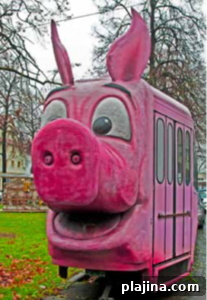
Some of the quirkiest museums began as private collections that kept expanding. For example, Stuttgart’s Pig Museum started when Erika Wilhelmer’s assortment of more than 25,000 pig-related items outgrew her home in Bad Wimpfen. Housed in a former slaughterhouse, the museum celebrates porcine culture in all its forms, from storybook references like The Three Little Pigs to culinary nods such as the BLT. The displays encompass fine art—paintings, sculpture and ivory netsuke—alongside kitsch, postage stamps, jewelry and mounted wild boar trophies. With more than 50,000 pig items organized around playful themes, the collection is curated with a clear sense of humor; a restaurant downstairs serves traditional German pork dishes.
Similarly, the Bunny Museum in Altadena, California, began with a single stuffed rabbit in the home of Candace Frazee and Steve Lubanski. The collection multiplied until it required a larger space, now marked by a giant bunny from a Rose Parade float. With more than 45,000 rabbit items, the museum showcases the kitschy and the cuddly but also explores the rabbit’s place in culture, language and society.
The world’s first cat museum in Kuching, Malaysia, tells a more civic story. Owned by the city—Kuching means “cat” in Malay—and housed in City Hall, the museum opened when more than 4,000 artifacts were transferred from the National Museum in Kuala Lumpur in 1988. Visitors enter beneath a giant cat face and encounter exhibits that examine cats across cultures: Japanese beckoning cat figures, Oriental art, Ancient Egyptian reverence, and displays highlighting popular icons such as Garfield and Hello Kitty.
Some of the most unusual museums grew out of scientific collections. While these institutions sometimes display unsettling surgical instruments or preserved specimens, their primary aim is education about health and medicine. Chicago’s International Museum of Surgical Science holds items like gallstones, historic blades and glass eyes alongside contemporary exhibits on medical technology. In Tokyo, the Meguro Parasitological Museum remains devoted to parasites, presenting samples and information about tapeworms and other organisms that fascinate and unsettle in equal measure.
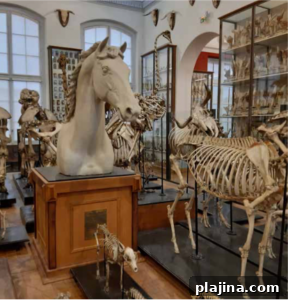
PHOTO: © THE FRAGONARD MUSEUM
The Fragonard Museum in Maisons-Alfort, France, founded in 1766, originated as the anatomy collection of the Royal Veterinary School of Paris. In addition to skeletons and models of physical malformations, the museum displays flayed and preserved human and animal specimens varnished to reveal muscles and bones. These figures once served as teaching aids at a time when human dissection was restricted; some are arranged in dramatic vignettes that reference historical or mythological scenes.
The Museum of Questionable Medical Devices, part of the Science Museum of Minnesota in St. Paul, collects devices once promoted as health cures. Its exhibits include electric shock machines, shoe-store X-ray boxes used in the early 20th century and a “rejuvenator” that claimed to reverse aging through radio waves, magnetic fields and ultraviolet light. These displays explore how desperation, hope and the limits of medical knowledge produced bizarre inventions.
Local industry often inspires museums that preserve regional memory. In Jonesport, Maine, the Maine Coast Sardine History Museum grew from the efforts of Ronnie and Mary Peabody, who began collecting equipment, artifacts and oral histories before the last sardine canneries closed. Visitors punch an original time clock to enter and can view vintage processing equipment, colorful sardine labels and the tools once used across the 15 canneries that once thrived there.
In Panissières, France, a former silk factory became the Museum of Neckties and Textiles, documenting a town that once produced the majority of French necktie fabric. Working looms and exhibits explain the craft of silk weaving and neckwear. In Belver, Portugal, a Soap Museum invites visitors to learn soapmaking and take home a custom bar, while Gore, New Zealand, commemorates local ingenuity with the Hokonui Moonshine Museum, which recalls the town’s clandestine distilling past.
Agriculture also spawns focused museums. The Museum of the Olive Tree in Nyons, France, traces the long history of local olive cultivation and oil production, featuring ancient Roman vessels and tools. Schrobenhausen, Germany, hosts the European Asparagus Museum, celebrating the region’s prized crop, while the Canadian Potato Museum on Prince Edward Island showcases the largest collection of potato-related farm machinery and artifacts, complete with a giant potato sculpture marking the entrance.
Leipzig’s Coffee Baum Coffee Museum occupies historic rooms above one of Europe’s oldest coffee houses. With more than 500 artifacts, the museum traces coffee’s journey from early trade to coffeehouse culture, including inventions such as Melitta filters. The exhibits reveal stories of commerce, scandal and politics as well as the social rituals that grew up around the cup. If the displays whet your appetite, the coffeehouse below serves fresh brews.
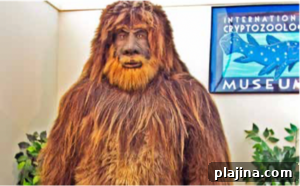
PHOTO: © STILLMAN ROGERS PHOTOGRAPHY
Personal passions can lead to museums that combine folklore, science and pop culture. Loren Coleman’s decades-long study of Bigfoot and other unknown creatures became the International Cryptozoology Museum in Portland, Maine. The museum blends sighting reports, casts of footprints, artists’ renderings, Hollywood props, documented hoaxes and souvenirs, creating a space where legend and investigation meet. Fans of other cryptids can also find niche museums devoted to creatures like Mothman in Point Pleasant, West Virginia.
Some museums exemplify grassroots collecting and crowd participation. The Umbrella Cover Museum on Peaks Island, Maine, began when Nancy Hoffman found a few umbrella covers while cleaning a closet. Embracing a mission to celebrate the mundane, she opened a cottage museum that quickly grew by donations. By 1972 the collection of roughly 700 covers earned recognition, and it has since expanded to more than 2,000 covers from over 70 countries. Visitors get a guided tour and can enjoy Nancy’s performance of “Let a Smile Be Your Umbrella” on accordion—a playful reminder that museums can celebrate the everyday as well as the extraordinary.