The names roll off the tongue, evoking sun-drenched beaches, lively music and vibrant color: Flamenco, Ipanema, Copacabana. You can almost feel yourself in the Cidade Maravilhosa — the Marvelous City. You can almost feel yourself in Rio de Janeiro.
Rio’s identity and beauty are rooted in Guanabara Bay. When the Portuguese arrived in January 1502 (hence the name Rio de Janeiro, “January River”), they found a sheltered bay fringed by dense forest and dramatic granite peaks. The French briefly established a settlement on an island in the bay, but they were expelled in 1565 and the Portuguese set the foundation for the city that followed.
In 1808, with Lisbon occupied by Napoleon, Rio became the capital of the Kingdom of Portugal and effectively the administrative center of the Portuguese Empire. That marked the city’s historic high point. After Brazil’s independence in 1822, Rio remained the national capital until 1960, when Brasilia became the political center and São Paulo rose to greater economic prominence.
Yet the spirit of the Cariocas — the people of Rio — never dimmed. Carnival, music and a culture of celebration make Rio internationally synonymous with hedonistic pleasures, but the city is also a major economic force in its own right.
With roughly 6.3 million residents, Rio is one of the largest cities in the Americas and generates a GDP exceeding $200 billion. Centro, the downtown business district, hosts many multinational offices as well as the headquarters of major Brazilian firms such as Petrobras and Vale.
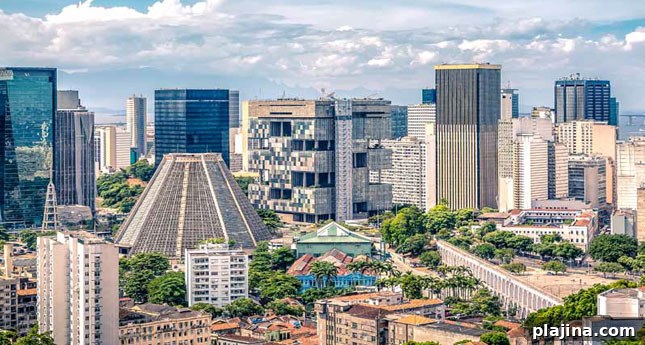
Centro, like Rio as a whole, reveals layers of history beneath its modern facade. On weekdays the area feels like any bustling financial center, full of traffic and commuters. Yet scattered among the skyscrapers are historic landmarks that tell five centuries of the city’s story.
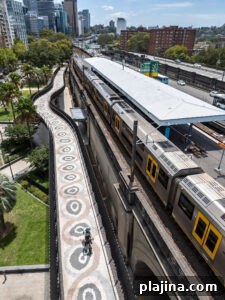
One striking relic is the whitewashed Carioca Aqueduct, its arches standing beside the more modern Petrobras headquarters and the conical Metropolitan Cathedral of St. Sebastian. Once the city’s primary source of fresh water, the aqueduct was decommissioned in the 19th century and later adapted to carry the Santa Teresa Tramway — the city’s first mass-transit line.
Generations of Cariocas and visitors cherished the century-old yellow trams until a tragic 2011 accident suspended the service. Plans have long been in place to restore tram operations with new rolling stock.
Transportation is one of Brazil’s perennial challenges, and Rio’s dramatic topography compounds the problem. Highways must weave through valleys, tunnels and narrow corridors, making rush-hour commutes slow and congested.
Infrastructure limitations raise the cost of doing business. The metro system, expanded ahead of the 2014 FIFA World Cup, helps reduce travel times to some extent — and makes getting to the beach easier after work — but transport inefficiencies still weigh on the economy. Estimates suggest transportation consumes about 13 percent of Brazil’s GDP, significantly higher than in many advanced economies.
Transport is only one element of the broader phenomenon known as Custo Brasil (the “Brazil Cost”). Businesses encounter higher prices and extra burdens compared with the United States or Europe. Factors include complex bureaucracy, institutional inefficiency, high taxation, security concerns and crime, shortages of skilled labor, and corruption. These issues increase operating costs and complicate investment.
Despite these obstacles, Brazil remains a major economic power alongside Russia, India and China, and Rio continues to attract both leisure visitors and growing numbers of business travelers. International tourists and executives arrive at Galeão International Airport to the north or at the centrally located Santos Dumont Airport for quick domestic connections and an unforgettable city landing.
If your trip is purely business during weekdays, Centro is a logical base. The Windsor Asturias is a popular downtown hotel choice. While some rooms could benefit from updates, its public spaces and rooftop bar are useful for informal meetings, and its location is convenient for many corporate appointments.
For a classic meeting spot in Centro, Confeitaria Colombo has been a landmark since 1893. Its period interiors, with tiled floors, mirrored walls and dark wood furnishings, create an atmosphere of timeless elegance. The upstairs Cristóvão Restaurant works well for business lunches, and for dinner Hachiko offers Pan-Asian cuisine as a solid option.
Centro is less vibrant on weekends, especially Sundays, when the streets quieten and visitors can become more vulnerable to petty crime. Crime is a reality across Rio, so exercising vigilance is wise. After a day or two you’ll learn local rhythms and safer routes; on arrival, ask your hotel for current safety advice and recommendations on neighborhoods to avoid.
The Belmond Copacabana Palace hotel © Ekaterinabelova | Dreamstime.com
If you can combine business with leisure, consider staying on the ocean side. The Belmond Copacabana Palace, overlooking the famous beach, remains one of the city’s most prestigious addresses after a recent renovation. For a more contemporary, design-driven option, the Hotel Fasano on Ipanema offers stylish accommodations and a bossa nova-inspired atmosphere.
Business culture in Rio tends to be relaxed — punctuality is often more flexible than in Europe or North America. Rather than scheduling early breakfast meetings, many local professionals prefer brunch or midday gatherings. The Copacabana Palace’s poolside Pergula restaurant is a favored spot for relaxed business conversations in a beautiful setting.
Rio’s combination of natural beauty, cultural vitality and economic importance makes it a compelling destination for both work and leisure. With sensible precautions and local guidance, visiting executives can enjoy productive meetings while also experiencing the city’s unique energy.