
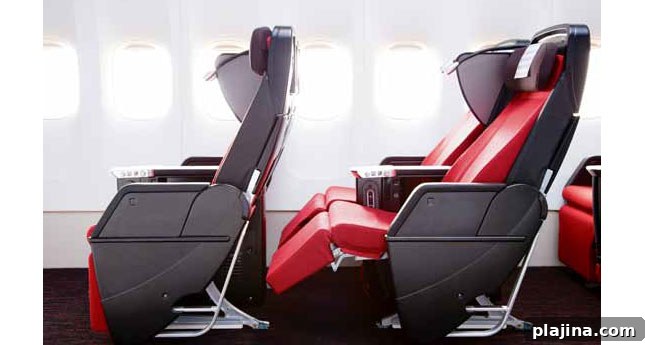
John Geigert, president of BioPharmaceutical Quality Solutions in Carlsbad, Calif., estimates he has flown more than 200,000 miles and taken roughly 20 premium-economy flights in the past year. He spends so much time in the air that he avoids standard economy. “As a frequent flyer on United and American Airlines, I automatically get seated in Economy Plus [United] or Main Cabin Extra [American],” he says. “When I fly internationally on other carriers, if I don’t purchase business class, I opt for premium economy.”
Premium economy first appeared in 1992 when Virgin Atlantic introduced an upgraded economy fare. Soon, many international carriers followed, offering roomier seats, improved meals and extra amenities priced between economy and business class. Airlines quickly recognized premium economy as an opportunity to serve budget-conscious business travelers and economy passengers who want more comfort. Some carriers initially resisted — concerned it might undermine business-class revenue — but by the mid-2010s many major airlines adopted the product.
Features vary by airline and aircraft, but on international routes premium economy typically provides a modest increase in seat width, extra recline and a larger personal entertainment screen. Power outlets for laptops are common, and meals are usually upgraded with complimentary beverages. Whether it should be called “business-minus,” “extra legroom” or simply a “class in between” depends on the carrier and the route.
For some travelers, premium economy amounts to little more than extra legroom. This is especially true on domestic flights, where some airlines market the offering as “Extra Leg Room” without increasing seat width. Over time, economy seat pitch on many carriers has tightened, and premium economy often responds to that pressure. Seat pitch and width vary widely across airlines, and in general international premium-economy products offer better amenities, food and service than their domestic equivalents.
Different airlines give the product different names: Cathay Pacific and Virgin Atlantic call it Premium Economy, Delta dubs its product Economy Comfort, and British Airways markets World Traveller Plus. Whatever the label, travelers should expect to pay a premium on long-haul routes. A SeatGuru study found that booking premium economy for trans-Atlantic travel can cost about 85 percent more than standard economy when purchased in advance; that premium can fall to roughly 34 percent when booked closer to departure. Cross-Pacific premium economy tends to command a higher premium — often close to 95 percent more — though the length of those flights can justify the cost for many passengers.
Geigert’s reasons for choosing premium economy focus on comfort and productivity, along with maintaining frequent-flyer status. Price and seat pitch follow. “Amazing what every inch of added space can mean on a long flight,” he notes. “I’m not particularly tall, so I don’t need much legroom, but those extra inches make the difference between being able to use a computer or not during the flight.”
Ted Bravos, president and CEO of the International Tour Management Institute, treats premium economy as part of a broader vetting process that balances convenience, price, service and reputation. He prioritizes direct routes and potential upgrades, aiming to minimize time in the air. While he values “inches and meals,” he also appreciates elements like the ambiance offered on certain carriers.
Industry awards can help identify strong premium-economy products. In 2013, the Skytrax World Airline Awards named Air New Zealand the best in three premium-economy categories: Best Premium Economy Class, Best Premium Economy Class Seat and Best Premium Economy Class Onboard Catering. Skytrax bases its awards on surveys from millions of passengers and evaluates airlines on dozens of performance indicators including seat comfort, food and service.
There can also be unexpected benefits to booking premium economy. Bruce Tepper, a marketing consultant with Joselyn, Tepper & Associates, bought a premium-economy ticket on a route scheduled for Boeing 787 Dreamliner service. When the 787 was withdrawn over technical issues, he was upgraded to business class despite having paid for premium economy.
Not every traveler finds the premium worth the cost. Arthur Painvin, director of operations at The Orchard in New York City, believes the price is often too high relative to the experience. “The difference in price is about midway between business and economy, but the service and comfort are much closer to economy,” he says. Despite flying premium economy on Air France multiple times, he adds, “I would not pay the going rate for premium-economy seating.”
Painvin summarizes premium economy as having “the good, the bad and the ugly.” The good: more comfortable seats and extra space, which matter especially on international journeys. The bad: food and overall service that can be similar to standard economy. The ugly: marketing that oversells the product, creating expectations the experience does not meet.
Others see value in the upgrade on long flights. Annemarie Osborn, a consultant based in Germany, says premium economy is worth the extra cost for lengthy trips but warns travelers not to expect a dramatically different level of service. “On a long flight it is worth the extra expense,” she says, “but you may be disappointed if you expect a fully premium experience.”
Premium economy chart