
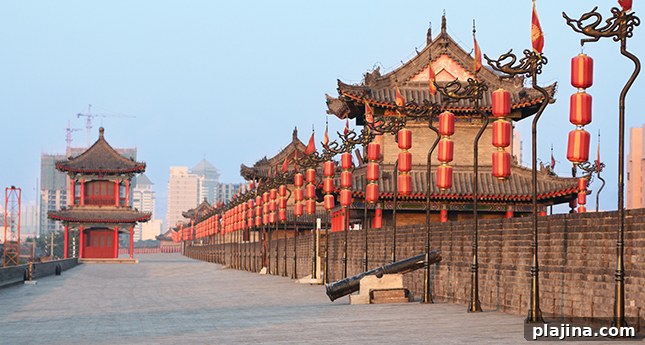
Once the storied capital of many dynasties—from the Qin (221–207 B.C.) through the golden Tang (618–907)—Xi’an spent centuries as a sleeping giant. While modern China’s political and economic power shifted east to Beijing and the booming coastal cities such as Shanghai and Shenzhen, Xi’an has quietly reawakened. The ancient city now balances two new realities: a rising middle class and a steady stream of international tourists. Alongside brick pagodas, Buddhist temples and silk scrolls you’ll find international hotels, car dealerships and designer boutiques.
The rapid modernization of this interior city can be startling. Twenty-five years ago, when I taught here, taxis were scarce, foreign goods rarely entered the city, and everyday items like rice or even bicycles required ration coupons. Today, Xi’an rations nothing. This terminus of the Silk Road is installing solar panels, polishing antiques, and opening up to the world—so transformed that Marco Polo would hardly recognize it.
I hardly recognized it either. Having stayed in a Citadines apartment-hotel in Paris with a view of the Eiffel Tower, I found myself in the same hotel chain in Xi’an, this time with a view of the 14th-century Drum Tower lit at night with kites flying above its tiled roofs. Xi’an is no Paris—its sophistication and array of delights lag behind—but the city is clearly catching up.
At the same time, Xi’an has not abandoned its past. Outside the city walls, the First Emperor’s Terracotta Army—comparable in scale and draw to the Great Wall—has made Xi’an a global tourist destination. The life-size subterranean guards, buried since 210 B.C., were unearthed in 1974 and remain the focus of this vital archaeological site. Commercial development has grown around the museum, but visitors still come to see the soldiers themselves. A welcome change: photography is now allowed in parts of the site, so staff no longer confiscate cameras.
Another historic site, the Big Wild Goose Pagoda (Da Yanta, built in 652), faces the pressures of mass tourism. The temple grounds, several miles south of the city wall, are flanked to the south by an Emperor Qin–themed amusement park and to the north by a series of musical fountain terraces. Despite these additions, climbing the winding stairs of this venerable Buddhist pagoda remains a rewarding experience; the site marks a high point of the Silk Road and the flowering of Chinese Buddhism.
Within the city walls, many old structures have given way to development, yet the surviving landmarks are being revitalized. The unpolished Forest of Steles Museum, set inside the southern city wall on the grounds of the 14th-century Temple of Confucius, retains its charm. The back hall is lively: artisans make inked rubbings of notable steles—engraved stone tablets—while visitors watch and can buy the rubbings on the spot.
In the city’s bustling core, sharply dressed young office workers weave past sightseers absorbing the new China. For people-watching, few spots rival the area outside the Kaiyuan Department Store opposite the Bell Tower, Xi’an’s symbol since 1384. The Bell Tower is no longer surrounded by bicycles and donkey carts but by private cars, taxis, motorcycles and even Mercedes. Still, the streets near the Drum Tower remain filled with traditional entrepreneurs: fortune tellers, letter writers, sidewalk seamstresses, toy vendors and suntanned peasant map-sellers calling out to passersby.
The Bell Tower links to the equally ancient Drum Tower via a new public square lined with shops built in Ming and Qing styles. Restaurants and cafes vie for attention—one eatery above a Häagen-Dazs shop displays a long neon scroll claiming “The Legendary De Fa Chang Restaurant is renowned for its superior delicious dumplings.” At night, pop music drifts through the square, young people gather, and the Drum Tower is lit dramatically, kites streaking upward in golden lines.
North of the Drum Tower lies the Muslim Quarter, home to the Hui minority for thirteen centuries. Down a narrow lane, the Great Mosque—built in 742 and China’s oldest—offers a peaceful retreat from the crowds, though many of its courtyards, pavilions and halls have been restored repeatedly. I spent several relaxed afternoons wandering Beiyuanmen Islamic Street, an outdoor bazaar full of crafts, steamed dumplings and skewers of barbecued lamb.
The defining feature of the walled city is the Ming Dynasty wall itself (1368–1644). It stands unmatched in China and has undergone extensive repair and restoration over the decades. You can now walk the full circuit—about nine miles—but I preferred to rent a bicycle and ride along the flagstones. Pedaling the ramparts gives you a measured view of Xi’an before industrialization fully took hold.
Even from the city wall, some historic sights like the Big Wild Goose Pagoda are partially hidden behind new office towers and apartment blocks. Concrete and glass are sprouting inside the walls, but the green belt between moat and ramparts still teems with everyday life: teenagers playing table tennis, opera singers performing in pavilions, kite-flyers, couples on benches, grandparents lifting grandchildren onto monkey bars, and workers retiling temple roofs. After centuries of decline, Xi’an is shaking off the dust of its dynasties and coming alive again, blending deep history with lively modern life.