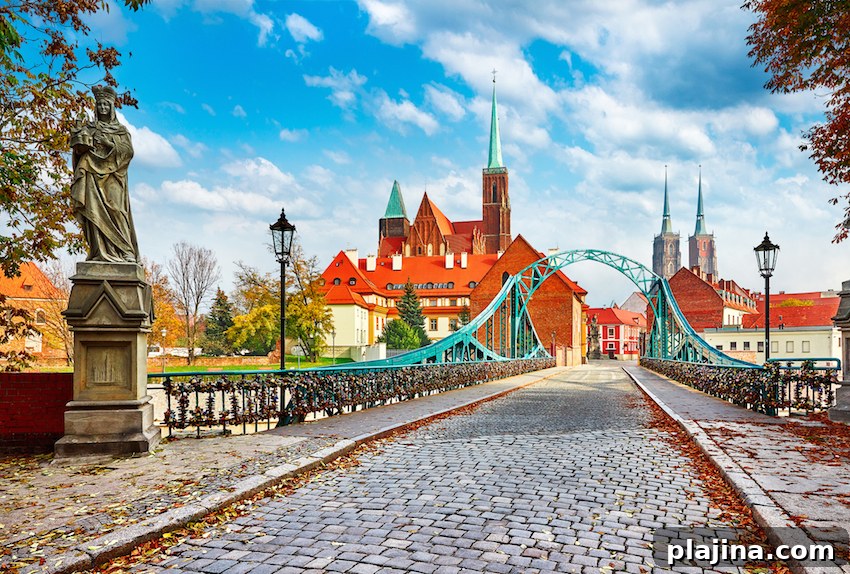
Nicknamed the “Polish Venice,” the waterfront city of Wroclaw was voted the 2018 “winning city” by European Best Destinations. Crisscrossed by the Dobra River, the Oder and several tributaries, western Poland’s largest city is perfect for exploring on foot. Highlights include the Zdrój Fountain, the Museum of Pharmacy and the Penitent Bridge — a narrow footbridge suspended between the towers of the Church of St. Mary Magdalene. Public sculptures are scattered throughout the city, such as “The Swordsman” by Hugo Lederer in Uniwersytecki Square and the giant “Chair” by Tadeusz, located between Rzeźnicza and Nowy Świat streets. For sweeping views, climb the tower of the Garrison Church, widely regarded as one of the best vantage points in Wroclaw.
One of Wroclaw’s most charming quirks is its population of decorative dwarf statues, now numbering around 350. The first dwarf appeared on Świdnicka Street as a symbol connected to Poland’s anti‑communist movement, and since then these small figures have proliferated across the city. Tracking them has become a popular activity for visitors; maps and mobile apps help you locate the most interesting and hidden dwarfs as you explore.
Every September the city celebrates the dwarfs with a dedicated festival. The event begins with the Great Dwarf Parade in Market Square and continues at the Great Dwarf Village, where sculptors and artisans demonstrate how the figures are made and share the stories behind them. The festival adds a playful, community‑focused dimension to Wroclaw’s rich cultural offering and gives visitors a lively way to connect with local traditions.