
A young man in traditional loose-fitting clothing and a straw hat sets a cloth filter over a metal pitcher and carefully measures the scoops. He pours steaming water over the grounds as we watch, waiting for the rich aroma to rise. When the brew has filtered through, he pours the dark coffee into mugs that warm our hands in the morning mountain mist. We sip and smile — this coffee tastes nothing like what comes from a diner pot.
We are concluding a farm tour in Colombia, one of the world’s most renowned coffee-producing countries. Colombia’s Coffee Triangle includes the cities of Armenia, Pereira and Manizales, a region where award-winning farms and tasting experiences are common. The area even hosts an amusement park devoted to coffee culture, Parque Nacional del Café.
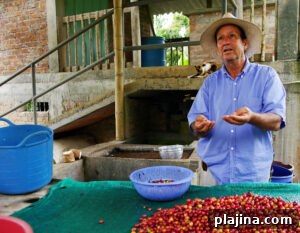
© RECHITAN SORIN | DREAMSTIME.COM
On the tour we saw how the “cherries” ripen from green to red on the bushes. Our guide walked us to the drying patios where beans are left to dry in the sun before being prepared for export. Beans destined for local markets are roasted on site, then ground for tastings like the one we enjoyed.
Such farm tours aren’t unique to Colombia. I’ve visited coffee farms across the Americas, from large producers in Costa Rica to boutique operations in Panama like Finca La Milagrosa, where creative roasters cobble equipment together from repurposed parts — a washing machine drum here, an axle there — to create a working roaster.
Coffee didn’t arrive in the Americas until European trade routes and the Columbian Exchange reshaped global diets. The New World contributed staples such as corn, potatoes and tomatoes, while Africa provided crops including bananas, coconuts and coffee. Once introduced, coffee adapted to suitable climates and soils across the globe.
Generally, coffee plants thrive at elevations between about 2,000 and 6,500 feet in temperate conditions. Arabica varieties perform best with some shade rather than full sun. Large-volume producers supply industrial-grade beans for instant coffee and chain outlets — Brazil and Vietnam alone account for a significant share of Robusta output. Meanwhile, specialty Arabica beans labeled “single origin,” “shade grown” or “fair trade” focus on flavor and ethical sourcing rather than mass volume.
Commercial and artisanal production often coexist within the same countries — Colombia, Indonesia and Ethiopia are examples — but smaller, specialty farms can command premium prices in places like Hawai‘i, Jamaica and Panama. Panama’s Geisha (or Gesha) variety, for instance, has fetched extraordinary prices at auction, sometimes reaching thousands of dollars per pound.
Coffee remains the most popular beverage in the United States. According to the National Coffee Association, roughly two-thirds of Americans drink coffee daily, with consumption rising notably in recent years. At home, drip machines are the most common brewing method; when ordering out, the latte is the favorite choice.
While excessive caffeine has known risks, moderate coffee consumption has been linked in multiple studies to positive health outcomes, including lower risks of heart disease, type 2 diabetes and some forms of liver disease, as well as associations with longer lifespans.
For travelers curious about the origins of their morning cup, many coffee-producing countries welcome visitors to farm tours. These tours provide farmers with an important supplementary income stream: retail sales in farm shops and paid tours bring steady year-round revenue compared with seasonal wholesale markets. Tours also strengthen consumer connections to origin brands and craft producers.
Typical coffee farm tours follow a familiar pattern. A guide leads visitors through the plantations, explaining how coffee trees grow and how cherries are harvested. Guests then see the processing stages — sorting, drying and often a roaster for either small-batch or larger-scale production — followed by a tasting of freshly roasted and brewed coffee, which often reveals far greater complexity than chain-brewed drinks.
In the Americas, countries offering established coffee tours include Mexico, every Central American nation, Colombia, Ecuador, Peru, Brazil and Bolivia. Agritourism has been an established economic and cultural driver in many of these communities for decades, and many farms are reachable as day trips from major cities such as Quito, Bogotá or Guatemala City.
Africa also offers notable coffee tourism, especially in countries tied closely to coffee’s origins: Ethiopia, Tanzania, Kenya, Rwanda, Burundi and Malawi host organized tours. Scholars generally agree that coffee cultivation began in the region that is now Ethiopia, where people have produced and consumed the beverage for more than a millennium. From there, coffee spread north into the Middle East and beyond.
Enthusiasts seeking deeper immersion can take multiday tours in coffee regions like Yirgacheffe and Sidama in Ethiopia, often combining tastings with cultural and historical visits. In Kenya and Tanzania, coffee excursions are frequently paired with safari itineraries.
Across Asia, coffee tours are available in parts of Indonesia, Vietnam, Laos, Thailand and Myanmar. These often appear as shore excursions for cruise passengers or as extensions to river cruise itineraries, bringing travelers into highland plantations for short visits.
Some coffee estates have expanded into full hospitality destinations. Hacienda Combia in Colombia, for example, offers a multi-station tour including basket weaving and wildlife explanations, and allows guests to participate in harvesting and processing. Other farms operate upscale lodges with spas and fine dining, such as Argovia Finca Resort in Chiapas, Mexico, and Finca Rosa Blanca in Costa Rica.
For coffee lovers, adding a farm visit in regions like Java, Kona, Boquete or Jamaica’s Blue Mountains can turn a regular vacation into a memorable, immersive experience that connects cup to countryside.