
According to data from the U.S. Federal Aviation Administration, at the end of 2023 there were 167,711 private pilots — people licensed to fly noncommercial aircraft. Of that total, just 14,192, or 8.4 percent, were women. Globally, women make up an estimated 4–6 percent of private pilots.
Private aviation covers a range of operations: individuals or businesses that own aircraft, charter operators, and fractional ownership programs in which several co-owners share cost and usage. Each model requires pilots who may fly only or who must also handle maintenance, logistics, and paperwork. Women in private aviation pursue many different paths and roles, carving careers that challenge long-standing gender imbalances in the cockpit.
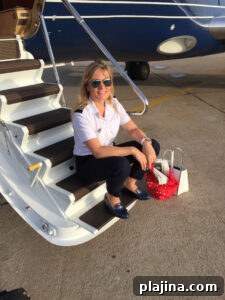
© Angela Lawson
Angela Lawson, a U.K.-based pilot working in business aviation, knew she wanted to fly from her teenage years, asking for lessons for birthdays and holidays. After studying at Southampton University and teaching secondary school for a time, Lawson chose not to return to the classroom after having children. She earned her private pilot’s license at 30, followed by an instructor rating, and used her teaching experience to provide flight instruction at the local airfield where she learned to fly.
Lawson later worked at a flight simulator company and as an air ambulance pilot, repatriating the deceased and flying injured passengers to hospitals. Those roles led to a business jet job in Belgium because she already had the appropriate type rating gained through simulator work. She began flying the Dassault Falcon 2000, a twin-engine jet with long range, and later progressed to the larger, three-engine Falcon 7X.
A few years into that job she was selected by a high-net-worth client who wanted a dedicated crew; she has served as senior first officer for the same employer for 11 years. Lawson appreciates the autonomy of private flying — greater control over accommodations, downtime, and some routing decisions compared with a commercial airline — while acknowledging the downside: when an owner wants to fly, the crew must be available and coverage can be scarce. Still, she calls working for a considerate owner “the pinnacle of private aviation.”
“The experiences are completely different from the airlines,” said Alexus Tuel, a private pilot who serves as second in command on an Embraer Legacy 600. Tuel enjoys avoiding the frequent airport layovers associated with airline work, using fixed-base operators (FBOs) and going directly to the aircraft. She originally trained in mental health therapy and moved to the Phoenix/Scottsdale area after graduate school. An uncle who wanted a flying partner introduced her to the sky and she quickly “caught the bug.”
Tuel trained, earned her license, and worked cargo operations in Ohio, where she gained experience as SIC in the Saab 340B and as VFR captain on the Cessna Caravan. Her current responsibilities also include flight planning and performance calculations. She describes staffing and paperwork as the least appealing parts of the job; smaller companies have fewer pilots and covering shifts can be logistically challenging. Schedules frequently change, sometimes altering start and end dates for rotations, which can complicate personal plans. She nonetheless values the variety of destinations — a four-day layover in Canouan in the Grenadines stands out as a favorite.
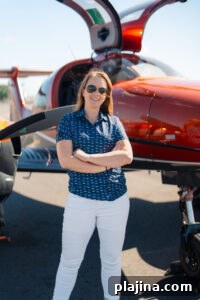
© Amber Brierly
Amber Brierly, a New Zealand–based pilot with experience in both commercial and private sectors, values the bespoke service private aviation offers. “In private aviation, the focus is on delivering a tailored travel experience, including direct access to destinations not easily reached by commercial routes,” she said.
Brierly studied aviation management at Massey University aiming for air traffic control, but testing issues changed her course. An internship at Embry-Riddle Aeronautical University in Florida and subsequent roles at FBOs in Scottsdale and Orlando exposed her to private jets and client service. In 2021 she shifted to pilot training and now works part-time for FlightSafety International as SIC supporting simulator training, in addition to instructing. She aspires to become a corporate long-haul jet captain. Brierly notes that many modern business jets use advanced avionics and systems that can exceed those found on some commercial airliners.
Managing client expectations is a recurring challenge in private aviation, especially when demands risk compromising safety. Brierly also recalls times when she struggled to be taken seriously early in her career, with conference attendees directing technical questions to male colleagues instead of her.
Sexism remains an obstacle in aviation and sometimes it comes from unexpected sources. Lawson remembers flying a critically ill man to the hospital when his wife questioned her role to the copilot: “My goodness, you’re going to let her fly?” Ground staff have also approached her in uniform and asked to speak to the pilot, assuming the pilot is male.
Elayne Humphrey, chief pilot for Cape Fear Aviation Flight Training in Fayetteville, North Carolina, remembers a mother who preferred a male instructor for a discovery flight for her 17-year-old son. Humphrey acknowledged the fear behind the decision and chose to substitute another instructor to make the family comfortable. She describes herself as an aviation geek who grew up watching aircraft land near Washington, D.C., but who entered aviation later in life.
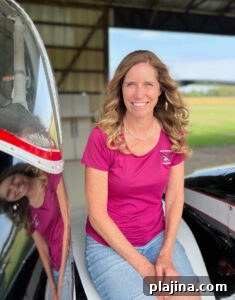
© Elayne Humphrey
Humphrey earned degrees in marketing research and a master’s degree before starting a web design business. After relocating to Fayetteville, a Civil Air Patrol flight reignited her interest in flying. Using an inheritance to fund training, she obtained her private pilot’s license in 2018. Although she once had the hours to pursue an airline job, she prefers the flexibility and lifestyle of private aviation: choosing when to work, avoiding extended hotel stays, and enjoying better food and schedules.
Since earning her license, Humphrey has flown more than 70 different aircraft and owns a Piper Arrow; her favorite remains the Piper Aztec. She believes women bring a skilled, precise approach to flying, and she actively recruits and mentors other women who often must work harder to prove themselves in aviation.
Lawson notes that a lack of female colleagues can be isolating when it comes to discussing issues like balancing family demands while flying or coping with menopause symptoms on the flight deck. To address that gap, groups such as Lady Aviators provide informal support, while organizations like Women in Aviation International offer scholarships, mentorship, networking, and employment resources. Brierly, who is part of the LGBTQIA+ community, finds representation and advocacy through groups such as the National Gay Pilots Association.
Although the number of women private pilots remains small, it is steadily increasing — fewer than 10,000 women held private pilot certificates in 2017. Pilots and advocates stress the importance of visibility and conversation to normalize women in the cockpit. “The more we speak out and tell people that we are pilots, the better it will get,” Tuel said. Humphrey emphasized empowerment and connection among women at local airports and reminded aspiring pilots that it’s never too late to start: she began at 48 and encourages others with a confident, “You got this.”