
Each year our Class Act examines premium economy cabins across the globe, comparing seat features and onboard amenities. What used to be a novelty—airlines offering an “in-between” cabin—has become commonplace: many carriers now include premium economy as part of their product line-up.
Today, the roster of airlines with premium economy reads like a list of the industry’s leaders, including Singapore Airlines, Delta Air Lines, American Airlines, United Airlines, Qantas, Cathay Pacific, Air New Zealand, Air Canada and many others. These carriers offer a range of upgraded seating and services designed to sit between standard economy and business class in comfort and price.
Financials help explain the surge. A March 2020 report from the Airline Passenger Experience Association highlighted premium economy’s revenue potential. Lufthansa Group executive Harry Hohmeister described premium economy as a “money-generating machine,” reporting it brings in significantly more revenue per square foot than traditional economy and even more than business class in some cases. American Airlines’ leadership has echoed that view, calling premium economy one of the most profitable uses of wide-body cabin space.
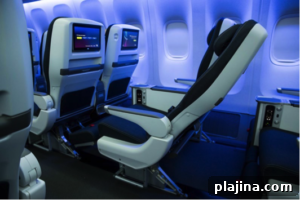
PHOTO: © BRITISH AIRWAYS
Given the financial incentives, airlines are increasing premium economy capacity on new aircraft. Qantas expanded premium economy on its A380s from 35 to 60 seats, British Airways added more premium seats to its A350, and Singapore Airlines even configured some A350s with only premium economy and business class, eliminating standard economy on select aircraft.
Some carriers remain without a distinct premium economy product, arguing their economy cabins are already more comfortable than average; Korean Air and Qatar Airways fall into this category. Others have experimented and reversed course—Turkish Airlines introduced a Comfort Class in 2016 but removed it that same year. Dubai-based Emirates surprised the industry by announcing a premium economy cabin, which would have been a first among Middle Eastern carriers. The launch, however, was delayed by the COVID-19 pandemic and now follows a slower, more uncertain rollout schedule.
Details of Emirates’ premium economy were murky from the start. In 2019, HAECO Cabin Solutions revealed its Eclipse Cabin concept and named an unnamed Middle East carrier as the launch customer. HAECO described the design as a way to improve privacy and comfort while maximizing passenger capacity and stowage space. Emirates’ own descriptions were scant but hinted at a “superette” layout and a “lazy-Z” leg support design. Plans to retrofit existing aircraft were later abandoned amid the pandemic, and the debut timeline remains undecided.
The pandemic has changed priorities across aviation, with cleanliness and safety taking precedence over product launches. Several planned introductions have been postponed or delayed. For example, in February 2020 KLM’s CEO Pieter Elbers announced plans to introduce a proper premium economy within a year, moving beyond KLM’s current Economy Comfort offering. Details were limited, and it remains uncertain whether the timeline will hold.
Swiss International Air Lines planned to introduce premium economy in spring 2021—the last Lufthansa Group carrier to do so—with an initial configuration on the Boeing 777-300ER featuring 24 seats in a 2-4-2 layout offering wider seats, greater pitch and increased recline. Whether these introductions proceed on schedule depends on how the broader aviation recovery unfolds.
As premium economy proliferates, differentiation goes beyond seat pitch and recline. Airlines now sell an end-to-end elevated experience: premium check-in and boarding, enhanced meal service, improved amenity kits and priority baggage handling. Features once reserved for premium cabins are increasingly extended to premium economy passengers, meaning “glorified economy” no longer accurately describes the cabin.
Different carriers emphasize distinct benefits. All Nippon Airways and Philippine Airlines use mood lighting to support rest and replicate day-night cycles. Japan Airlines, Virgin Australia and Air New Zealand offer some of the widest seats in the category, enhancing comfort on long-haul flights. British Airways has upgraded its premium-economy dining, while Singapore Airlines extends its Book the Cook service to premium-economy customers. Delta includes Tumi amenity kits and memory foam seating, Qantas provides calf rests for better ergonomics, and American partners with Casper for improved bedding.
With so many options, choosing premium economy can be overwhelming. Industry awards can guide decisions: Air Canada was named Best Premium Economy Class in Global Traveler’s 2020 Leisure Lifestyle Awards, while Skytrax’s 2019 rankings placed Virgin Atlantic at the top for premium economy, followed by Singapore Airlines, Air New Zealand, Austrian Airlines (noted for premium-economy catering), Air Canada, Qantas, Lufthansa and others. These rankings reflect a mix of seat comfort, service, dining and overall experience.
As premium economy transitions from novelty to norm, airlines continue to refine the product. For travelers seeking a meaningful upgrade without the expense of business class, premium economy increasingly offers a compelling balance of comfort, service and value. The cabin that once sat squarely “in-between” has emerged as a significant and evolving segment of the modern flying experience.