
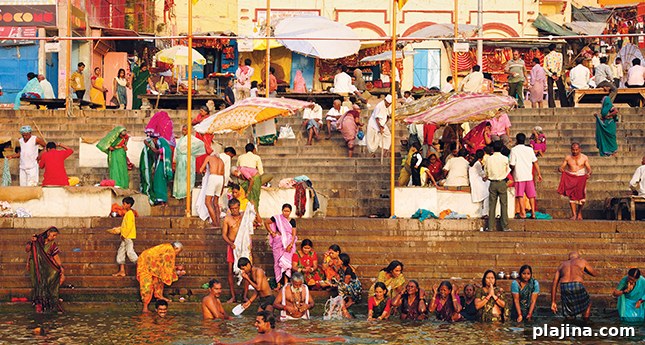
As we climbed into the boat at sunset to watch people perform an age-old ritual of bathing to cleanse their sins, I noticed an unexpected passenger: a man squatting on the deck, massaging the feet of one of my companions. “Who’s this?” I asked. “Did we hire a masseuse?” Not exactly. He was a penitent hoping to improve his karma by doing good deeds. He offered free foot massages with the polite suggestion that a tip would be appreciated. Only in India did the scene make sense.
I was in Varanasi, a city devoted to the Hindu god Shiva. According to Hindu belief, dying here can grant moksha, release from the cycle of rebirth. Regardless of what you believe, Varanasi is uniquely compelling — unlike any other place in India or the world. One of the world’s oldest continuously inhabited cities, it dates back to around 1200 B.C. Located in Uttar Pradesh in northern India, Varanasi is revered as one of the country’s holiest sites. The Ganges, called Mother Ganga, draws pilgrims who come to wash away sins, perform rituals and cremate their dead.
Having spent the previous week on a whirlwind tour of India’s Golden Triangle — New Delhi, Agra and Jaipur — I thought I had grown somewhat accustomed to the country. Varanasi proved me wrong. After dropping our bags at the hotel, my friends and I hired rickshaws to reach the river for an evening boat ride, the first of two excursions we had planned. Sunrise and sunset are when the river is busiest and offer the clearest window into how sacred and central the Ganges is to Hindu life.
Mark Twain famously wrote that Varanasi “is older than history, older than tradition, older even than legend, and looks twice as old as all of them put together.” On that evening, his description felt apt: the city seems to carry centuries in every crumbling facade and in each ritual performed on the waterfront.
Reading about Varanasi cannot prepare you for being there; hearing descriptions won’t either. It’s like describing a rollercoaster to someone who’s never ridden one: the experience is thrilling, disorienting, a little frightening and over all too soon.
Even reaching the river felt like an exercise in faith. Streets teem with pedestrians, motorbikes, auto rickshaws, bicycle rickshaws, cows, dogs, cars and buses, all moving in a complicated, seemingly improvised choreography that only locals truly understand. To an outsider it appears chaotic and risky, yet it flows.
Along the Ganges’ western bank are about 80 ghats, or stepped riverfronts. Each morning hundreds — sometimes thousands — of Hindus bathe, wash clothes and pray at these ghats. Every evening, chanting Brahmans lead rituals, singing and praying with large gatherings of devotees and curious onlookers. Burning ghats host cremations; watching the funeral pyres is a powerful, often overwhelming experience. At Varanasi, the private and public are interwoven and on display.
Despite severe pollution in the Ganges, Hindus continue to perform centuries-old rites. There are initiatives to clean the river, but progress is slow. I bought a lotus candle to release onto the water but was advised to avoid immersion in the river itself, an instruction I followed.
The evening ceremonies are ornate and intense, but a dawn visit brings a quieter, contemplative beauty. Groups gather in the shallow water to greet the rising sun with prayer, while others wash clothes or recite lessons. Our boat drifted past a cluster of students repeating their lessons after their teacher, an intimate, ordinary scene folded into the sacred landscape.
On request, we took an introductory yoga class on the river’s eastern shore. Taught by a local master in the land where yoga likely began, the session impressed on me proper alignment and breathing in a way no studio class back home had. Custom experiences like this are one reason to travel with a guide: they save time, reduce stress and help avoid being misled.
I could have watched river life all day. At one point several men queued on a ghat for straight-razor haircuts while a boy zipped by on roller skates, batting a ball with a hockey stick; just beyond them priests chanted. The ordinary and the sacred sit side by side in Varanasi.
Of course, there’s more to explore than the water. I had hoped to bring home an authentic sari, and Varanasi’s reputation for exquisite textiles made it the perfect place to shop. I visited Mehta International, where weavers still produce brocade on wooden looms while sales attendants explain traditional techniques.
Shopping in India can be tiring: bargaining with street vendors or spending hours in a shop under the pretense of hospitality, sipping tea while time slips away. My sari purchase fell into the latter category, but it was a pleasant, immersive experience. The shopkeeper entertained us with stories of famous American visitors — Goldie Hawn’s name came up more than once — a reminder of how small threads of celebrity can travel far.
When I finally chose a sari, the attendants wrapped me in a rich plum fabric and handed written instructions for draping it at home. To complete the look, they placed a matching bindi on my forehead, a small benediction of color.
My sari remains a treasured souvenir, but more than any purchase, it’s the memories of Varanasi — the rituals, the river, the crowded ghats and the quiet dawn prayers — that I carry with me. I look forward to returning.