
TAIPEI IS A BEEHIVE OF ACTIVITY, as you would expect of a city with a population comparable to Chicago, but those are not bumblebees you hear at every intersection. They’re motorized scooters — the preferred mode of transport for many young Taipei residents. Compact, agile and a little edgy, these two-wheelers match Taipei’s energy perfectly.
Bolstered by Taipei’s economic strength, Taiwan’s per capita GDP surpasses that of several well-known countries. Luxury cars weave through scooter traffic while business and commerce thrive across the city.
Many international carriers fly to Taiwan Taoyuan International Airport — roughly 12–14 hours non-stop from Los Angeles and about 15–16 hours from New York City. From the airport, frequent MRT express trains take you to downtown Taipei, covering about 31 miles in 38 minutes. Once in the city, taxis are convenient and often the simplest way to reach your hotel or move around.
Downtown Taipei offers numerous business-friendly hotels. The elegant Palais de Chine, adjacent to the main train station, provides airport shuttle service and hotel-wide Wi-Fi. In the upscale Xinyi district, W Taipei blends contemporary design with more than 30,000 square feet of meeting and event space.
The Regent stands beside an underground shopping street, a useful retreat from street-level noise and occasional pollution. Other prominent hotels include Grand Hyatt, Sheraton Grand, Mandarin Oriental, Le Méridien and the Kimpton, all offering comfortable accommodations and reliable business facilities.
When meeting local clients, the first question you’ll often hear is, “Have you eaten?” This greeting reflects the central role of food in Taiwanese culture. It’s typically rhetorical — a polite “Yes” (or “shi”) suffices — but be prepared: you’ll likely be invited to a meal or a drink soon after introductions, or you might invite them to dine out instead. So where should you go?
Hotel restaurants are a convenient and safe choice, especially those with a view. W Taipei features two notable options: Yen, serving New Cantonese cuisine on the 31st floor, and The Kitchen Table, offering international dishes throughout the day on the 10th floor. Palais de Chine’s 17th-floor Le Palais has won high acclaim for its Chinese cuisine. Still, many of Taipei’s best dining experiences are found at street level across central neighborhoods.
Tim Ho Wan (with locations in Taipei) offers affordable Michelin-recognized dim sum, famous for steamed dishes and baked pork buns. J.W. Teres serves authentic Bulgarian food and wines — one of many European-style restaurants in the city. Mume presents Nordic-inspired cuisine crafted from Taiwanese ingredients, a creative fusion that has drawn attention. Chun Shui Tang, with multiple branches, is credited as the birthplace of boba milk tea and also serves excellent dim sum.
For drinks, Mikkeller Taipei and the city’s Taihu Brewing taprooms pour a range of well-crafted beers. Bars such as Fourplay Cuisine, SoShow Bar & Restaurant and Hanko 60 offer inventive cocktails with Taiwan-inspired flavors. Wine Café and Whinos Bar & Kitchen are among central Taipei’s notable wine bars for a relaxed evening.
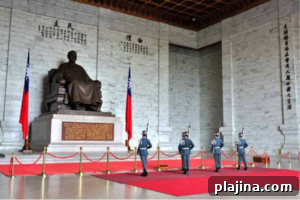
Chiang Kai-shek Memorial Hall Honor Guard PHOTO: © XIN HUA – DREAMSTIME.COM
If you have a free day, visit the observation deck on the 91st floor of Taipei 101, which was the world’s tallest building when it opened in 2004. Nearby, Breeze Nan Shan is a futuristic mall worth exploring. For cultural history, choose from the National Palace Museum, home to millennia of Chinese art; the Chiang Kai-shek Memorial Hall; and historic temples such as Longshan and Xiangtian. Night markets are an essential Taipei experience — Shilin and Jingmei (indoor and outdoor options) offer abundant street food and a lively local atmosphere.
If your schedule allows extra time to explore beyond Taipei, consider day trips or short tours. Beach lovers can head to Fulong or Kenting, while Yangmingshan National Park offers hot springs and hiking. Taroko National Park is ideal for mountain hiking and dramatic gorges. Sun Moon Lake provides scenic cycling — you can rent a bike and follow its roughly 18-mile lakeshore route. Taiwan’s high-speed rail also connects you to Kaohsiung and other cities, enabling you to traverse much of the island quickly and comfortably.