
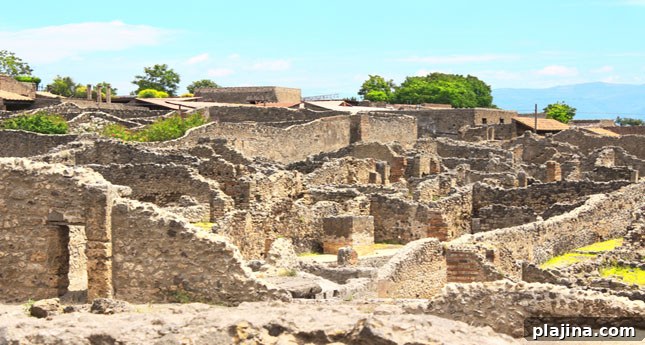
Visitors to the Amalfi Coast, especially those staying in Sorrento, often make a short excursion to Pompeii. This ancient Roman city was suddenly buried under some 30 feet of ash when Mount Vesuvius erupted in 79 AD, preserving buildings, streets and everyday objects in an extraordinary time capsule. Pompeii is one of two nearby sites preserved by that eruption; the port town of Herculaneum was similarly entombed and today offers a complementary glimpse into life on the Bay of Naples.
Pompeii, once home to about 20,000 people, is the larger and more famous of the two archaeological sites. From the expansive forum the ruined streets fan outward past noble villas, administrative buildings, bakeries and markets, public baths and a dense neighborhood of shops and brothels. Its scale and richness make Pompeii an immersive experience, though some sections can be crowded with visitors.
Herculaneum (Ercolano), by contrast, was a smaller port town of roughly 4,000 residents. While more compact than Pompeii, it is exceptionally well preserved and typically less crowded, making it easier to explore at a relaxed pace. Buried beneath about 60 feet of volcanic material until excavations began in the mid-18th century, Herculaneum has yielded intact villa blocks, lodging houses, taverns, columns, boat sheds and a bath complex. The site is particularly noted for its abundance of frescoes and wall paintings, which offer vivid and intimate details of Roman domestic life nearly two millennia ago.
Travelers can visit both sites via the Circumvesuviana train line that links Sorrento to Naples, making day trips straightforward. Many of the most impressive artifacts recovered from the eruptions are housed in the Archaeological Museum in Naples, where sculptures, mosaics and everyday objects provide further context for what is visible in the ruins. It is also worth remembering that Mount Vesuvius remains an active volcano—Europe’s only one—with its last recorded eruption in 1944—adding a powerful geological backdrop to these archaeological sites.